
Lieferung heute & morgen

Qualitätsgarantie

Willkommens-Angebote freischalten: KOSTENLOSE Lieferung | Bis zu 80 % RABATT | Kostenlose 30-Tage-JoyPlus-Testphase
App herunterladen
By Joybuy Product Recommendation Officer, August 29, 2026
A dead battery on your smartphone, laptop, or headphones rarely comes at a good time. A reliable power bank has therefore become an indispensable companion for many. But the market is flooded with options whose technical specs cause more confusion than clarity. Before you make a decision, it's crucial to understand the common marketing traps that often lead to a bad purchase.
This guide will help you understand the key features of an Anker power bank and make a choice that is perfectly tailored to your needs.
Many products advertise impressive numbers, but not all of them deliver on their promises in practice. Pay attention to these three points to avoid disappointment:
To make the right choice, focus on these three objective criteria. They determine the actual performance and utility of your mobile charging solution.
As mentioned, the mAh figure alone can be misleading. A more precise metric is the watt-hour (Wh), as it takes voltage into account. This is particularly relevant for air travel, as most airlines impose a 100 Wh limit for power banks in carry-on luggage.
Charging power, measured in watts (W), indicates how quickly energy is transferred. Ensure the power bank's output matches your devices' requirements.
A fast charger or power bank with PD technology communicates with the connected device to ensure the optimal charging power.
Modern charging solutions offer more than just power. Integrated features can significantly simplify daily life.
Based on these objective criteria, we have identified a few Anker charging solutions that are particularly well-suited for specific user groups.
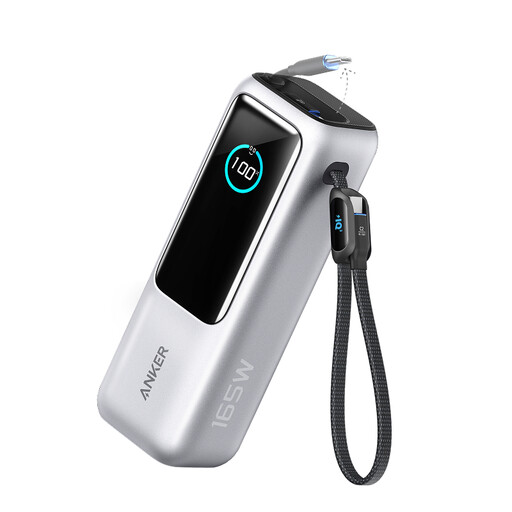
Why It's a Match: Ideal for professionals and travellers who need to charge a laptop, tablet, and smartphone simultaneously at high speed. Its high capacity and power output make it a mobile workstation.
Solves the "fast charging" misconception with a clear 165W total output and multiple high-power USB-C ports explicitly designed for laptops like the MacBook Pro.
High 25,000mAh capacity. Three USB-C ports and built-in cables for maximum flexibility. Charges up to four devices simultaneously.
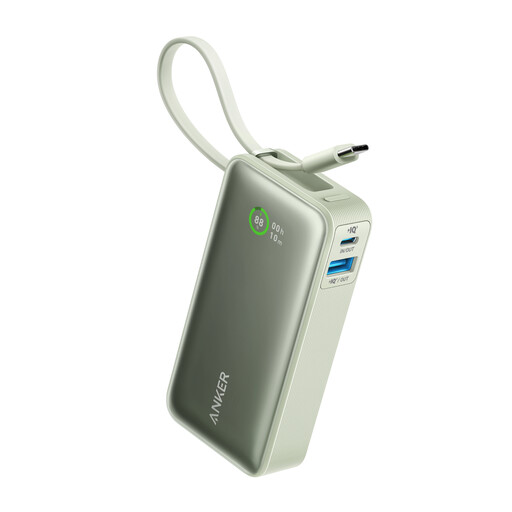
Why It's a Match: Perfect for users deeply invested in the Apple ecosystem. This power bank not only charges an iPhone via the built-in USB-C cable but also features a certified charging module for the Apple Watch.
Addresses the compatibility and cable management problem by offering an all-in-one solution for key Apple devices. No more searching for that special Apple Watch cable.
Compact design. Integrated 30W USB-C cable. Officially certified charger for the Apple Watch.
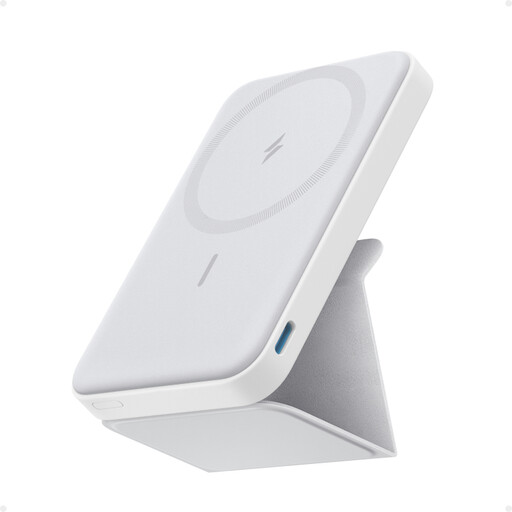
Why It's a Match: For iPhone users seeking maximum everyday convenience. The power bank attaches magnetically, charges wirelessly, and doubles as a stand for video calls or media viewing, thanks to its foldable kickstand.
Completely solves the forgotten-cable problem with wireless charging. The magnetic alignment ensures efficient power transfer, which is often an issue with basic Qi charging pads.
MagSafe-compatible for easy attachment. Integrated, foldable kickstand. Slim and compact design for high portability.
We have compiled a complete, up-to-date list of products that fully meet these strict selection criteria and safety standards.
That depends on the iPhone model and its battery capacity. As a rule of thumb, take the power bank's nominal capacity (e.g., 20,000 mAh) and multiply it by about 0.65 (to account for energy loss). This gives you a real-world capacity of around 13,000 mAh. An iPhone 15 Pro, with a battery of about 3,274 mAh, could therefore be fully charged approximately 3 to 4 times.
No. A USB-C port alone is not a guarantee of laptop compatibility. The crucial factor is the output power in watts (W). Check your laptop's power requirements. Most need at least 45W, while more powerful models like a MacBook Pro often require 65W or more. A laptop power bank must be able to provide this power via a USB-C PD port.
International air safety regulations limit the capacity of lithium-ion batteries in carry-on luggage. The limit is typically 100 watt-hours (Wh) per battery. Power banks up to 26,800 mAh usually fall below this value and can be carried on without issue. Larger models up to 160 Wh often require airline approval. Power banks are strictly prohibited in checked luggage.