
Lieferung heute & morgen

Qualitätsgarantie
App herunterladen
Kategorien
Choosing the right power bank depends on specific technical requirements. Capacity, measured in milliampere-hours (mAh), charging power in watts (W), and supported charging technologies are crucial parameters that define the performance and application of an external battery. For users of smartphones, tablets, and other mobile devices, making an informed decision based on these metrics is essential to ensure a reliable mobile power supply. This article analyses the technical specifications of various Anker power banks to guide your selection.
The choice of a portable charger should be based on an analysis of your individual usage patterns and the technical specifications of the devices you need to charge.
Battery capacity is the primary indicator of the amount of energy a power bank can store.
The speed at which a device charges is determined by the power output and the supported charging protocols.
The number and type of ports determine the power bank's versatility. A combination of USB-A and USB-C ports covers most use cases. Some models also feature integrated displays that show precise information about the remaining battery level and charging time, a functional upgrade over simple LED indicators.
Based on the technical criteria above, we present a selection of models that cater to different user profiles.
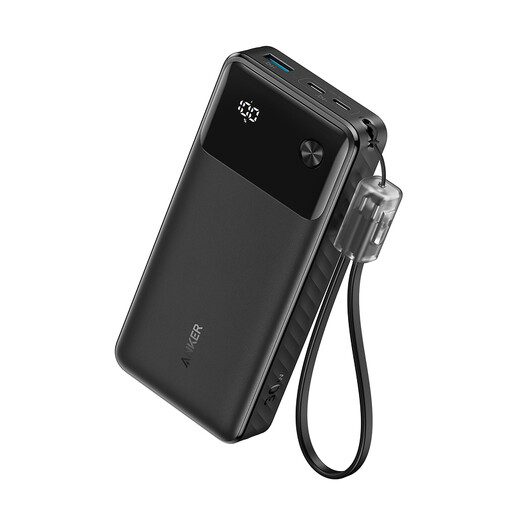
Why we recommend this product: This model is designed for users who need high capacity and flexible charging options. With 20,000 mAh and a total output of 30W across three ports, it's a powerful portable phone battery that can handle even demanding charging scenarios.
Pros:
Who it's for: Travellers, professionals, and users with multiple devices who need a reliable and long-lasting power source for extended periods without access to a power outlet.
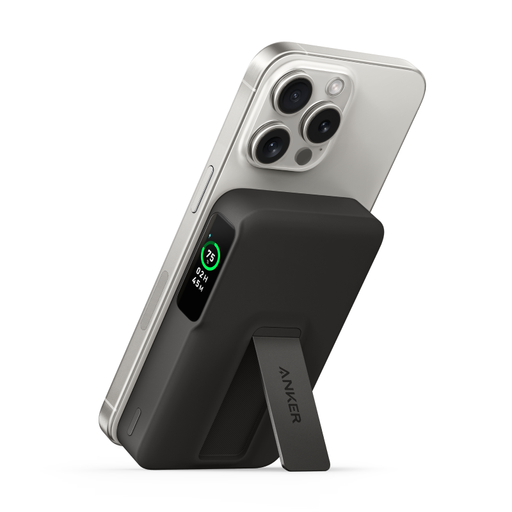
Why we recommend this product: This model combines a moderate 10,000 mAh capacity with state-of-the-art wireless charging technology. Its Qi2 certification ensures efficient and fast 15W charging for compatible devices. The integrated display and kickstand significantly enhance its practical utility.
Pros:
Who it's for: Owners of MagSafe or Qi2-compatible iPhones who value wireless convenience, fast charging, and thoughtful extra features.
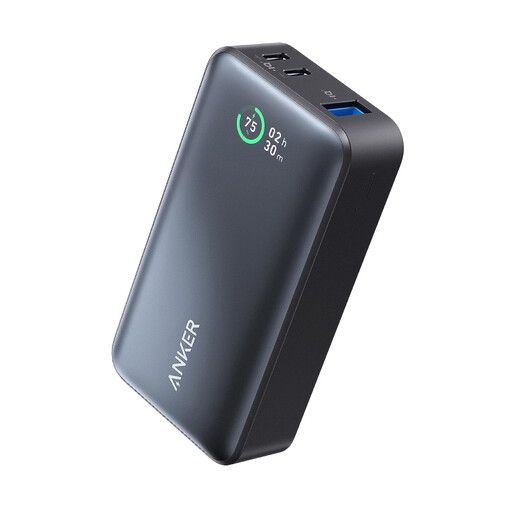
Why we recommend this product: The Anker 533 Power Bank is a compact powerhouse. It combines a 10,000 mAh capacity with a high 30W output via USB-C, making it an exceptionally fast charging solution for its size. The smart display is a practical feature in this class.
Pros:
Who it's for: Users who prioritise maximum charging speed in a compact form factor. Ideal for daily use to quickly charge an iPhone or another PD-compatible device.
A reliable power supply is essential for the functionality of your tech devices while travelling. Equally important is the right gear for personal comfort and protection from the elements. Those who are often on the move need functional apparel that adapts to changing conditions. In this context, it might be worth looking into weather-resistant outerwear. You can find a selection of functional clothing, for example, in our UK Jackets category.
1. How many times can a 10,000 mAh power bank charge a phone? The number of charge cycles depends on the smartphone's battery capacity and the energy transfer efficiency (typically 60-70%). A 10,000mAh power bank can charge an iPhone 15 Pro (approx. 3,274 mAh battery) about 1.8 to 2 times. For a device with a larger battery, like the Samsung Galaxy S24 Ultra (5,000 mAh), the capacity is sufficient for about 1.2 to 1.4 full charges.
2. What does Power Delivery mean on a power bank? Power Delivery (PD) is a universal fast-charging standard that uses the USB-C port. It enables a dynamic and higher power output between the charger and the end device. A power bank with Power Delivery can intelligently negotiate the voltage and current to safely charge devices like smartphones, tablets, or even laptops at the fastest possible speed (e.g., 30W, 65W, or more).
3. Is a MagSafe power bank only suitable for iPhones? A MagSafe power bank is primarily designed for iPhones from the 12 series onwards, as they feature the integrated magnetic ring for docking. However, models that support the newer Qi2 standard will also be compatible with future Android devices that adopt it. Additionally, most of these power banks can also wirelessly charge other Qi-enabled devices (like Android smartphones or wireless headphones) without the magnetic attachment, albeit potentially with lower efficiency.