
Lieferung heute & morgen

Qualitätsgarantie

Willkommens-Angebote freischalten: KOSTENLOSE Lieferung | Bis zu 80 % RABATT | Kostenlose 30-Tage-JoyPlus-Testphase
App herunterladen
Standing for long periods, whether at a standing desk, in the kitchen, or in a workshop, often leads to tired feet, aching legs, and back strain. An anti-fatigue mat is designed to alleviate this exact discomfort by providing a cushioned yet supportive surface.
This article serves as a practical guide. It explains the key features of a high-quality ergonomic mat and presents a selection of models to help you choose the best one for your specific needs.
Choosing the right mat depends on several factors. The following criteria will help you make an informed decision.
The material is crucial for both comfort and durability. Most mats are made of high-density foam, PVC, or a combination of materials. A high material density ensures the mat retains its shape and doesn't flatten under constant pressure. The thickness, often between 1.2 cm and 2 cm, determines the level of cushioning. A thicker mat isn't necessarily better; the key is the balance between softness and supportive firmness. A good cushioned floor mat encourages subtle, unconscious movements in your leg muscles, which can help promote circulation.
The mat's size should fit your workspace. A compact standing desk mat is often sufficient, while a longer mat offers more freedom of movement in a kitchen or workshop. Pay close attention to safety features: a non-slip backing is essential to prevent sliding on smooth floors like tile or hardwood. Additionally, beveled edges reduce the risk of tripping, which is especially important in busy areas like the kitchen, where a non-slip kitchen mat is a must.
The intended use case determines the surface requirements. A workstation mat in an office should be discreet and easy to clean. A workshop mat, on the other hand, needs to be more resistant to oils, chemicals, and dropped tools. For the kitchen, a water- and stain-resistant surface that can be easily wiped down with a damp cloth is a major advantage.
Here is a selection of mats that are well-suited for different applications due to their specific features.
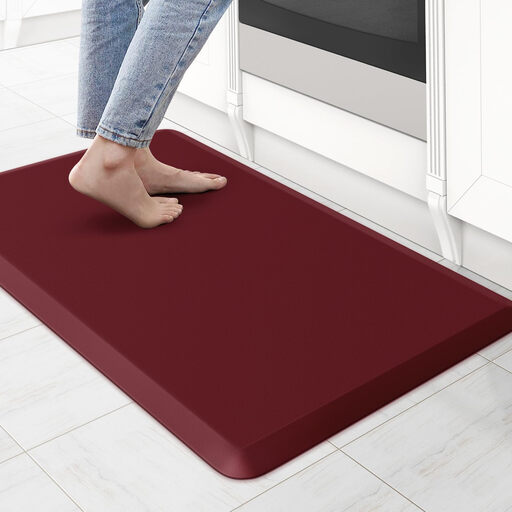
Why It Stands Out: This mat combines a comfortable 1.2 cm thickness with high-density foam that provides stable support for your feet, legs, and back. The vibrant red colour adds a dynamic accent to any room, whether it's an office or a kitchen.
Pros:
Who It's For: Individuals looking for a functional mat for a standing workstation who also want to add a pop of colour to their environment. Ideal for a home office, kitchen, or reception area.
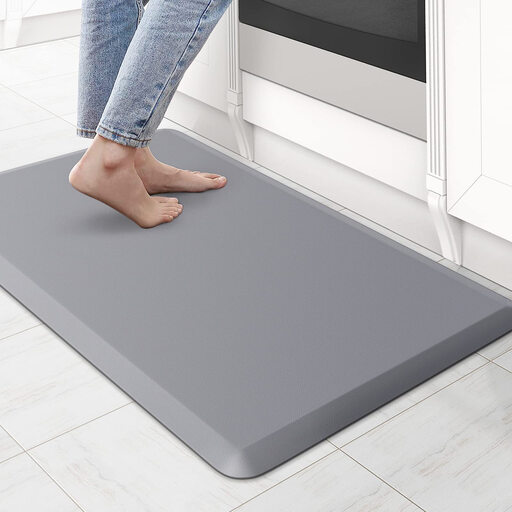
Why It Stands Out: This model, in a neutral grey, blends seamlessly into any environment. Its high-density foam core is designed to encourage subtle movements, thereby supporting circulation. The durable, water-resistant surface makes it a practical choice for many areas.
Pros:
Who It's For: Users who need a reliable and unobtrusive workstation mat for the office, garage, or kitchen. Its durability also makes it a good workshop mat for light-duty tasks.
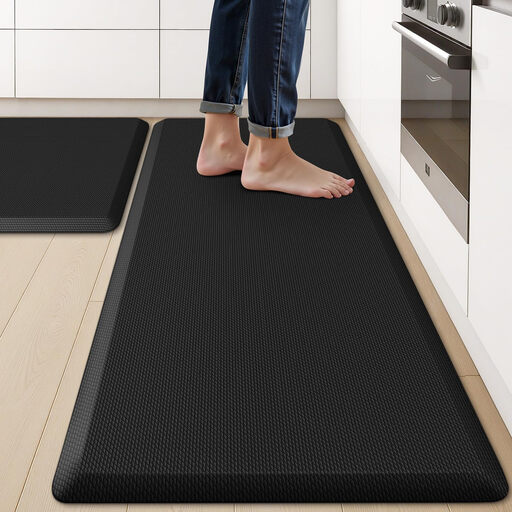
Why It Stands Out: With its generous dimensions of 101.5 x 44 cm, this mat offers an extended range of motion. The internal honeycomb structure, made of high-density PVC, provides excellent rebound and pressure relief. The beveled edges and non-slip, wave-patterned base maximise safety.
Pros:
Who It's For: Users who need a large and particularly durable cushioned floor mat for high-traffic areas. Perfect for the laundry room, in front of long workbenches, or as an extended kitchen mat.
Can't find the right size or design for your needs? There is a wide variety of models that differ in dimensions, materials, and colours. Each ergonomic mat offers specific benefits for different requirements.
Discover more models in our Cushioned Standing Mat category and find the perfect solution for your workspace.
A common thickness for anti-fatigue mats is between 1.2 cm and 2.5 cm. However, the density and quality of the material are more important than sheer thickness. A high-density mat, even if it's thinner, provides better support and durability than a thick but overly soft mat that quickly loses its shape.
Yes, most mats are designed to be used with shoes. For use as a workshop mat, where sturdy footwear is common, a mat with a particularly durable and puncture-resistant surface is recommended. In an office setting, most mats are compatible with standard office footwear.
Cleaning is generally straightforward: most mats can be simply wiped down with a damp cloth and a mild detergent. To maintain its non-slip properties, ensure that both the floor and the underside of the mat are always clean and dry. The integrated non-slip backing provides the primary grip.