
Lieferung heute & morgen

Qualitätsgarantie

Willkommens-Angebote freischalten: KOSTENLOSE Lieferung | Bis zu 80 % RABATT | Kostenlose 30-Tage-JoyPlus-Testphase
App herunterladen
Prolonged standing on hard floors, whether at a standing desk in your home office, in the kitchen, or in a workshop, can lead to noticeable discomfort in your feet, legs, and back. An anti-fatigue mat is designed to reduce pressure on the body and increase comfort during standing activities.
This article serves as a comprehensive guide. It explains which features to look for when making your selection and presents a curated list of mats for various applications. Our goal is to provide you with an informed basis for your purchasing decision.
The right mat depends on your individual needs. Three key criteria will help you find a suitable option.
The core of any joint-friendly mat is its material. Polyurethane foam (PU) is frequently used, offering a great balance between softness and supportive firmness. High material density ensures that the mat retains its shape even under prolonged use and doesn't compress too much. Thickness alone is not always the deciding factor; a 1.2 cm thick mat with high density can be more effective than a thicker but overly soft mat that provides inadequate joint support.
The dimensions of the mat should fit your workspace. For a static workstation, like a standing desk, a compact workstation mat is often sufficient. If you move around more while you work, such as in a kitchen or workshop, a longer or wider mat is more advantageous. Measure the intended area to ensure the mat offers enough room to move without becoming a tripping hazard.
A non-slip base is an essential safety feature to prevent the mat from sliding on smooth floors like tile or wood. Additionally, bevelled edges help to minimise the risk of tripping. For use in a kitchen or workshop, a water-resistant and easy-to-clean surface is beneficial. Such a non-slip kitchen mat or workshop mat is simple to maintain and retains its functionality even in demanding environments.
Here is a selection of mats designed for different needs and spaces.
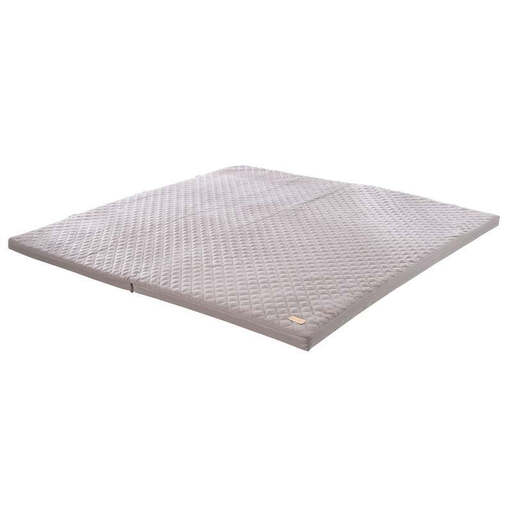
What Makes It Stand Out This mat from roba is primarily designed as a play and crawl mat for children, but its construction offers remarkable versatility. It can be folded from a large play mat (120 x 120 cm) into a thicker mattress (60 x 120 cm). The polyurethane foam core and its thickness of 4 cm (as a play mat) or 8 cm (when folded) provide substantial cushioning that can also be comfortable for adults during short periods of standing on hard floors.
Advantages
Who It's For This mat is a practical solution for households looking for a versatile product. It is suitable for those who need a flexible surface for various purposes in their living area and occasionally want a comfortable standing space.
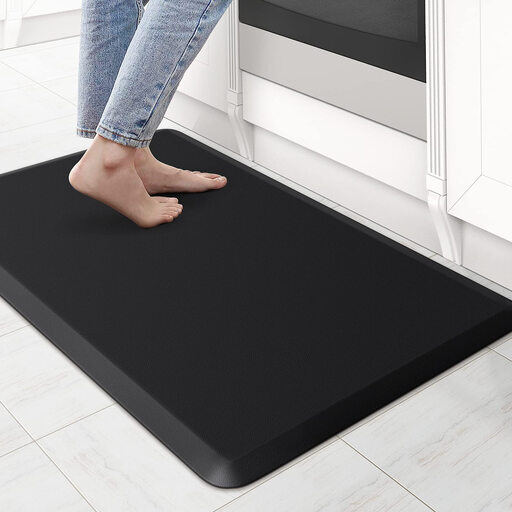
What Makes It Stand Out This ergonomic floor mat was specifically developed for use at standing workstations. With a thickness of 0.47 inches (approx. 1.2 cm) and a high-density foam core, it offers targeted support to reduce strain on feet and joints. Its compact dimensions make it the ideal mat for standing desks in offices or home offices.
Advantages
Who It's For Ideal for professionals who need a dedicated, space-saving solution for their individual workstation with a standing desk and who prioritise ergonomic features.
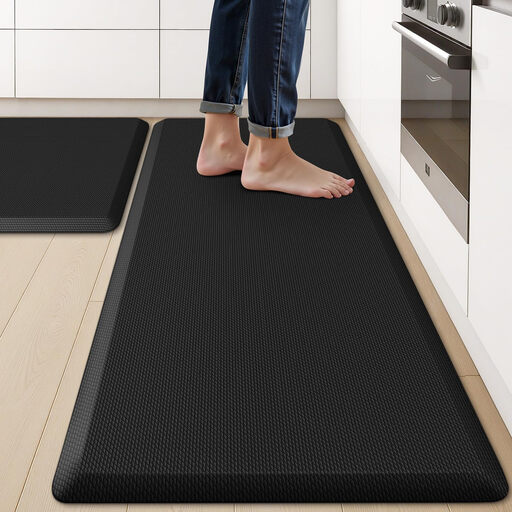
What Makes It Stand Out This larger version of the LONGKING mat, measuring 101.5 x 44 cm, offers significantly more room to move. It is perfectly suited for environments where you aren't stationary, such as along a kitchen counter or a workbench. The high-density foam and robust construction are designed for more intensive use.
Advantages
Who It's For This mat is the right choice for individuals who work in the kitchen, garage, workshop, or at a large desk and need a durable, large-surface mat for dynamic standing activities.
The selection presented here covers common use cases. However, if you are looking for different sizes, materials, or designs that better suit your specific requirements, you can find more models in our collection.
? Explore more models in our Soft Rubber Mat category
There is no one-size-fits-all answer, as material density is just as important. Common thicknesses for ergonomic mats range from 1.2 cm to 2.5 cm. A good mat offers noticeable cushioning while being firm enough to provide stable support. A mat that is too soft can compromise your balance and reduce the supportive effect.
This is generally not recommended. The casters on office chairs can permanently damage the foam surface. Anti-fatigue mats are designed exclusively for standing. For use with chairs, hard plastic floor protectors are the more appropriate choice.
Most mats have a water-resistant surface, which makes cleaning straightforward. Wiping it down with a damp cloth and a mild soap solution is usually sufficient. Avoid harsh cleaning agents, as they can damage the material. Always follow the manufacturer's care instructions.