
Lieferung heute & morgen

Qualitätsgarantie

Willkommens-Angebote freischalten: KOSTENLOSE Lieferung | Bis zu 80 % RABATT | Kostenlose 30-Tage-JoyPlus-Testphase
App herunterladen
By a Joybuy Product Recommendation Officer, July 22, 2026
Prolonged standing, whether at a height-adjustable desk, in the kitchen, or at a workbench, can take a toll on the body. Discomfort in the feet, legs, and back are common consequences. An anti-fatigue mat is designed to increase comfort during standing activities by reducing pressure on the body. This article serves as a guide to help you understand the features and differences between various mats and make an informed choice for your specific needs.
Choosing the right mat depends on several factors. The following three criteria will help you identify a suitable ergonomic workstation mat.
The core of any anti-fatigue mat is its material. Common materials include polyurethane (PU), PVC foam, and EVA foam.
The dimensions of the mat should suit the location of use. A standing desk mat should offer enough space to change your foot position occasionally without stepping off the mat. Standard sizes are often in the range of 50x70 cm to 60x90 cm. For use as a kitchen mat or workshop floor mat, longer or modular formats can be advantageous. Look for beveled edges. These reduce the risk of tripping and make it easier for office chairs or utility carts to roll onto the mat.
Safety is a key consideration. The underside of the mat must be non-slip to lie securely on smooth floors like tile, laminate, or wood. A textured or grooved underside provides the necessary grip. The top surface should also have some texture to ensure stable footing, even with different types of footwear. For areas where liquids are handled, such as kitchens or workshops, a water-resistant and easy-to-clean surface is an important feature for a non-slip kitchen mat.
Based on the criteria mentioned, we have compiled a selection of mats suitable for various applications.
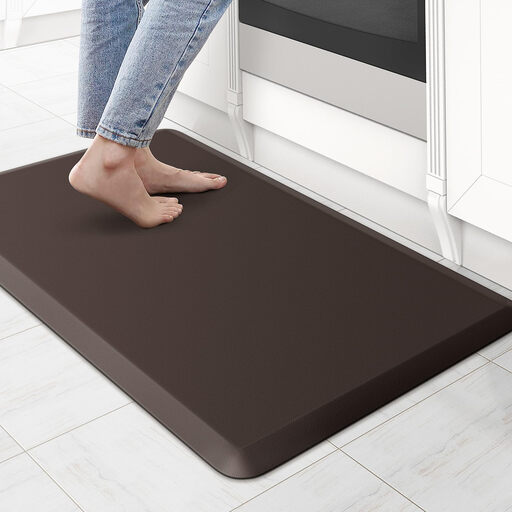
Why It Stands Out This mat from LONGKING combines a thickness of 1.2 cm (0.47 inches) with high-density foam. This combination aims to provide balanced cushioning that reduces pressure on the feet, legs, and back during extended periods of standing. The classic design in brown blends discreetly into office and home environments.
Pros
Who It's For With its dimensions of 71 x 44 cm, this mat is a great choice for individual workstations, such as an office workstation mat in front of a standing desk or in the kitchen in front of the counter.
View the LONGKING Mat on Joybuy.com
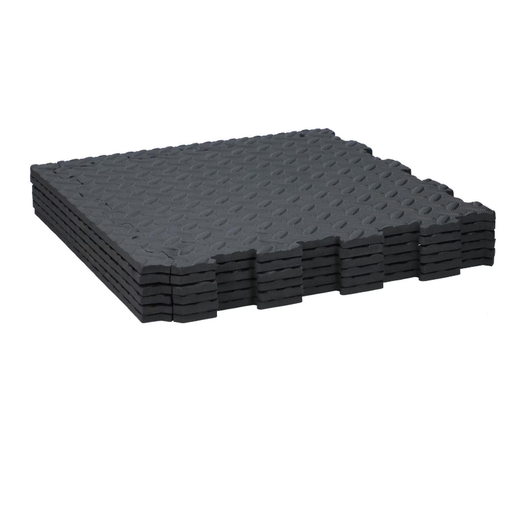
Why It Stands Out This set from Black + Decker consists of six interlocking pieces made of EVA foam. Its modularity allows you to flexibly adapt the shape and size of the surface to fit the room. Each individual mat measures 40 x 40 x 1 cm, providing a total coverage of 0.96 m?.
Pros
Who It's For This set is ideal for users who need to cover a larger or irregularly shaped area. It works perfectly as a workshop floor mat, for the area in front of a long workbench, or as a base in playrooms and home gyms.
View the Black + Decker Set on Joybuy.com
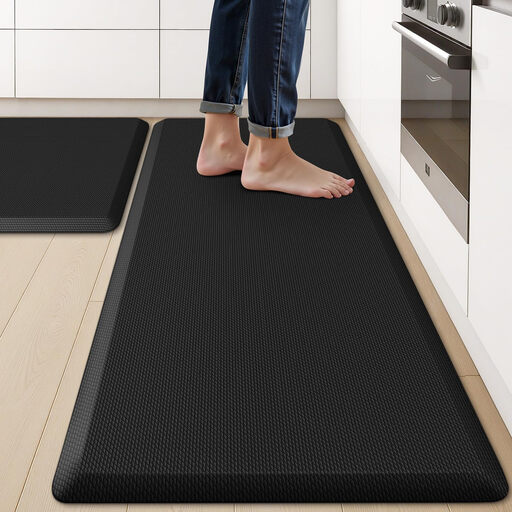
Why It Stands Out This mat is distinguished by its generous dimensions of 101.5 x 44 cm and a special internal structure. According to the manufacturer, a honeycomb structure inside the high-density PVC material provides high rebound and prevents the mat from bottoming out.
Pros
Who It's For This mat is a great option for anyone looking to cover a larger area and who values a robust, low-maintenance surface. Its length makes it particularly practical as a non-slip kitchen mat in front of the sink and stove or along a workbench.
View the Large Anti-Fatigue Mat on Joybuy.com
An anti-fatigue mat is specifically designed for standing tasks. However, if you are looking for a solution to secure rugs on smooth floors or to protect the floor in high-traffic areas, a different type of pad might be more suitable.
For hallways and entryways, you can find a selection of appropriate products in our category for non-slip rug pads for hallways.
An anti-fatigue mat provides a cushioned surface that encourages the body to make minimal, continuous balancing movements. These micro-movements can promote muscle activity in the legs and help distribute the pressure on joints and the spine caused by standing rigidly on a hard surface.
A common thickness for ergonomic workstation mats is between 1.2 cm and 2.5 cm. The optimal thickness is a trade-off: the mat must be thick enough to provide noticeable cushioning but firm enough to ensure stable footing and not pose a tripping hazard. For most office and home applications, a thickness of about 1.2 to 2.0 cm is often sufficient.