
Lieferung heute & morgen

Qualitätsgarantie

Willkommens-Angebote freischalten: KOSTENLOSE Lieferung | Bis zu 80 % RABATT | Kostenlose 30-Tage-JoyPlus-Testphase
App herunterladen
A new sideboard should serve two key purposes: creating valuable storage space and blending harmoniously into your living area. However, the selection is vast, and not every piece of furniture lives up to its product photos. Flaws often only become apparent after a few months of use—sagging shelves, sticking drawers, or unsightly scratches on the surface.
To save you from this disappointment, we'll illuminate the most common pitfalls and show you which objective criteria truly matter. This will empower you to make an informed decision that perfectly suits your home and your needs.
Many pieces that look appealing at first glance turn out to be impractical or unstable in daily use. Pay close attention to these three weak points:
To avoid these problems, you should check a few technical details before buying. They provide a more reliable indication of quality than any marketing promise.
The foundation of any sturdy piece of furniture is its material. Sideboards are primarily made from MDF (medium-density fibreboard) and particleboard. MDF panels are generally denser and more dimensionally stable. Regardless of the material, the panel thickness is a key indicator: values of 15 mm or more for the frame and 18 mm for the top panel suggest a more solid construction.
The surface seal is just as important. A melamine resin coating offers good protection against scratches and moisture and is easier to maintain than a simple foil finish, which can quickly peel at the edges. This is especially relevant for an oak-effect sideboard or a brilliant white model.
The true value of a sideboard is revealed in its functionality. A cabinet with drawers and doors should allow for a well-thought-out interior organisation.
An anti-tip device is essential, especially in households with children. This is a simple mechanism used to anchor the furniture to the wall to prevent it from tipping over. Reputable manufacturers include this component as standard.
Instead of making a one-size-fits-all recommendation, we have selected models that meet specific requirements and incorporate the quality features mentioned above.
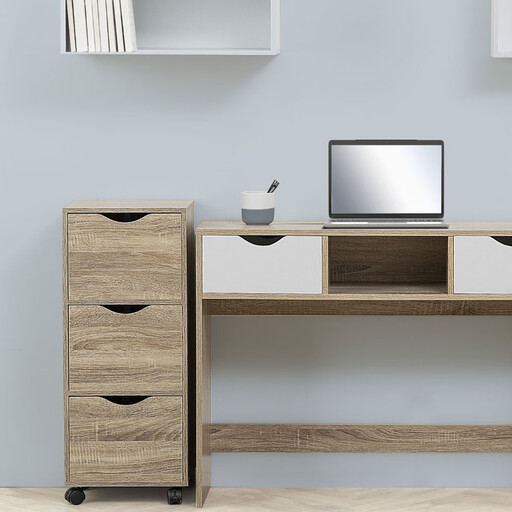
Why this model is a great fit: This compact chest of drawers is ideal for anyone who needs flexibility. Thanks to its castors, it can be moved effortlessly and used as a side table in the living room, for extra storage in a home office, or as a practical hallway cabinet.
The composite particleboard construction and a clearly defined maximum load capacity of 45 kg ensure stability appropriate for its size, avoiding the problem of wobbly small furniture.
High mobility thanks to 4 castors with a locking system; the wood used is FSC-certified.
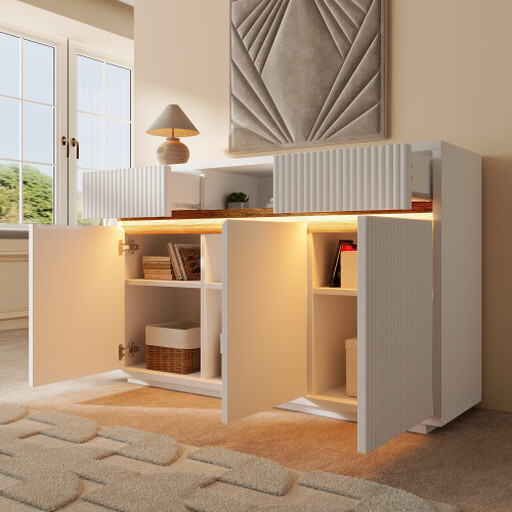
Why this model is a great fit: This model is a clear choice for a modern interior. The handleless design, clean lines, and integrated LED lighting make this white sideboard a real eye-catcher in any living room.
It actively counters the problem of impractical storage space: the shelves behind the doors are height-adjustable (in 6 cm increments) and can even be completely removed, offering maximum flexibility for items of different sizes.
Integrated LED strip with control via remote or app; an included anti-tip device provides additional safety.
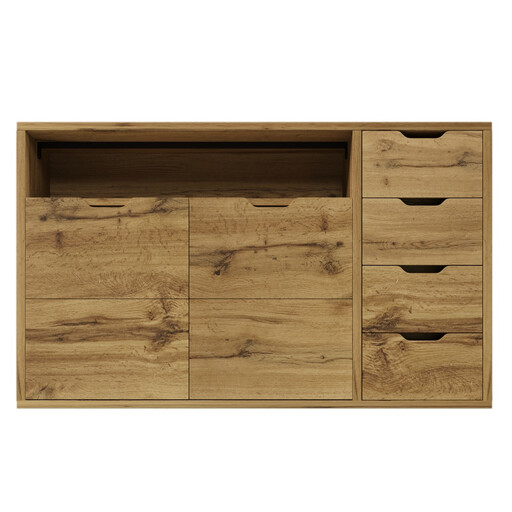
Why this model is a great fit: This oak-effect sideboard combines timeless aesthetics with thoughtful functionality. The combination of open compartments, doors, and four drawers offers a versatile storage solution for the living room or dining area.
It directly addresses the problem of low-quality hardware: the doors are equipped with soft-close hydraulic hinges, and the drawers run on high-quality runners. This ensures durable and convenient use.
High load capacity of 70 kg for the top panel; soft-close function on the doors; height-adjustable shelves for flexible customisation.
We have compiled a complete, up-to-date list of products that fully meet these strict selection criteria and all relevant safety standards.
The weight capacity varies greatly depending on the construction and material. A top panel can typically support between 30 kg and 70 kg, while shelves and drawers are often rated for 5 kg to 10 kg. Always check the manufacturer's specific details, which can be found in the technical specifications. A higher weight capacity is often an indicator of a more robust build.
Although the terms are often used interchangeably, there are traditional distinctions:
Today, the lines are blurred, and many pieces of furniture combine elements of all three types.
Surfaces with a melamine resin coating are very easy to maintain. A soft, slightly damp cloth is usually sufficient for cleaning. Do not use abrasive cleaners or scouring pads, as these can damage the surface. Stubborn stains can be removed with a mild, pH-neutral cleaner.