
当日/次日达

品质保障

开启新人专享福利: 全场免邮 | 低至 2 折 | 免费试用 30 天 JoyPlus 会员
下载 Joybuy
By: Joybuy Product Recommendation OfficerDate: August 30, 2026
Choosing a 3D printer can quickly become overwhelming. The market is dominated by marketing promises of extreme speeds and effortless operation, but the post-purchase reality is often quite different. Many users invest in a device only to find it doesn't deliver the expected performance. This guide will help you identify the crucial features and avoid common purchasing pitfalls, ensuring your investment pays off in the long run.
The 3 Most Common Pitfalls When Buying an FDM Printer:
To avoid these issues, you should focus on verifiable technical specifications rather than marketing buzzwords. Three parameters are particularly important for demanding projects and prototyping.
A fast 3D printer is only useful if speed doesn't come at the expense of precision. Look for systems with integrated vibration compensation. This technology actively detects and neutralises the vibrations caused by rapid print head movements. The result is clean surfaces and sharp edges, even at high speeds. This is a key feature that distinguishes a high-performance printer from one that is merely fast.
An advanced 3D printer with auto-levelling should offer more than just basic calibration. Look for systems that perform a high-resolution measurement of the print bed, for example, using a 49-point measurement grid. Such a system creates a detailed digital map of the surface and dynamically adjusts the Z-axis during the first layers. This ensures optimal adhesion across the entire print surface and is the prerequisite for reliable and repeatable results.
For advanced 3D printing for prototyping, the ability to process a wide range of filaments is essential. The crucial specs here are:
Based on the objective criteria above, we have identified products suitable for specific user profiles. Instead of a long list, we present one targeted recommendation.
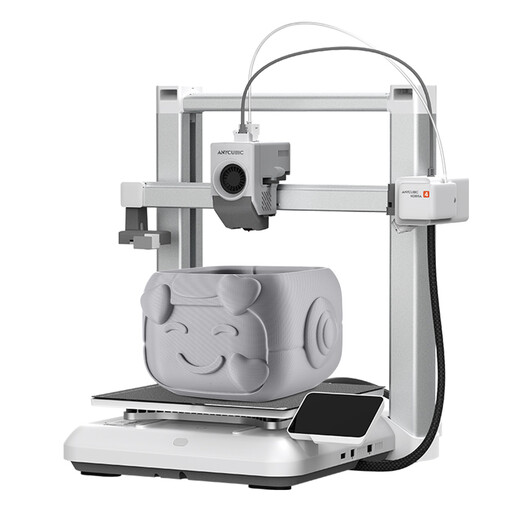
Why This Fits Their Persona: This model is designed for users who want to move beyond simple hobbyist printing and need a reliable, fast FDM printer for functional parts, complex models, and small-batch production. The combination of high speed and intelligent monitoring features minimises failed prints and maximises efficiency. When you buy the Anycubic Kobra 4, you are investing in a tool for productive applications.
It directly addresses the core problems: The integrated vibration compensation enables high-quality printing at speeds of up to 300 mm/s. The LeviQ 3.0 Auto-Leveling with 49 measurement points ensures a reliable first layer. The 300°C nozzle and 100°C heated bed provide the necessary flexibility for engineering filaments.
The intelligent ecosystem, with AI-powered error detection (spaghetti detection), remote monitoring via app, and power loss recovery, offers a high degree of process reliability, which is crucial in a prototyping environment.
We have compiled a complete, up-to-date list of products that fully meet these strict selection and safety criteria.
Thanks to its 300°C high-temperature nozzle and a print bed that heats up to 100°C, the Kobra 4 is capable of processing a wide range of materials. This includes standard filaments like PLA, PETG, and TPU, as well as more demanding engineering filaments like ABS and ASA. The standard-issue hardened steel nozzle is also suitable for printing with abrasive composite materials (e.g., those containing carbon fibre).
The device uses the LeviQ 3.0 Auto-Leveling system. It performs a precise 49-point measurement of the print bed to create a detailed height map. During the printing of the first layers, the Z-axis is adjusted with micrometre precision according to this map. This process compensates for even the slightest imperfections and ensures consistently excellent first-layer adhesion, which significantly increases print reliability.
Yes, its core features are geared towards this use case. The high recommended print speed of 300 mm/s (maximum 600 mm/s), supported by vibration compensation, allows for rapid design iteration. The ability to process high-strength and temperature-resistant engineering filaments makes it an efficient tool for producing functional prototypes and end-use parts.