
Lieferung heute & morgen

Qualitätsgarantie

Willkommens-Angebote freischalten: KOSTENLOSE Lieferung | Bis zu 80 % RABATT | Kostenlose 30-Tage-JoyPlus-Testphase
App herunterladen
An Anycubic Kobra X Combo 3D printer is aimed at users who want to create more than simple, single-colour standard models. Creative users, makers, model builders, educational institutions and small businesses often look for multi-colour printing, flexible filaments, short print times and a setup process that is as automated as possible.
However, choosing the right printer can involve some common pitfalls. For example, high speed figures are often advertised without specifying the material, model geometry or layer height. A multi-colour system also does not automatically mean that every material can be combined as desired. Before buying, you should therefore make sure that the technical specifications match your intended application.
The Anycubic Kobra X Combo is specified with a maximum print speed of 600 mm/s and maximum acceleration of 20,000 mm/s². The manufacturer recommends a print speed of 300 mm/s. In practice, the achievable speed depends on factors including the filament, nozzle temperature, component geometry, layer height and the surface quality you want.
For highly detailed miniatures, a slower profile may be the better choice. For larger, less complex components or batch production, the high movement speed can save time.
According to the product specifications, the included ACE 2 Pro enables integrated 4-colour printing and can be expanded to support up to 19 colours. This makes the Kobra X Combo a multi-colour 3D printer with extensive creative potential. Even so, the filaments must be compatible in terms of printing temperature, adhesion and moisture levels.
PLA and PETG, for example, can have different temperature and adhesion requirements. TPU needs a suitable feed profile because of its flexibility. PVA can be used as a water-soluble support material, but requires dry storage. The maximum number of colours therefore describes the system’s capacity, not necessarily every sensible combination of materials.
With a 260 × 260 × 260 mm build volume, the Kobra X Combo offers a cube-shaped printing area suitable for larger models and several smaller parts in a single print. Nevertheless, you should check before buying whether the object you want to create will actually fit without being split into sections.
The printer and ACE 2 Pro also require sufficient space, access to a power supply and a dry environment for the filament. For homes, classrooms or small workshops, noise levels, ventilation and clearance from moving and hot components are also important considerations.
For larger models, the 260 × 260 × 260 mm build volume is an important comparison point. According to the product specifications, the heated print bed reaches a maximum of 100 °C, while the nozzle reaches up to 300 °C. The standard nozzle has a diameter of 0.4 mm; nozzles measuring 0.25, 0.6 and 0.8 mm are also available as optional accessories.
A smaller nozzle can support finer structures, while larger nozzles allow a higher material flow rate for sturdy parts with fewer details. With fibre-reinforced filaments such as PLA-CF or PETG-CF, choosing a suitable nozzle is particularly important. The Kobra X Combo is specified with a hardened steel nozzle.
The supported materials listed are PLA, PETG, TPU, PVA, PLA-CF, PETG-CF and ASA. This means the printer supports rigid, flexible, water-soluble and fibre-reinforced filaments. Before ordering, you should still check the manufacturer’s recommendations for print profiles and storage.
A direct-drive extruder with a short filament path can be helpful when working with flexible materials. However, it does not replace the need to set the temperature, speed and retraction correctly.
According to the product description, LeviQ 3.0 automatic adjustment handles automatic levelling and Z-offset calibration. Other listed features include filament monitoring, tangle detection, power-loss recovery and AI spaghetti detection.
These functions can reduce common print failures, but they do not replace checks of the print bed, filament and printing environment. The integrated HD camera operates at 720p. The printer can be controlled and monitored via the device itself, slicing software, the Anycubic App or USB.
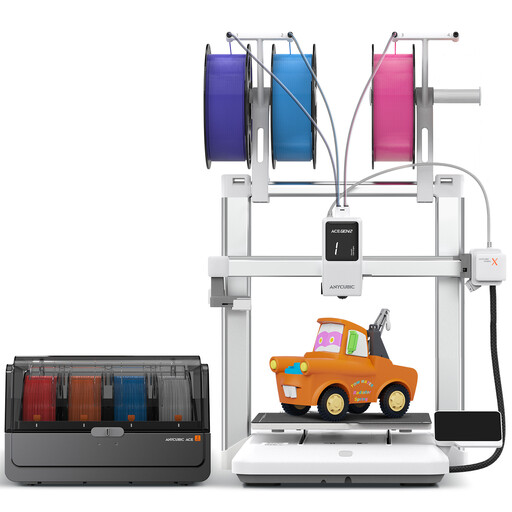
Why this product suits the profile: This FDM 3D printer combines a 260 × 260 × 260 mm build volume with integrated 4-colour printing and the ACE 2 Pro. Automatic levelling and filament monitoring make it easier to get started with multi-colour projects.
The recommended speed of 300 mm/s puts the maximum figure of 600 mm/s into context. This makes it easier to match performance to the desired print quality and component.
4 colours integrated, expandable to up to 19 colours; supports PLA, PETG, TPU, PVA and fibre-reinforced filaments.
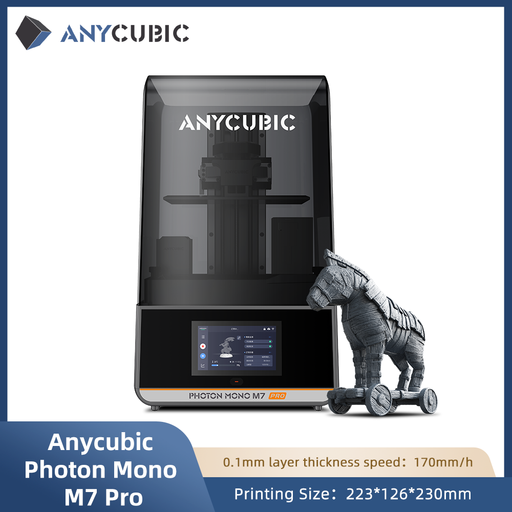
Why this product suits the profile: For detail-focused model builders and users who prioritise fine surfaces, a resin system offers an alternative device category to an FDM printer.
The resin system is clearly differentiated from filament printing. It is therefore suitable for buyers who do not primarily need flexible filaments or large FDM components.
14K monochrome LCD, stated build volume of 223 × 126 × 230 mm and support for various resin types.
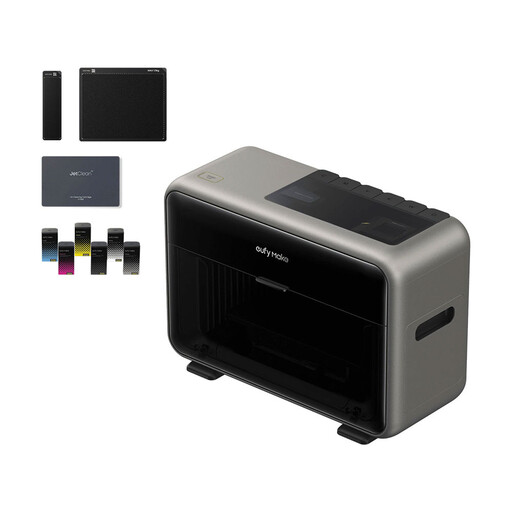
Why this product suits the profile: For small businesses and creative users who want to print directly onto wood, metal, glass, leather or ceramics, a UV printer is a different solution from an FDM or resin 3D printer.
Its intended use is clearly different from FDM: the device uses UV-curing inks and requires ventilation and suitable safety measures.
Stated print resolution of 1,440 dpi and relief printing with a height of up to 5 mm.
We have put together a complete, regularly updated list of products that fully meet these strict selection criteria and the safety regulations applicable in the EU.
The Kobra X Combo is supplied as a kit containing the printer base, gantry frame, ACE 2 Pro, print plate, PTFE tubes and assembly accessories. To get it up and running, you need to install the gantry frame, cables, spool holders and purge wiper, among other components. The cables should be connected according to the number of pins.
Ongoing costs include more than just filament. Multi-colour printing generates additional purge material whenever the colour changes. Nozzles, print plates, PTFE tubes and, where applicable, drying solutions are also consumable or replacement parts. If you use the printer frequently, you should also factor the power consumption of the heated bed, nozzle and ACE system into your calculations.
The printer contains hot components and fast-moving parts. It should be placed on a stable, dry surface and operated out of children’s reach. Do not touch the nozzle or extruded material with your bare hands while the printer is operating.
Before buying, users in Germany should also check that the mains voltage, contents of the package, operating instructions and customer service are suitable for their location. Suitable ventilation is particularly important when using ASA and other materials that require high temperatures.
According to the product specifications, the ACE 2 Pro system initially supports 4 colours. Expansions are intended to enable use with up to 19 colours. The combination that is actually suitable depends on the filament type, print profile and model.
Yes, TPU is listed as a supported filament. However, the temperature, feed speed and retraction must be set correctly for reliable results. The filament should be dry and free from impurities.
The printer unit is specified as measuring approximately 455.4 × 445.3 × 461.3 mm. According to the product specifications, the ACE 2 Pro measures approximately 368 × 291.5 × 236.5 mm. You should allow additional space for spools, cables and access for maintenance.