
Lieferung heute & morgen

Qualitätsgarantie

Willkommens-Angebote freischalten: KOSTENLOSE Lieferung | Bis zu 80 % RABATT | Kostenlose 30-Tage-JoyPlus-Testphase
App herunterladen
As a cat owner, you want to ensure your pet is always well-cared for—even when your work schedule is unpredictable, you're travelling, or you have multiple cats with different dietary needs. An app-controlled cat feeder can offer a reliable solution. It not only automates feeding times but also allows for precise control over food portions, thereby promoting a healthy diet.
This guide explains the most important features to consider when making your choice and presents a selection of models suited for various requirements.
Choosing the right device depends on your individual needs and those of your cat. You should consider three key aspects in your decision.
A smart cat feeder typically connects to your home's 2.4 GHz Wi-Fi network, linking to an app on your smartphone. This enables remote control and programming. However, a crucial feature is its fail-safe capability. Look for models with a backup power supply (usually batteries) that ensures operation even during a power outage. Some devices also feature an offline mode, which continues to execute the saved feeding schedule even without an active internet connection.
The capacity of the food container, usually measured in litres, determines how often you need to refill the automatic cat food dispenser. For longer absences, a volume of 4 litres or more is recommended. Equally important is protecting the dry food from moisture and pests. Look for an airtight lid, an automatic seal on the food outlet, and the use of desiccant bags. An anti-clog mechanism and compatibility with your preferred kibble size are other important details for smooth operation.
Depending on your living situation, specialised functions can make daily life significantly easier:
Based on the criteria mentioned, we have compiled a selection of models that stand out for their specific features and reliability.
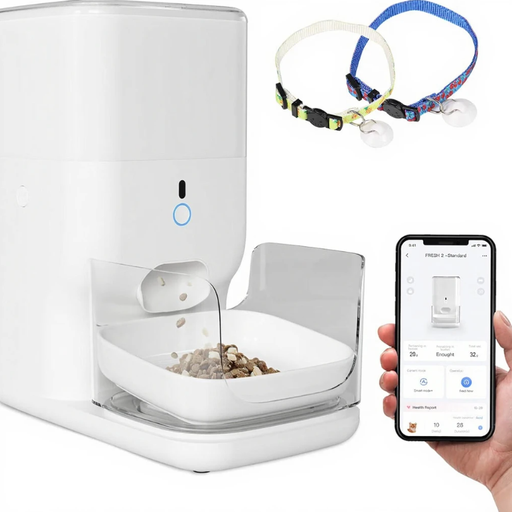
What makes it stand out: The Catlink FRESH 2-F04 is specifically designed for the needs of multi-cat households. Using RFID collar tags, the feeder identifies each cat individually, ensuring that every pet receives only its own pre-defined food in the correct amount. The app logs feeding behaviour and can send alerts for any irregularities.
Advantages:
Who it's for: Ideal for owners of two or more cats, especially if one cat requires special food or if there is food competition in the household.

What makes it stand out: The PETKIT YumShare Solo integrates a feeder with a 1080p HD camera and two-way audio. This allows you not only to see your cat but also to talk to them, no matter where you are. AI-powered bowl detection helps to dynamically adjust feeding plans and prevent overfeeding.
Advantages:
Who it's for: Perfect for cat owners who travel frequently and want the peace of mind of knowing their cat is eating, or for those who simply enjoy interacting with their pet remotely.
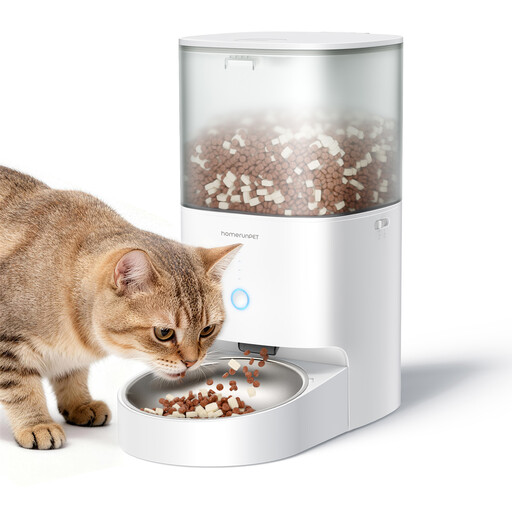
What makes it stand out: This model from homerunPET is notable for its exceptionally long battery life of up to six months. This allows the feeder to be placed completely independently of a power outlet, offering maximum flexibility in choosing its location.
Advantages:
Who it's for: For users who value maximum reliability and independence from the power grid, or who want to place the feeder in a location without a nearby outlet.
The market for automatic pet feeders is diverse. In addition to the models presented here, there are numerous other devices that differ in capacity, design, and range of functions. Whether you are looking for a simple feeder with a timer or another smart model, there is a suitable solution for almost every need.
Explore our full range of automatic timed cat feeders and find the perfect model for your cat.
1. How does a feeder for 2 cats work? There are two common systems. Simple models use a Y-shaped splitter to distribute food into two bowls, but this does not allow for individual control. Advanced systems like the Catlink FRESH 2-F04 use individual recognition via an RFID chip on the collar. The feeder only dispenses food when the authorised cat is at the bowl, ensuring precise and separate feeding.
2. Can an automatic feeder get clogged? Clogging can occur, especially with improperly sized kibble or greasy food. However, modern devices are often equipped with anti-clog mechanisms, such as a rotating impeller in the container or a wide dispensing channel. It is important to follow the manufacturer's specifications for maximum kibble size and to clean the food outlet regularly.
3. Does a smart feeder always need a Wi-Fi connection? A Wi-Fi connection is required for initial setup, programming feeding schedules, and using remote features like the camera. However, many high-quality models have internal memory and an offline mode. This means that once a feeding schedule is saved, it will be executed reliably even if the internet connection is temporarily lost.