Occasional compote freezers
If you sometimes have leftovers after a family meal, first check whether there’s room in your existing freezer. The Verbraucherzentrale’s guidance on making use of leftovers supports this needs-based approach.


For a single family meal, the free space in your existing freezer should be enough to start with; consider buying an additional chest freezer mainly if you regularly store larger quantities. The Verbraucherzentrale warns that a freezer that is too large for your needs can use electricity unnecessarily. So compare usable capacity, freezing capacity in kg/24 h, annual energy consumption and dimensions, rather than simply looking for the largest model. For longer storage, the Bundesinstitut für Risikobewertung recommends cooling hot food quickly to below 7 °C.
If you sometimes have leftovers after a family meal, first check whether there’s room in your existing freezer. The Verbraucherzentrale’s guidance on making use of leftovers supports this needs-based approach.
If you often freeze several portions or seasonal produce, consider usable capacity and freezing capacity alongside ongoing electricity costs. These criteria reflect guidance from the Verbraucherzentrale and the Bundeszentrum für Ernährung.
If you need extra freezer space but have limited room, or want to put the appliance in an unheated area, check its dimensions and the permitted ambient temperature for the specific model. The Verbraucherzentrale and the manufacturer’s model-specific information offer useful guidance.
For the occasional portion of compote, first check whether your existing freezer has enough room. If you freeze food regularly, batch size, energy consumption and where you’ll put the appliance become more important.
| What you need | What to check before buying | Who does this matter most to? |
|---|---|---|
| Needs and usable capacity | Check the space available in your existing appliance and the number of portions you actually need to freeze. Compare usable capacity only if you regularly need more room. | If I only freeze leftovers occasionally, I want to know first whether I need a second appliance. Around 36% of consumers put having the right amount of space at the top of their list. |
| Freezing capacity | Compare the quantity you want to freeze at one time with the specific model’s freezing capacity in kg/24 h. | If I regularly freeze several portions at once, the appliance’s ability to freeze fresh food matters more than storage space alone. Around 29% of consumers prioritise batch size. |
| Energy consumption | Compare kWh/year and usable capacity together; estimate potential costs using your own electricity price per kWh. | If I’m running an extra appliance all the time, I want to assess its energy use in relation to the capacity I need. Around 21% of consumers focus first on running costs. |
| Where it will go and keeping things organised | Check the external dimensions, the space needed to open the lid and the stated ambient temperature range. Label portions in suitable containers. | If space is limited or I want to find individual portions easily, I need an appliance that fits and storage that’s easy to navigate. Around 14% of consumers prioritise placement and organisation. |
An appliance that’s larger than you need can use electricity unnecessarily. If you only have the occasional leftovers to freeze, first check whether there’s room in your existing freezer.
Estimate how many portions you actually need to freeze and how often you have larger batches before comparing usable capacity and dimensions.
Capacity in litres tells you how much food you can store. The kg/24 h figure for a specific model tells you how much fresh food it can freeze within that time.
If you regularly freeze larger quantities, compare both figures separately with your needs.
The permitted ambient temperature varies by model. The specification for one appliance doesn’t automatically apply to other chest freezers.
Check the documentation for your chosen model and the temperatures at the intended location.
Using suitable portions and labels makes it easier to keep track of what you have and take out what you need later.
Put the compote into suitable freezer containers and note the contents and date.
The GT100-050E weiss is a compact extra chest freezer with 99 litres of usable capacity.
Beko’s German range includes chest freezers in different sizes, including the HSM14550 with 148 litres and the HSM27050 with 284 litres.
Liebherr lists the CFc 1875 Plus as a chest freezer with a total capacity of 192 litres.
With 299 litres of usable capacity, the GT300E is a larger chest freezer.
The HCE200C is part of the Chest Serie 3 range.
The Joybuy models below range from a smaller extra freezer for a little more storage to appliances for regular stock-ups. If you only need to freeze one family portion, first check the space available in your existing freezer.
 No image available
This model could provide extra freezer space if room is limited, as long as its dimensions suit your chosen location.
Usable capacity: 141 l; 4-star freezer compartment; removable freezer basket; dimensions: 632 × 554 × 848 mm; energy consumption: 179 kWh/year; energy rating E; 38 dB; switches between fridge and freezer modes.
 No image available
Its smaller capacity may suit you if you need a limited amount of extra freezer space. Check the available space first.
Usable capacity: 95 l; 4-star freezer compartment; removable freezer basket; dimensions: 550 × 475 × 848 mm; energy consumption: 165 kWh/year; energy rating E; 38 dB; switches between fridge and freezer modes.
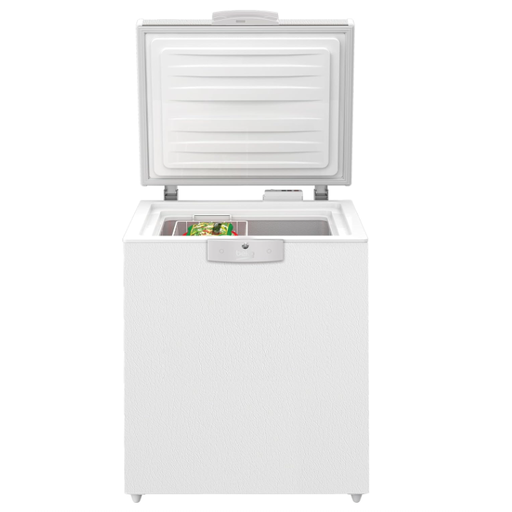 No image available
This model may be worth considering if you need extra freezer space and its capacity and freezing performance suit the amount you plan to store.
Usable capacity: 148 l; freezing capacity: 6.5 kg/24 h; 4-star system; one freezer basket; energy consumption: 147 kWh/year; energy rating D; product specifications state that it operates at ambient temperatures down to −15 °C; manual defrosting is required when more than 5 mm of ice has built up.
 No image available
With its larger capacity, this model is designed for regular stock-ups. Consider whether you’ll use the extra storage space regularly.
Usable capacity: 197 l; 4-star freezer compartment; removable freezer basket; dimensions: 816 × 554 × 848 mm; energy consumption: 197 kWh/year; energy rating E; 38 dB; switches between fridge and freezer modes.
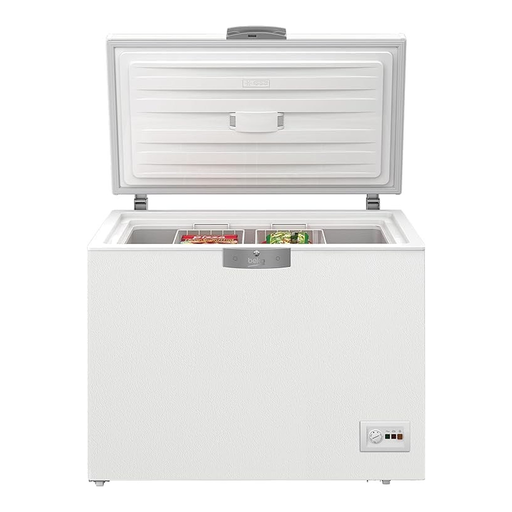 No image available
This larger model could suit you if you need extra storage alongside occasional family portions and have enough space for it.
Usable capacity: 230 l; 4-star system; two freezer baskets; dimensions: 67.5 × 110.5 × 86 cm; product specifications state that it operates at ambient temperatures down to −15 °C; temperature alarm; LED interior lighting; 35 dB(A).
No. First check the space available in your existing freezer. An extra chest freezer is mainly worth considering if you regularly freeze or store larger quantities. The Verbraucherzentrale points out that an appliance that’s too large can use electricity unnecessarily.
For longer storage, cool hot food quickly, then put the compote into suitable, labelled portion-sized containers. The Bundesinstitut für Risikobewertung recommends quickly cooling hot food to below 7 °C. The Bundeszentrum für Ernährung recommends using suitable portions and labelling them with the contents, quantity and date.
The Verbraucherzentrale recommends −18 °C as the optimum temperature for chest freezers and upright freezers. This is consumer guidance, not a general legal minimum temperature for private households.
Multiply the kWh/year figure on the specific model’s EU energy label by your electricity price per kWh. This gives you an estimate for comparison; actual consumption also depends on how and where you use the appliance.
For the specific model, compare usable capacity, energy consumption in kWh/year and freezing capacity in kg/24 h if you regularly freeze larger quantities at once. The Verbraucherzentrale says the energy label includes details such as the efficiency class, annual energy consumption, volume and noise level. Make sure you’re comparing the same model variant.