For the occasional small batch of apple compote, you don’t automatically need an additional chest freezer. The Verbraucherzentrale says that an existing freezer compartment is often enough for people living alone or those who rarely eat frozen food. If you regularly have more portions to freeze, compare the capacity you need with the specific appliance’s annual kWh consumption, freezing capacity and dimensions. The German Federal Institute for Risk Assessment recommends cooling hot food quickly to below 7 °C before storing it for longer; the German Federal Centre for Nutrition recommends freezing planned quantities in individual portions.
Who might need a chest freezer?
Occasional batch cooks
If you only make apple compote now and then, first check whether your existing freezer compartment can hold the portions you plan to freeze. The Verbraucherzentrale lists an existing fridge-freezer as a possible option for people living alone and those who rarely eat frozen food.
Regular batch cooks
If you often freeze several individual portions, you may need extra freezer space that’s easy to organise. The German Federal Centre for Nutrition recommends measuring out the amount you need and freezing it in individual portions.
People living alone with limited space
When adding freezer space, consider not only room for containers but also the appliance’s external dimensions and where you’ll put it. The German Environment Agency points out that freezers run continuously, so check the specific model’s annual energy consumption too.
What should you consider when choosing one?
Existing freezer compartment
A good fit if: you only freeze small amounts occasionally and have enough room for the containers.
The trade-off: You may run short of space when cooking a larger batch.
Compact chest freezer
A good fit if: you regularly have more portions to freeze than your existing compartment can hold, and you have a suitable place for it.
The trade-off: An additional appliance takes up space and adds to your ongoing electricity consumption.
Larger chest freezer
A good fit if: you regularly freeze larger quantities of other foods, too.
The trade-off: You may end up with more capacity than you need for the occasional portions of compote.
| What you need |
What to check before buying |
Who might find this important? |
| Do I need an additional appliance? |
Count the individual containers that are suitable for freezing and check how many will fit in your existing freezer compartment. |
If I only freeze a few portions now and then, I want to know whether my existing compartment is big enough before buying anything else. Around 33% of consumers put the question of whether they need an additional appliance first. |
| Annual energy consumption |
Compare the annual kWh figure on the EU energy label and calculate the cost using your own electricity price per kWh. |
As an additional appliance runs continuously, I want to compare its consumption with my tariff. Around 27% of consumers prioritise ongoing electricity costs. |
| Larger quantities |
Compare the amount of compote you’ll be adding in one day with the freezing capacity in kg per 24 hours. Also check that your containers will fit. |
When cooking a larger batch, I want to be able to fit the containers in and freeze the new quantity. Around 20% of consumers prioritise having space for larger quantities of food. |
| Space and access |
Measure the floor space, the route for moving the appliance and the clearance above the lid. Check whether a basket suits the way you store food. |
If space is limited or I want to organise lots of small containers, I look at the dimensions and how easy it is to reach everything. Around 20% of consumers prioritise placement and access. |
Avoid common buying mistakes
-
Buying a separate chest freezer for occasional portions
An additional appliance takes up floor space and runs continuously. If you only have a few portions, your existing freezer compartment may be enough.
First check how many containers you usually freeze and how much free space is left in your existing appliance.
-
Assuming the energy efficiency class tells you the total electricity consumption
The energy efficiency class is no substitute for comparing the stated annual energy consumption. Even a small appliance may offer more freezer space than you need.
When comparing specific models, check the annual kWh figure and usable capacity.
-
Looking only at capacity
Usable capacity and freezing capacity in kg per 24 hours describe different things. When freezing a larger batch, you need to consider not only the space available but also how much the appliance can freeze in that time.
Estimate how much cooled compote you’ll be adding at once, then compare it with the stated freezing capacity.
Relevant brands at a glance
Exquisit
The GT100-050E is a compact chest freezer that could be an option if you need extra freezer capacity.
- According to the manufacturer: 99 l usable capacity, one freezer basket and 169 kWh/year.
- Check whether you need the capacity for your actual food stocks and whether the annual energy consumption suits your needs.
Bomann
The GT 7355 is a 100-l chest freezer with a basket to help you organise your food stocks.
- The manufacturer states an annual consumption of 135 kWh and a freezing capacity of 4,5 kg per 24 hours.
- The manufacturer’s freezing capacity figure isn’t a measurement taken in a home. Also consider the installation conditions and how much space you actually need.
Beko
According to the manufacturer, the freestanding HSM10440 has a usable capacity of 104 l.
- Its stated external dimensions are 86 × 53,7 × 58,5 cm (H × W × D); its stated energy efficiency class is E.
- Check the specific model’s annual energy consumption in its product information before assessing its energy use.
Liebherr
With a capacity of 192 l, the CFc 1875 Plus is designed for regularly storing larger quantities.
- According to the manufacturer, its external dimensions are 82 × 104 × 71 cm (H × W × D).
- Liebherr says SmartFrost reduces ice build-up, but it doesn’t eliminate the need to defrost completely. Check that the capacity and dimensions suit your needs.
Joybuy models for extra freezer space
The models below are chest freezers with different capacities. Compare their specifications with the portions of compote you regularly freeze and the space you need for other frozen food.
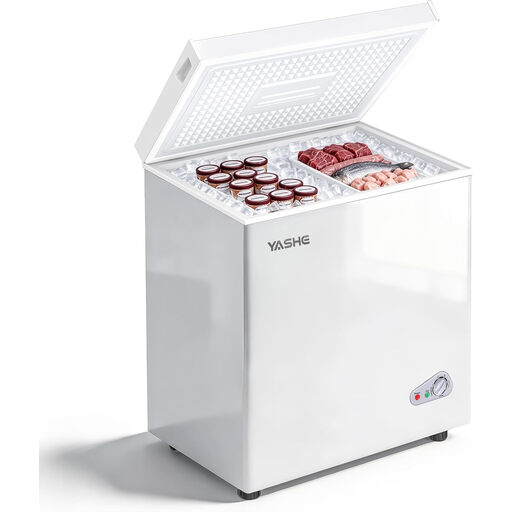 No image available
YASHE BC-150Q-EU chest freezer, 150 l, freestanding, 2 removable baskets, 6 temperature settings, white
Could suit regular food storage, but 150 l may be more freezer space than one person needs for occasional portions of compote.
150 l; freestanding; 2 removable baskets; 6 temperature settings.
View at Joybuy
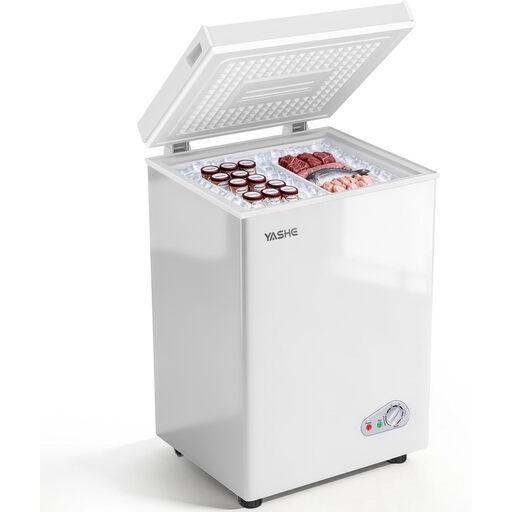 No image available
YASHE BC-100Q-EU chest freezer, 100 l, freestanding, 2 removable baskets, 6 temperature settings, white
Could be a good fit if you regularly have more portions to freeze than your existing freezer compartment can hold. Check the capacity against the amount of food you actually store.
100 l; freestanding; 2 removable baskets; 6 temperature settings.
View at Joybuy
 No image available
Gorenje FH15E6W5 chest freezer, 141 l, FastFreeze, FreezeProtect -15℃, flexible baskets, white
The larger capacity could be useful if you regularly store extra food. Check that you’ll make use of the freezer space.
141 l; FastFreeze; FreezeProtect -15℃; flexible baskets.
View at Joybuy
 No image available
CHiQ chest freezer, 99 l, 4-star freezing, E, white
Could provide extra space for storing portions, but the capacity may be more than one person needs for occasional batches of compote.
99 l; 4-star freezing; energy efficiency class E; wire basket.
View at Joybuy
Frequently asked questions
How should I prepare apple compote for freezing in individual portions?
For longer storage, cool hot food quickly to below 7 °C, as recommended by the German Federal Institute for Risk Assessment. Then divide the compote into portions in suitable containers marked as freezer-safe, and label each one with its contents and date.
What temperature should I set my freezer to?
The Verbraucherzentrale gives −18 °C as the optimum temperature for a freezer or chest freezer. Check the setting and also follow the instructions in your appliance manual.
How can I compare the energy consumption of different chest freezers?
Compare the annual kWh figure on each appliance’s EU energy label, then multiply it by your own electricity price per kWh. The label figure is based on standardised conditions; usage and location can affect actual consumption.
What information does a chest freezer’s energy label show?
For the household refrigeration and freezer appliances it covers, the EU energy label provides information including the energy efficiency class, annual energy consumption, capacity and noise levels. According to the European Commission, the A to G scale has been in use since 1 March 2021.
What should I do with an old freezer?
In Germany, old electrical appliances are collected separately. The German Environment Agency lists local collection points and retailer take-back when buying a new appliance. Before ordering, check whether collection and removal are offered.


