Holidaymakers with their own baking dish
If you’d like to use your own dish, check in advance that it will fit in the oven at your accommodation and that you can select the right heating function for your recipe.


If the oven you have can accommodate your baking dish and offers the right heating function, you won’t need another appliance to make apple crumble. If there’s no suitable oven, choose a freestanding mini oven based on the outside dimensions of your dish and the installation requirements for the specific model. More compact appliances are more likely to limit the portion size. The REWE recipe referenced here suggests 175 °C fan oven and around 40–45 minutes as a starting point. Even so, check that the apples are soft and the crumble topping is golden.
If you’d like to use your own dish, check in advance that it will fit in the oven at your accommodation and that you can select the right heating function for your recipe.
A freestanding mini oven may be an option for smaller portions. As well as the appliance’s dimensions, allow for the required clearance around it in its intended position.
If you want to bake more crumble in one go, compare your dish’s dimensions with the usable cooking space and check that you have enough room for the larger appliance.
A good fit if: your dish fits and the oven offers the heating function your recipe needs.
The trade-off: you won’t need another appliance or extra space for it. Keep an eye on how golden the topping is and whether the apples are soft as they bake.
A good fit if: you tend to bake smaller portions and can safely position the appliance with the required clearances. Steba lists the KB M19 as having a 19-litre capacity and internal dimensions of 31 × 25.5 × 23.5 cm (W × D × H).
The trade-off: your dish must fit in the usable cooking space. The Steba KB M19 manual also requires 10 cm between the back of the appliance and the wall.
A good fit if: you want to bake a larger dish or more portions in one go, and have enough worktop space. Rommelsbacher lists the BG 1805/E as having a 42-litre capacity and accommodating round baking tins up to 31.5 cm in diameter.
The trade-off: according to Rommelsbacher, the BG 1805/E measures 54.5 × 43 × 36 cm (W × D × H). For rectangular dishes, the stated diameter doesn’t replace checking the actual dimensions.
| What to consider | What to check before buying | Who is it most important for? |
|---|---|---|
| Dish size and portions | Compare the outside dimensions and height of your dish with the internal dimensions, shelf positions and the maximum dish size expressly approved for the specific model. | If I want to use my own dish at a holiday cottage, I want to know it will fit before I start baking. Around 31% of consumers focus primarily on whether their dish will fit. |
| Space for the appliance | Check the appliance’s external dimensions, door clearance, socket location and all the clearances specified in the manual for the exact model, at the intended location. The Steba KB M19 requires 10 cm between the back of the appliance and the wall. | If worktop space is limited, I want to find a suitable spot without overlooking the required clearances. Around 31% of consumers prioritise a safe place to position the appliance. |
| Heating function and browning | Check the heating functions, temperature settings and timer on the specific model. REWE suggests 175 °C fan oven and around 40–45 minutes for the recipe referenced here. Check the result rather than treating the cooking time as a guarantee. | If I want to bake a recipe using a fan oven, I need an oven with the right heating function and control over how golden the topping gets. Around 25% of consumers put the heating function first. |
| Running costs and accessories | Check what’s included and whether replacement accessories are available. Compare energy consumption only for similar baking tasks. The consumer advice centre recommends taking the appliance’s actual energy consumption into account. | If I plan to use the appliance regularly, I want to know what accessories I’ll need and have an idea of its energy consumption. Around 13% of consumers focus first on running and ongoing costs. |
The stated capacity in litres doesn’t tell you on its own whether a particular dish will fit. Manufacturers’ details on internal dimensions and approved round dish diameters can vary.
Measure the outside of your dish, including the rim and handles, and compare the dimensions with the details for the exact model.
If your dish doesn’t fit, you may need to use a different one or bake in several batches.
The Steba KB M19 manual says the appliance is not designed to be built in and warns that its surfaces can get hot and its ventilation slots must not be covered.
Before buying, check the positioning requirements from the relevant manufacturer and make sure they’re compatible with the space you have in mind.
The rated power alone doesn’t show how much electricity the appliance uses for a comparable baking task.
Compare energy consumption figures only on the same basis and under similar baking conditions. The consumer advice centre recommends taking the appliance’s actual electricity consumption into account.
The KB M19 is a 19-litre model for smaller dishes and kitchens with limited space. Steba lists internal dimensions of 31 × 25.5 × 23.5 cm (W × D × H), as well as switchable fan assistance.
Rommelsbacher lists the BGE 1580/E as having a 30-litre capacity and accommodating round baking tins up to 29 cm in diameter. The BG 1805/E offers 42 litres, according to the manufacturer, and is approved for round tins up to 31.5 cm.
According to Severin, the TO 2079 is a 20-litre model. The product page lists fan assistance, as well as top and bottom heat that can be used together or separately.
According to CASO Design, the freestanding TO 26 SilverStyle is a 26-litre model with fan assistance, top heat and bottom heat. The manufacturer lists it as accommodating round baking tins up to 30 cm in diameter.
This selection features freestanding mini ovens for baking at a holiday cottage. Compare the dimensions of your dish and the space you need with the details for each model.
 No image available
The 32-litre capacity can help you narrow down your options, but also check that your dish will actually fit.
Listed in the product name: 32 L, 1,600 W, timer, crumb tray and a temperature range of 100–250 °C.
 No image available
A compact appliance may suit smaller batches. The product description recommends this 10-litre model for 1–2 people.
Listed in the product name: 10 L, pizza function and a temperature range of 100–230 °C.
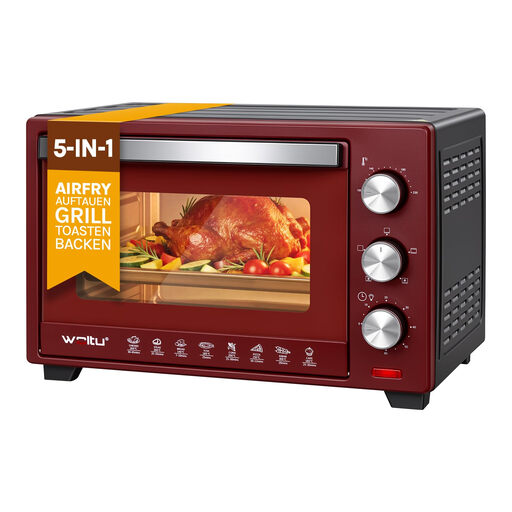 No image available
If you’re considering a larger cooking space, compare your dish’s dimensions with the details for the specific appliance. Capacity alone doesn’t confirm that it will fit.
Listed in the product name: 28 L, temperature control and timer.
No, not as a guaranteed baking time. REWE suggests 175 °C fan oven and around 40–45 minutes for its recipe, but the actual time can vary depending on the recipe and oven. Check that the apples are soft and the crumble topping is golden.
Only if the manual for the specific appliance expressly allows it. The Steba KB M19 manual says the appliance isn’t designed to be built in, requires 10 cm between the back of the appliance and the wall, and warns against covering the ventilation slots. Check the manual for other models individually.
For a consumer purchase in Germany, your statutory rights against the seller are separate from any voluntary manufacturer’s guarantee. Check the terms of any additional guarantee and whether spare parts are available for the specific model.
Electrical and electronic equipment covered by relevant harmonised EU legislation must carry the CE marking. It is the manufacturer’s declaration of conformity, not a certificate issued by a central EU testing body. Check the marking and the manufacturer’s information for the specific product.
In Germany, electrical appliances must not be put in household rubbish. The German Environment Agency lists recycling centres and suitable retail take-back points as disposal options.