Families with busy mornings
If you want to make several glasses of apple juice, compare the feed chute, pulp container and ease of cleaning. Philips lists a 75-mm chute for the HR1856/70, while Bosch gives the MES4010 a measurement of 84 mm.


If you want to make several glasses of juice from firm apples at breakfast, compare the feed chute, pulp container and the juice jug actually included with centrifugal juicers. A slow juicer may be a good fit if you’d prefer to choose the juice texture or want a large ingredient hopper; just bear in mind the assembly, cleaning and space it takes up. Container capacities and manufacturers’ preparation-time claims are no substitute for comparing the whole process.
If you want to make several glasses of apple juice, compare the feed chute, pulp container and ease of cleaning. Philips lists a 75-mm chute for the HR1856/70, while Bosch gives the MES4010 a measurement of 84 mm.
Compact dimensions can be important if you’re making smaller quantities. Severin lists a 0.5-l juice container and dimensions of 28 × 35 × 20 cm for the ES 3566.
If you want to adjust the texture of your juice using different filters, compare slow juicer models with fine and coarse filters. Remember to factor these extra parts into assembly and cleaning, too.
A good fit if: You want to juice firm apples in the morning with minimal chopping.
Things to weigh up: Chute width, juice jug and pulp container are separate features. Philips says the HR1856/70 can make up to 2 l of juice per batch without emptying the pulp container; Bosch lists a 1.5-l juice container for the MES4010. These figures don’t represent directly comparable amounts of juice.
A good fit if: You value a large ingredient hopper or the option to choose between different filters.
Things to weigh up: An ingredient hopper isn’t a juice container. Hurom lists a 2-l hopper and a 600-ml chamber for the H320N; manufacturers’ claims don’t prove a general advantage over centrifugal juicers for vitamin retention or yield.
A good fit if: Saving space and making smaller quantities matter more to you than processing a large batch at once.
Things to weigh up: Severin lists a 0.5-l juice container and a 6-cm feed chute for the ES 3566. You may need to transfer juice to another container or chop apples to make several glasses.
For a family breakfast, start by weighing up how much juice you need and how long you have for preparation. Then consider cleaning, space and your preferred texture.
| What matters to you | What to look for | Who is it important for? |
|---|---|---|
| Several servings | Check the juice jug, pulp container and ingredient hopper separately. | If I’m preparing several glasses for a family breakfast, I want to understand what each container is for and avoid having to refill it too often. Around 29% of consumers put capacity for several servings first. |
| Minimal preparation | Compare the feed chute diameter with the size of your apples and check the preparation instructions. | When there’s little time in the morning, I want to avoid having to chop apples whenever possible. Around 29% of consumers prioritise easy preparation. |
| Cleaning | Check how the juicer comes apart, access to the filter, whether a cleaning brush is included and which parts are approved for the dishwasher. | If I want the juicer clean straight after breakfast, I want to know how to clean the filter and other parts. Around 24% of consumers put washing up first. |
| Space and smaller quantities | Compare the appliance’s dimensions, the space needed to operate it and the juice container. | If my kitchen has limited worktop space and I usually make smaller quantities, the space it takes up matters more to me than processing a large batch at once. Around 12% of consumers prioritise compact dimensions. |
| Juice texture | Check which filters are included and what the instructions recommend for apples. | If I want to choose the texture using different filters, I also check how many parts I’ll need to clean afterwards. Around 6% of consumers first consider their preferred texture. |
The hopper, juice jug and pulp container all have different functions. Hurom lists a 2-l ingredient hopper and a 600-ml chamber for the H320N. The amount of juice you can make without emptying the pulp container is also different from the capacity of the jug.
Compare the number of glasses you plan to make with the capacity of the juice jug, and check separately how much the pulp container and hopper can hold.
Apples come in different sizes. A stated chute width doesn’t mean every apple will fit without checking. The Federal Centre for Nutrition recommends avoiding apples with bruised or rotten patches.
Measure the apples you usually buy and follow the preparation instructions for your chosen model.
Claims about seconds per glass don’t necessarily include washing, chopping, assembly and cleaning. Claims about vitamin retention come from manufacturers and, on their own, don’t provide an independent comparison of different types of juicer.
Make your decision based on the whole process, your preferred texture and the specific features listed for each model.
The HR1856/70 is a centrifugal juicer with a manufacturer-listed 75-mm feed chute.
The MES4010 is a centrifugal model with an 84-mm feed chute and a 1.5-l juice container.
The ES 3566 is a compact centrifugal juicer, while the ES 3571 is a slow juicer alternative with two filters.
The MultiJuice 7 SJ7000GY has a 75-mm feed chute and is described as suitable for larger quantities of firm apples.
The H320N is a slow juicer with a large ingredient hopper, plus fine and coarse filters.
This selection includes centrifugal juicers and slow juicers with wide feed chutes. When juicing apples, check that the fruit will fit through the chute.
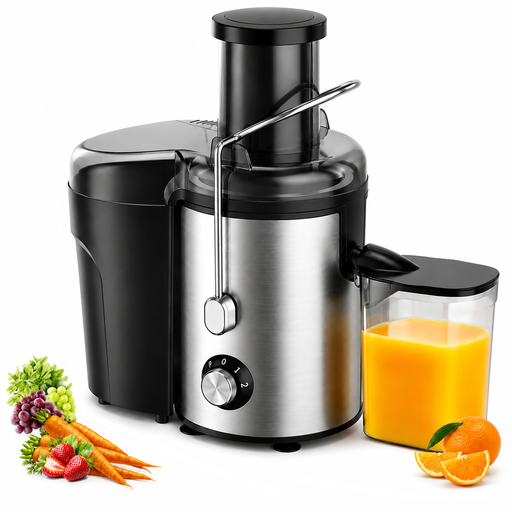 No image available
The 75-mm chute is suitable for apples that will actually fit through it.
600 W; two speed settings.
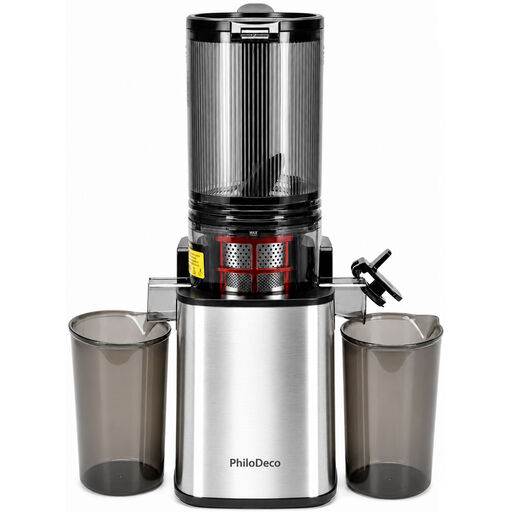 No image available
The product description says the wide feed chute is suitable for whole apples; check the size of your fruit.
110-mm feed chute; 40 Nm; dual filter; reverse function.
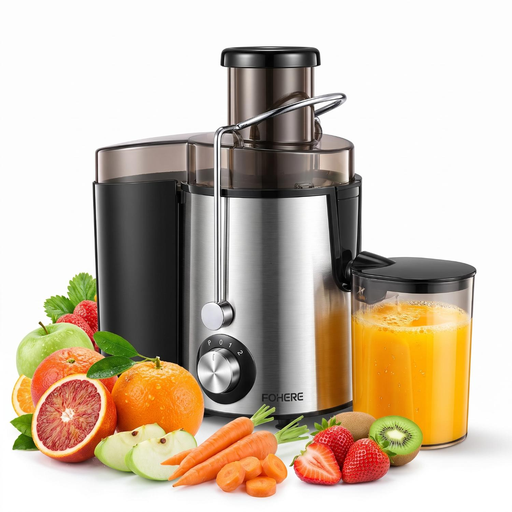 No image available
The 75-mm chute is suitable for apples that will actually fit through it.
800 W; three speed settings; 304 micro-mesh filter.
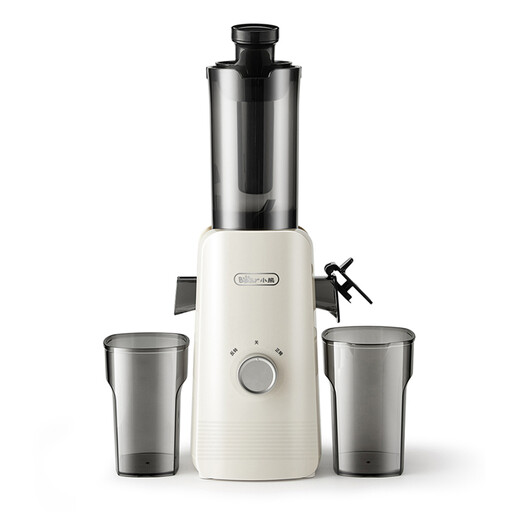 No image available
The product description says the 80-mm feed chute is suitable for whole apples; check that your fruit will fit.
80-mm feed chute; 1 l according to the product name; cleaning brush listed in the product description.
 No image available
The product description says the 3-inch chute is suitable for whole apples; what matters is whether your apples will fit through it.
600 W; stainless steel according to the product name.
It depends on whether the apples fit through the feed chute; a manufacturer-listed measurement such as 75 mm only applies to fruit that will actually fit. Discard any apples with rotten patches. For the Severin ES 3571, the manufacturer recommends washing and chopping apples to size; for other appliances, follow their individual instructions.
For the Severin ES 3571, the manufacturer says to use only the pusher to feed ingredients into the juicer, not your hand. Make sure the appliance is assembled correctly and the filter is clean. For other appliances, follow the relevant instructions.
For each model, check which parts the instructions specifically say are dishwasher-safe, and whether the filter, cleaning brush and any spare parts you need are available. A voluntary manufacturer’s warranty is separate from your statutory rights against the seller.
Mains-powered household appliances covered by the EU Low Voltage Directive must meet conformity requirements. Germany’s Federal Network Agency describes the CE marking as a declaration made by the manufacturer under its own responsibility, and lists German-language accompanying documents as something retailers should check. CE is not an independent quality mark and, on its own, doesn’t confirm that a particular product listing complies.
Shelf-life information for packaged fruit juice doesn’t apply to fresh juice that hasn’t been processed in the same way. Make only as much as you need, if possible, and keep any leftovers chilled. Don’t drink juice showing signs of mould or fermentation, advises the consumer advice centre.