Who is a food dehydrator suitable for?

Apple snackers with limited worktop space

If you only dry thin apple rings occasionally, compact dimensions and trays that are easy to put away afterwards are important. WMF and Rommelsbacher provide specific dimensions and designs that you can compare.

Regular apple processors

If you want to dry several apples at a time, the usable area of the trays matters more than the number of trays alone. Rommelsbacher and Graef list the drying area of their respective appliances.

People looking for a simple routine

If you want to plan the drying process and check the rings easily, look for a timer, accessible trays and clear cleaning instructions. The Federal Centre for Nutrition recommends checking how dry the food is rather than relying on a set time alone.

What should you look for when buying?

Stackable appliance for small batches

A good fit if: you dry individual snack portions and have limited worktop space to spare. WMF lists five trays, a temperature range of 30–70 °C and a timer of up to 24 hours for the KÜCHENminis Snack to go.

The trade-off: the number of trays alone doesn’t tell you how many apple slices will fit. Check the external dimensions and the clearance needed during operation too.

More drying area in a limited space

A good fit if: you regularly process several apples and have room for the Rommelsbacher DA 350, including the clearance it needs. Rommelsbacher lists five height-adjustable tiers and a total drying area of 0,42 m².

The trade-off: the total area is spread across several tiers. Compare the appliance dimensions of 31,50 × 33,70 × 25,30 cm with the space you have in mind.

Pull-out tray appliance for larger quantities

A good fit if: more drying area and individually removable trays matter more to you than having the smallest possible appliance. Graef lists six pull-out trays and a drying area of 0,65 m² for the DA506.

The trade-off: the larger area needs more worktop space. The manufacturer’s claims about heat distribution are not an independent performance comparison specifically for apple slices.

Use your existing oven

A good fit if: you only dry apple rings occasionally and don’t want another appliance taking up space. The Federal Centre for Nutrition describes drying food in the oven at a low temperature with the door slightly open, allowing moist air to escape.

The trade-off: the Federal Centre for Nutrition describes the oven method as energy-intensive.

Buying priority What to look for Who is it important to?
Worktop space and storage Check the external dimensions against the intended spot; allow for the clearance needed for air circulation, as stated in the instructions. If I have limited worktop space, I want to know whether the appliance will fit there while it’s drying. Around 36 % of consumers are likely to consider available space their top priority.
Drying capacity and area Compare usable drying area rather than just the number of trays; arrange the apple slices with space between them. If I process several apples at a time, I need enough usable area without placing the slices too close together. Around 29 % of consumers are likely to prioritise drying capacity.
Controls and cleaning Check the timer range, how easy the trays are to access and the cleaning instructions for the specific model. If I want to keep the process simple, I want to be able to check the rings easily and clean the trays afterwards. Around 21 % of consumers are likely to prioritise an easy routine.
Energy consumption Compare how often you’ll use the appliance and the measured kWh per batch; don’t treat the wattage as a consumption figure. If I’m considering an additional appliance, I want to estimate its actual energy use based on how I’ll use it. Around 14 % of consumers are likely to consider energy consumption decisive when drying repeatedly.

Common buying misconceptions

  • Comparing only the number of trays

    More trays don’t automatically mean more usable drying area or a smaller footprint on your worktop.

    Measure the space where you plan to put the appliance, then compare its external dimensions and usable drying area with your usual apple portions.

    An appliance that doesn’t fit well in the space you’ve chosen will take up worktop space throughout longer drying cycles.

  • Assuming the timer ending means the apple rings are dry

    The Federal Centre for Nutrition notes that drying time depends on the size and thickness of the pieces. A timer alone therefore can’t confirm how dry the food is.

    Slice the rings as thinly and evenly as possible, spread them out with space between them and check the dried fruit before storing it.

    Residual moisture can affect storage, so check the rings before putting them away.

  • Assuming wattage tells you the exact energy consumption

    An appliance’s power rating isn’t a measured consumption figure for each drying cycle. Running time and frequency of use affect its actual energy requirements.

    When comparing appliances, look at measured kWh per batch and consider how you plan to use yours, rather than relying on the wattage alone.

Brands to consider

WMF

The KÜCHENminis Snack to go has a stackable design that may suit small batches and kitchens with limited worktop space.

  • WMF lists five trays, temperature control from 30–70 °C and a timer of up to 24 hours.
  • The manufacturer’s descriptions “quiet” and “compact” aren’t measured claims about noise levels or suitability for every location.

Rommelsbacher

The DA 350 combines several height-adjustable tiers with a stated total drying area. Check that it fits the space you have available.

  • Rommelsbacher lists five tiers, 0,42 m² of drying area, external dimensions of 31,50 × 33,70 × 25,30 cm, a temperature range of 35–75 °C and a timer of up to 36 hours.
  • The stated area and temperature range don’t demonstrate drying consistency for apple slices in a comparative test.

Graef

The DA506 is a pull-out tray appliance for buyers who can make use of more drying area and have enough space for it.

  • Graef lists six pull-out trays, 0,65 m² of drying area and a timer of up to 40 hours.
  • The manufacturer’s claims about Dry-Balance technology aren’t independent evidence of performance with apple slices.

Stöckli

The Dörrex, with its timer and metal trays, has a round, expandable design. Check the exact version before buying.

  • For the Dörrex 0076.70M, Stöckli lists three metal trays included, a timer of up to 12 hours and a diameter of 33,50 cm.
  • The model codes 0076.70M and 0076.72M shouldn’t be treated as the same version. Check the model code and included features.

Severin

Severin describes the OD 2940 as suitable for drying fruit, vegetables and herbs.

  • The manufacturer’s description of its intended uses includes fruit.
  • Check the external dimensions and details of the specific version before choosing this appliance for a small kitchen.

Joybuy products for drying apple slices

The following Joybuy picks are food dehydrators with several stainless steel trays for fruit. Compare their footprint, number of trays and cleaning requirements with the amount of apples you usually dry.

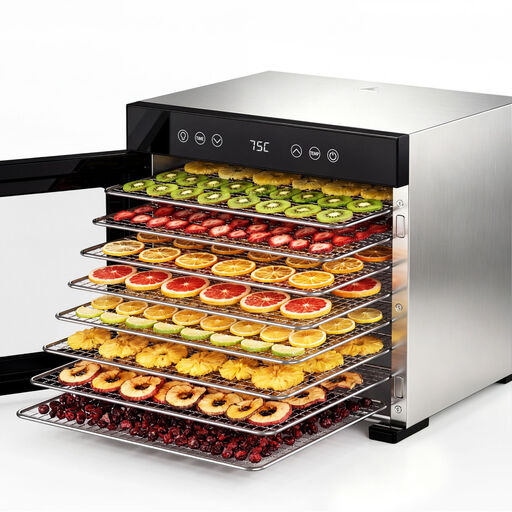
Havenwell food dehydrator with 10 stainless steel trays

Havenwell food dehydrator, 10 stainless steel trays, 850 W

The ten trays provide several levels for apple slices. Check that the appliance dimensions suit your available space.

The product details list adjustable temperature settings, a timer of up to 48 hours and ten programmes.

Power rating: 850 W. According to the product description, the ten trays and the BPA-free plastic drip tray are dishwasher-safe.

View at Joybuy
Havenwell food dehydrator with 8 stainless steel trays

Havenwell food dehydrator, 8 stainless steel trays, 650 W

The eight trays provide several levels for fruit. Check the appliance’s footprint and how much space you can leave clear while it’s in use.

The product details list temperature control from 35–85 °C, a timer of up to 48 hours and a touch display.

Power rating: 650 W. According to the product description, the appliance has an interior light.

View at Joybuy

Frequently asked questions

How can I tell when apple rings are dry enough?

The Federal Centre for Nutrition suggests that dried food should be slightly pliable: when you press it firmly, no juice should come out. Check the rings as they dry, as a set number of hours won’t work for every slice thickness.

Can I dry apple rings in the oven instead of using a food dehydrator?

Yes. The Federal Centre for Nutrition recommends using a low temperature and leaving the oven door slightly ajar so that moist air can escape. It describes this method as energy-intensive.

What applies if an appliance develops a fault: a guarantee or statutory rights?

For a consumer purchase in Germany, statutory consumer rights are a claim against the seller, while a guarantee is an additional voluntary promise with its own terms. If a product is faulty, the first step may be to request a repair or replacement. The Verbraucherzentrale explains the difference between the two.

What should I look for in the CE marking and drying trays?

For electrical appliances covered by CE regulations, the manufacturer uses the CE marking to declare that the product meets the relevant EU requirements; it isn’t an independent quality mark. The European Commission also sets out EU requirements for materials that come into contact with food. Check the manufacturer’s information, the instructions and the details for the specific version.

Can I put an old food dehydrator in household rubbish?

No. In Germany, waste electrical equipment is collected separately. The Federal Environment Agency notes that municipal collection points generally accept it free of charge.