For the occasional small batch, your existing oven may do the job, but it will be occupied while the apples dry and, according to the consumer advice centre, uses a lot of energy. If you dry fruit regularly and want to keep your only hob free, a separate appliance may be worth considering. Choose its design based on the size of your usual batch and the space you have for using and storing it, rather than looking at wattage alone.
Which option is right for you?
You want to keep your hob free
If you want to cook while the apples are drying, a separate appliance can keep your hob free. The Federal Centre for Nutrition describes how to dry apple rings, while the consumer advice centre points out that the oven is tied up for a long time when used for drying.
Small batches and limited space
If you regularly dry modest quantities, compare the usable rack area with the space the appliance will take up in your kitchen and when stored away.
Larger batches in one go
If you want to lay out more apple slices at once, check the usable drying area, the space between the slices, and the room needed to position and clean the appliance.
What should you look for when buying?
Your existing oven
A good fit if: you only dry a small batch occasionally and don't need to use the oven for cooking at the same time.
Keep in mind: the oven will be occupied, and the consumer advice centre describes this method as energy-intensive.
Compact stackable dehydrator
A good fit if: you dry fruit regularly, want to keep your hob free and have limited space for an appliance.
Keep in mind: the number of tiers and their combined drying area don't tell you how many slices will fit on the racks with enough space between them.
Cabinet dehydrator with trays
A good fit if: you regularly dry larger quantities and have suitable space to position and store the appliance.
Keep in mind: a larger stated drying area doesn't automatically mean the appliance will fit in a small kitchen or use less electricity.
Air-drying
A good fit if: you have a warm, sheltered and well-ventilated spot, and can check the slices regularly.
Keep in mind: the Federal Centre for Nutrition specifies a minimum temperature of 30 °C and warns that the process takes longer and carries a risk of spoilage.
| Buying criteria |
What to check before buying |
Who is this important to? |
| Hob and space for the appliance |
Check where the appliance can sit for a complete drying cycle, and what clearance the instructions require for ventilation. |
If I want to use my only hob while drying, a separate appliance could be right for me; around 33 % of consumers have this concern. |
| Drying area and batch size |
Compare the usable rack area and the appliance's external dimensions with your usual batch size. Apple slices need space for air to circulate. |
If I want to fit my usual batch on the racks while still keeping space in the kitchen, I look at the drying area and appliance dimensions; around 27 % of consumers prioritise this balance. |
| Timer and monitoring |
Check the timer, temperature range and instructions for the specific model. A timer doesn't replace checking the slices. |
If I want to plan a drying cycle more easily and check the apple slices as they dry, ease of use matters to me; around 20 % of consumers share this priority. |
| Cleaning and use |
Read the cleaning instructions for the racks and drip trays. The rated power alone doesn't show how much electricity one batch will use. |
If I plan to use the appliance often, I look at how easy the racks and drip trays are to clean and how I can track the energy used by my own drying cycles; around 20 % of consumers pay particular attention to these factors. |
Common buying mistakes
-
Comparing only the number of tiers
The combined drying area doesn't tell you how many apple slices will fit on each rack with enough space between them. The appliance's external dimensions also need to suit the space you have.
Compare the usable rack area and appliance dimensions with your usual batch size. Keep the ventilation openings clear as instructed.
-
Using wattage to estimate electricity costs
The rated power isn't the measured energy consumption for a particular batch of apples. The energy use and cost of drying in an oven also depend on the actual drying cycle.
To compare costs, you need the energy used in kWh for comparable drying cycles and your electricity price per kWh.
-
Buying a “Dörrex” without checking the variants
Stöckli makes several versions of the Dörrex. Features such as the timer and rack material can vary between models.
Check the full model number and the specific features included in the offer before assuming it has features found on another version.
-
Assuming the timer tells you when drying is complete
According to the Federal Centre for Nutrition, drying time depends on factors including the size and thickness of the apple pieces. A timer can't tell you whether the slices are dry enough.
Cut the apples into even slices where possible, arrange them with space between each one and check them as they dry.
Brands to consider
WMF
The KÜCHENminis Snack to go dehydrator is a compact option for regularly drying smaller batches.
- WMF specifies five racks, a temperature range of 30–70 °C and a timer of up to 24 hours.
- Check how many apple slices will fit on the racks with enough space between them. Claims about saving space or energy apply only to the specific comparison stated.
Rommelsbacher
The DA 350 is a stackable dehydrator with adjustable-height tiers and a stated total drying area.
- Rommelsbacher says the model has five tiers, a drying area of 0,42 m², a temperature range of 35–75 °C and a timer of up to 36 hours.
- The total area doesn't show how many slices will fit on each tier with enough space between them. The manufacturer's claims about performance and even drying aren't independent comparative test results.
Stöckli Haushalt
The Dörrex range includes stackable dehydrators with different rack materials and features.
- Stöckli offers versions with metal or plastic racks, with and without a timer.
- Only certain versions have a 12-hour timer. Check the full model number and the features of the specific version.
Klarstein
The Shaftesbury is a larger appliance with six trays, designed for regularly drying larger batches.
- Klarstein specifies a drying area of 0,6 m², a temperature range of 35–85 °C, a timer of up to 24 hours and dishwasher-safe metal racks.
- The larger drying area is only practical for small batches if you have space to position and store the appliance. The manufacturer's claims about efficiency and noise aren't based on independent measurements.
Steba
The ED 4 is an example of a stackable dehydrator with specific instructions on where and how to use it.
- The ED 4 instructions specify 280 W and an adjustable temperature range of 40–70 °C.
- For this model, the instructions require the ventilation openings to be kept clear and the appliance to be supervised during use. These details don't automatically apply to other Steba models.
Dehydrators at Joybuy
These models are separate appliances for drying fruit and vegetables. When choosing, check that the stated number of tiers and the features suit your batch size and the space you have available.
 No image available
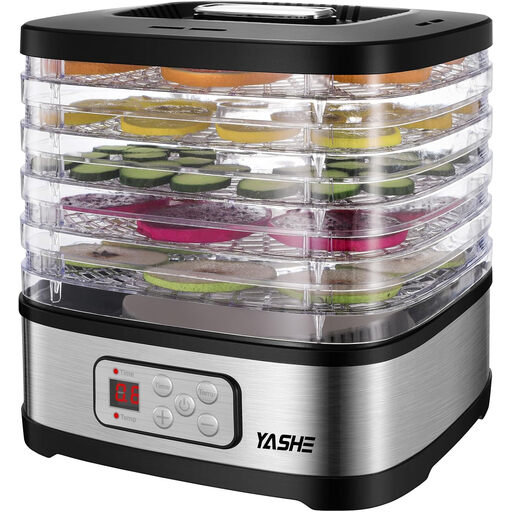
YASHE GGJ-261B Dehydrator, 35–70 °C, 72-hour timer
An option if you regularly dry fruit and want to keep your hob free while it's drying.
Five adjustable-height tiers; 35–70 °C; timer up to 72 hours; 240 W.
View at Joybuy
 No image available
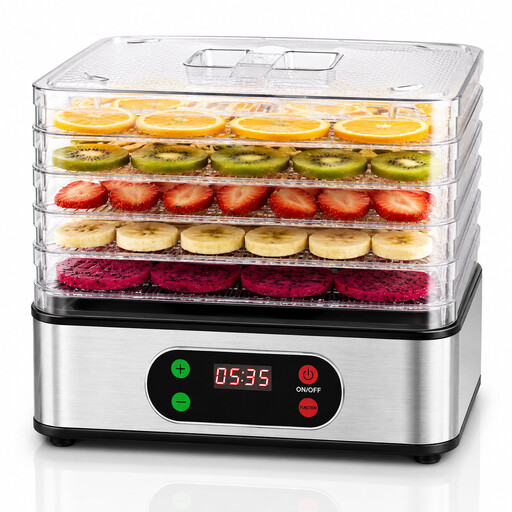
Dehydrator with LED display, 35–70 °C
An option if you want to dry fruit and set the temperature and running time.
Timer from 0,5 to 72 hours in 30-minute increments; 350 W; removable parts are described as dishwasher-safe.
View at Joybuy
 No image available
Havenwell Dehydrator with 10 Stainless Steel Trays, 48-hour Timer
An option if you want to dry larger batches of fruit at once and have room for an appliance with ten trays.
Adjustable temperature; timer up to 48 hours; 850 W. The trays are described as dishwasher-safe.
View at Joybuy
 No image available
Havenwell Dehydrator with 8 Stainless Steel Racks, 35–85 °C
An option if you want to dry several batches at once and check the slices as they dry.
Eight stainless steel racks; 35–85 °C; timer up to 48 hours; 650 W; touch display and interior light.
View at Joybuy
 No image available
WOOX Dehydrator with 5 Drying Trays and Timer
An option if you want to dry several apple slices on removable trays.
Five removable drying trays measuring 280 × 235 mm; timer and temperature control.
View at Joybuy
Frequently asked questions
How should I prepare apples, and how can I tell when they are dry?
The Federal Centre for Nutrition recommends removing the cores and cutting the apples into thin rings. Check the slices as they dry: according to the Federal Centre for Nutrition, they should still be slightly pliable and should no longer release juice when pressed firmly. Drying time also depends on factors such as the thickness of the slices.
Can I place a dehydrator right next to my only hob?
Follow the positioning and ventilation instructions for your specific appliance rather than assuming a standard clearance. For example, the instructions for the Steba ED 4 require the ventilation openings to be kept clear and specify minimum clearances.
How do I work out the electricity cost of a drying cycle?
Multiply the actual energy used by your drying cycle in kWh by your electricity price per kWh. The rated power alone doesn't show how much electricity a particular batch of apples will use.
What does the CE marking tell me about a dehydrator?
The Federal Network Agency describes the CE marking as a declaration made by the manufacturer under its own responsibility, rather than an independent quality mark. Also check that the specific appliance comes with clear instructions for use and safety.
How should I dispose of an old dehydrator?
Electrical appliances must not be put in household waste. The Federal Ministry for the Environment lists local collection points and retailers required to take back old appliances as possible places to dispose of them; the take-back rules that apply depend on the legal requirements.


