For a one-off small batch, you could start by using your existing oven. If you plan to dry fruit regularly or in larger quantities, a food dehydrator is an obvious alternative. Make your choice based on usable drying area, kitchen space and the available time and temperature settings. Remember to leave time before eating to check how dry the slices are. The German Federal Centre for Nutrition (BZfE) describes oven drying as energy-intensive and a food dehydrator as a simpler, more energy-efficient method. This does not, however, provide a cost comparison for specific appliances or batch sizes.
Who might be interested in a food dehydrator?
Hosts preparing lots of apple slices
If you’re preparing food for several people, usable drying area matters more than a high number of tiers alone. Area figures for individual models are provided by brands such as Rommelsbacher and GRAEF, but they don’t guarantee that a particular quantity of apples will fit.
People serving food at a set time
A timer can make it easier to plan the drying cycle, but you’ll still need to check the slices: their size and thickness affect how long they take to dry. The BZfE recommends checking how dry they are before packing them.
Occasional users with limited space
For an occasional small batch, you could first consider using your existing oven. If you dry food regularly, compare the dimensions and trays of the specific appliance with the space you have available. A manufacturer’s description of a model as compact doesn’t, by itself, prove that it has enough capacity.
What should you look for when choosing one?
Your existing oven
A good fit if: you only prepare a small batch occasionally and don’t want to buy an additional appliance.
Things to consider: The BZfE describes oven drying as energy-intensive. A cost comparison depends on the appliance, how often you use it and the batch size.
Compact food dehydrator
A good fit if: you regularly dry smaller quantities and have limited space for an appliance.
Things to consider: The number of trays and compact design don’t tell you how many slices will fit without overlapping.
Food dehydrator with pull-out trays
A good fit if: you regularly prepare larger quantities and want to fill or check individual tiers.
Things to consider: Drying area and tray count vary by model; they don’t tell you which appliance will dry apples faster.
First, decide whether buying an additional appliance makes sense for the way you’ll use it. Then compare the usable area, the space it will take up and how easy the specific model is to operate.
| What matters |
What to check before buying |
Who will find this useful? |
| Usable drying area |
Compare the stated area or tray dimensions with the batch you have in mind, not just the number of tiers. Rommelsbacher lists 0.5 m² and seven trays for the DA 650; GRAEF lists 0.65 m² and six racks for the DA506. |
If you’re preparing food for several guests, you’ll want to know whether all the slices will fit in one batch. Around 36% of consumers put usable area first. |
| Planning the time |
Check the adjustable running time and temperature. Allow plenty of time, as the BZfE notes that drying time depends, among other things, on the size and thickness of the pieces. |
If you want to bring the apple slices to a meal starting at a set time, you’ll need to allow time for the drying cycle and checking the slices. Around 29% of consumers prioritise being able to plan ahead. |
| Space and frequency of use |
For a one-off small batch, you could consider using your existing oven. If you’ll use a dehydrator regularly, check the appliance’s external dimensions and tray area separately. |
If you only dry food occasionally or have limited space, you’ll want to weigh up another appliance against the kitchen equipment you already have. Around 21% of consumers prioritise space or infrequent use. |
| Cleaning and carrying |
Check whether the trays can be removed and cleaned according to the instructions. Use clean containers that protect the slices from moisture when transporting them. |
If you’re bringing the slices for others, you’ll want trays that are easy to reach and a clean way to transport the snack. Around 14% of consumers prioritise cleaning and carrying. |
Common buying and usage mistakes
-
Assuming the number of tiers means it will fit a batch for your guests
Apple slices need space around them so air can circulate. Their size and thickness also affect drying time, so several tiers don’t guarantee that you’ll have enough for the evening.
Compare the usable area and tray dimensions with the batch you have in mind. If you have a set time to serve them, try a test batch and allow plenty of time.
-
Using the wattage as a direct guide to electricity costs
A power rating alone doesn’t tell you how much it will cost to dry a particular batch of apples. The BZfE describes the energy requirements of ovens and food dehydrators in general terms, not as a cost comparison between individual models.
To compare costs, you’ll need to use the same batch size and usage as your basis, along with the actual energy consumption and your electricity tariff.
-
Assuming the slices are ready when the timer ends
A preset running time doesn’t replace checking how dry the slices are. The BZfE describes properly dried food as still slightly pliable; pressing it firmly should not release any juice.
Check the slices before packing them. Use clean hands and work surfaces, and protect sufficiently dried pieces from moisture during transport.
Notable brands and product ranges
WMF KÜCHENminis Snack to go
An appliance option for smaller batches you prepare regularly.
- WMF lists five racks, a temperature range of 30–70 °C and a timer of up to 24 hours.
- The number of racks alone doesn’t tell you whether your planned batch of apple slices will fit.
Rommelsbacher DA 650
A tray-style appliance with a stated drying area and a longer adjustable running time.
- The manufacturer lists a drying area of 0.5 m², seven trays, a temperature range of 35–75 °C and a timer of up to 99 hours.
- These figures describe the model’s features; they don’t represent independently measured drying performance or guarantee a particular quantity of apples.
GRAEF DA506
A model with pull-out racks for regular use or larger batches.
- GRAEF lists six racks and a drying area of 0.65 m².
- The manufacturer’s figures for the minimum temperature differ. If this is an important factor in your choice, check the instructions for the exact version.
Steba ED 5
A model with trays that can be used individually and electronic timer control.
- Steba lists five trays that can be used individually, a temperature range of 40–70 °C and a timer that can be set for 1–36 hours.
- Check that the stated area is large enough for your batch and that the trays will fit in the space you have available.
Stöckli Dörrex
A stackable range of appliances with different features.
- Stöckli offers versions with metal or plastic racks, both with and without a timer.
- The features and specifications of one version don’t necessarily apply to every Dörrex model. Check the exact version before buying.
Food dehydrators at Joybuy
This selection at Joybuy includes food dehydrators for planning the drying time and drying fruit; trays and adjustable settings vary by model.
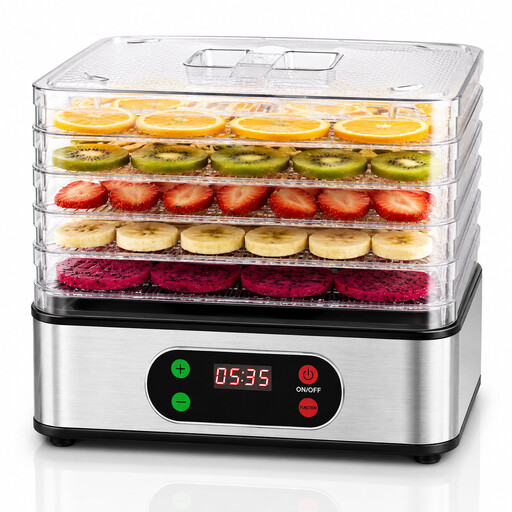 No image available
Food dehydrator with LED display, 35–70 °C, 0.5–72-hour timer, 350 W
For a drying cycle you can plan, with adjustable time and temperature.
Temperature: 35–70 °C; timer: 0.5–72 hours in 30-minute increments; power: 350 W. The tiers can be configured in different ways and are spaced 3.5 cm apart. Stated to be BPA-free.
View at Joybuy
 No image available
Havenwell food dehydrator with 8 stainless steel racks, 35–85 °C and 48-hour timer
For drying several racks at once with settings you can plan ahead.
Eight stainless steel racks; temperature range: 35–85 °C; timer: 48 hours; power: 650 W. Features a touch display and interior light.
View at Joybuy
 No image available
WOOX 5-tray food dehydrator with temperature control and timer
For an adjustable drying cycle with several removable trays.
Temperature range: 35–75 °C; timer: 72 hours. Five removable drying trays, each measuring 280 × 235 mm.
View at Joybuy
Frequently asked questions
How can I tell when the apple slices are ready?
According to the German Federal Centre for Nutrition, they should still be slightly pliable and should not release any juice when pressed firmly. Try to cut the apples into evenly sized slices, check them as they dry and don’t rely on the preset running time alone.
How should I prepare and bring the apple slices?
The BZfE recommends removing the cores and cutting the apples into thin rings. Use clean hands and equipment; protect sufficiently dried slices from moisture and contamination when storing and transporting them.
How can I compare electricity costs, and what should I do if the appliance is faulty?
To compare costs, use the same quantity of apples, actual usage and your electricity tariff as a basis; a wattage figure alone won’t give you a cost calculation. If a product is faulty, distinguish your statutory rights against the seller from any voluntary guarantee.
Do commercial food hygiene rules apply to a bring-and-share meal?
EU Hygiene Regulation 852/2004 excludes the domestic preparation, handling and storage of food for private domestic consumption from its scope. The name “bring-and-share meal” alone doesn’t establish whether a publicly organised or regularly catered event has additional obligations; even food provided free of charge may be relevant under the law. Check with your local food safety authority about these types of event, and follow good hygiene practices regardless.


