People sharing a space with limited room
If you need to keep walkways and work surfaces clear while your aprons dry, compare the airer’s dimensions when in use with a wall-mounted option, and check how much storage space it needs afterwards.


Choose a clothes airer based on how many aprons you need to hang at once, how long they need to stay there and how much floor space must remain free while they dry. A folding airer provides a spread-out hanging area, while a tower airer takes up space differently; a wall-mounted option requires a suitable place for installation. Before using heat, check the care labels on your aprons and the appliance instructions. Heat is no substitute for ventilation, and you should compare the power rating with the actual running time. If you don’t need to save time, an unheated airer uses no electricity for a heating function.
If you need to keep walkways and work surfaces clear while your aprons dry, compare the airer’s dimensions when in use with a wall-mounted option, and check how much storage space it needs afterwards.
If you want to hang several aprons separately at the same time, check the usable rails, height and spacing rather than comparing only the number of heated bars.
If you’re keeping an eye on room humidity and electricity use, factor in ventilation options as well as the heating function’s running time and power rating.
A good fit if: you want to hang several aprons side by side and have enough floor space available while the airer is in use.
The trade-off: When unfolded, it takes up space in the communal area; folded away, it needs less storage space.
A good fit if: you have a narrow space available rather than a low ceiling.
The trade-off: Check that long aprons can hang freely between the tiers; its height may still be a consideration when folded away.
A good fit if: you need to keep the floor clear and installation, including an electrical connection, is permitted and suitable at the chosen location.
The trade-off: It needs to be installed and connected; unlike a portable airer, it can’t be put away after each use.
A good fit if: your aprons can dry without a time constraint and you have somewhere to hang them and a way to ventilate the room.
The trade-off: It may occupy the communal area for longer, and you’ll also need to remove the moisture released into the room as the aprons dry.
| What matters to you | What to look for when buying | Who is this especially important for? |
|---|---|---|
| Floor space and shared use | Dimensions when in use and when folded away; consider the installation method only if the location is suitable and installation is permitted. | If walkways and work surfaces need to stay clear, consider how much space the airer takes up while in use. Around 36% of consumers put floor space first. |
| Hanging space for aprons | Rail layout and spacing for several aprons; height and clearance from the floor for longer items. | If you want to hang several aprons separately at once, check the length and spacing of each tier. Around 29% of consumers prioritise usable hanging space. |
| Humidity, fabrics and safe use | Ventilation options in the room, along with care labels, appliance instructions and the electrical connection. | If care instructions, room humidity or safe operation are key to your decision, consider how you’ll use the airer in your particular setting. Around 21% of consumers prioritise these conditions of use. |
| Electricity use | Consider the rated power and planned running time together; take your electricity tariff and unheated drying into account. | If you’re weighing ongoing costs against a potential time saving, work out the electricity use from the power rating and running time. Around 14% of consumers prioritise running costs. |
The number of heated bars doesn’t tell you whether several aprons can hang at full length with enough space between them.
Measure your aprons and compare their length with the tiers and the space available.
As clothes dry, moisture enters the room; heat doesn’t automatically remove it from the air.
Whatever the design, make sure you have a way to ventilate the room appropriately.
The power rating in watts alone doesn’t tell you how much electricity a full drying cycle will use. Running time and your electricity tariff also matter.
Compare the options using the same assumed running time and your tariff. Include unheated drying if you have enough time.
Adler offers heated folding airers in a range of designs.
Silvergear offers a heated tower airer with a heat cover as an alternative to a wide folding airer.
Foxydry Pro is a wall-mounted airer that lowers by motor and uses room air or warm air.
The following portable electric drying options include a folding heated clothes airer and a portable electric clothes dryer with an adjustable frame.
 No image available
The folding design and central drying area with two fold-out side wings may suit you if you want to hang several items in separate sections.
The title gives a heating range of 45–55 °C; the description lists a power rating of 230 W and a load capacity of up to 10 kg.
Before buying, check the care labels on your aprons and the safety and product documentation for this model.
 No image available
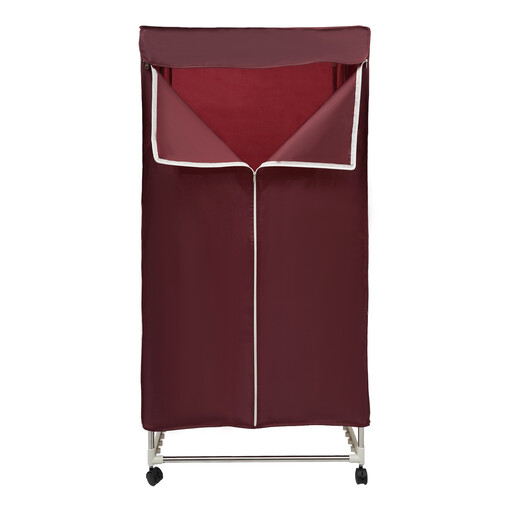
The adjustable frame, with one or two tiers, may be useful for items of different lengths; check that your aprons can hang freely on it.
The description lists 1,200–1,500 W, four timer settings and an adjustable frame. The title describes the appliance as foldable.
Before buying, check the care labels on your aprons and the safety and product documentation for this model.
No. As clothes dry, moisture enters the room air; the German Environment Agency recommends taking particular care to ventilate regularly when drying wet laundry indoors. The right ventilation option depends on the room.
No, there’s no one-size-fits-all answer. Check the care label on each apron and the airer’s instructions before using heat.
Multiply the rated power in kilowatts by the assumed running time in hours, then multiply that figure by your gross price per kilowatt-hour. This is a calculation based on the assumed running time and rated power, not a measured energy figure for each apron dried.
For new electrical equipment covered by the 1. ProdSV, the required conformity assessment procedures, an EU Declaration of Conformity from the manufacturer and CE marking apply. According to the German Federal Institute for Occupational Safety and Health, CE is not an independent safety certification mark. Whether the rules apply to a particular appliance depends, among other things, on its intended rated voltage.
Don’t put it in your household rubbish. The German Environment Agency lists recycling centres and suitable in-store take-back schemes for old electrical appliances.