
Lieferung heute & morgen

Qualitätsgarantie

Willkommens-Angebote freischalten: KOSTENLOSE Lieferung | Bis zu 80 % RABATT | Kostenlose 30-Tage-JoyPlus-Testphase
App herunterladen
An armchair should suit the room, your height and how you plan to use it. If you simply look for the cheapest model or the softest padding, you can easily overlook important details. When buying an armchair, disappointing purchases are usually caused by three common pitfalls:
The right choice should therefore be based on verifiable information such as dimensions, weight capacity, materials, adjustment range and care requirements.
Do not compare only the width and height. With a recliner, TV chair or armchair with a footrest, the depth when reclined is particularly important. A model with a basic depth of 90 to 100 cm may require considerably more space when extended.
Compact models are suitable for small flats, reading corners or a home office. Wide recliners, on the other hand, need sufficient clearance from furniture and walls. You should also check:
A metal or steel frame can provide a sturdy base for a recliner. However, the stated maximum weight capacity and secure assembly remain crucial. With foam padding, check the product information for its density. A soft surface does not necessarily mean lasting seating comfort.
Faux fur, chenille, corduroy and other textile upholstery differ in feel and care requirements. Pet owners should check whether the manufacturer states that the upholstery is wipe-clean or particularly hard-wearing. Avoid harsh cleaning products when dealing with delicate fabrics.
An electric recliner with two motors can adjust the backrest and footrest independently. This allows more precise positioning than a simple mechanism. However, you need to take the power connection, cable routing and moving parts into account. Children should not use electric recliners unsupervised.
A manual recliner is generally operated using a lever or pull ring. It does not require electricity and usually has a simpler construction. Check the actual adjustment range, which side the controls are on and whether the footrest can be fully returned to its original position.
With a swivel armchair or rocking chair, the base, brakes and freedom of movement are important. A garden armchair or sun lounger also requires a suitable, level surface and regular care appropriate to the material.
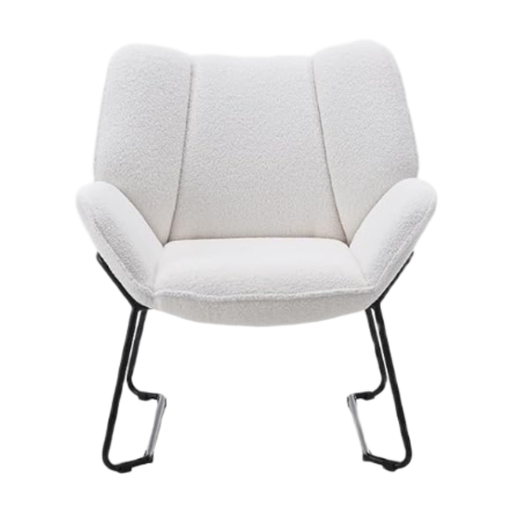
Why this product suits the profile: This compact armchair measures 67 × 71.5 × 80 cm and is suitable for living rooms, bedrooms or balconies. The seat height is 40.5 cm.
The product details specify the overall dimensions, seat height and maximum weight capacity of 120 kg. This makes it easier to check whether the armchair will fit the available space before buying.
Metal frame with a powder-coated finish, armrests and high-density foam padding; assembly with the included tools.
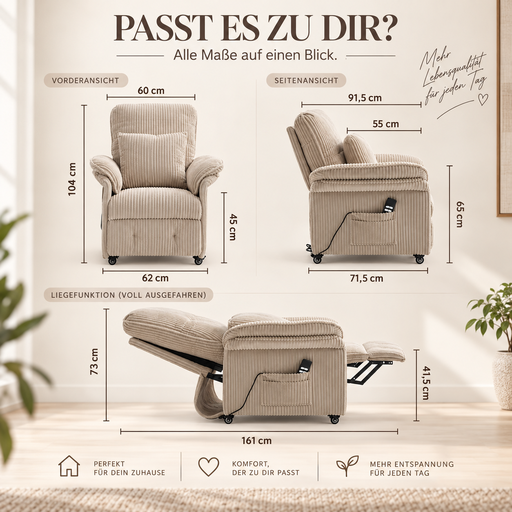
Why this product suits the profile: Two separate motors allow the backrest and footrest to be adjusted independently. This makes it suitable for regular reading, watching television or relaxing in the living room.
The adjustment range is clearly specified as 95° to 175° for the backrest and 90° to 180° for the footrest. The rear castors can be locked.
Steel frame, high-density foam, four 360° castors and two side pockets. The maximum weight capacity is 200 kg.
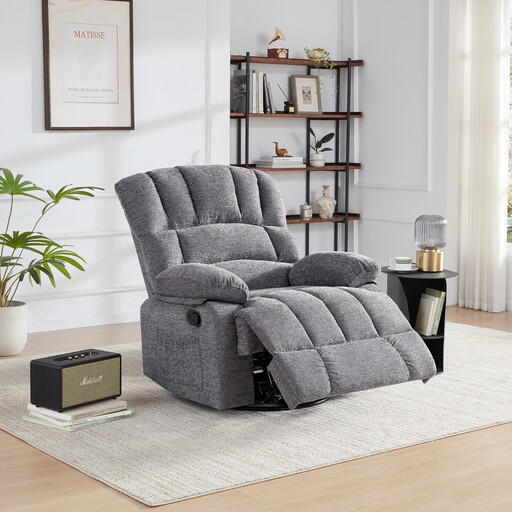
Why this product suits the profile: This wide armchair combines a 360° swivel function, a manual reclining position of up to 160° and a rocking motion of up to 30°. It is designed for longer periods of sitting in the living room or bedroom.
The basic dimensions of 105 × 94 × 103 cm and the extended depth of 164 cm make the required space clear. The stated weight capacity is 350 lb.
Wide seat, padded armrests and tool-free assembly using plug-in connections.
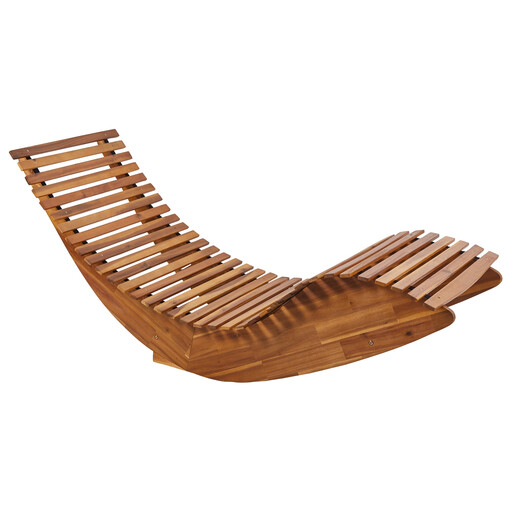
Why this product suits the profile: This curved acacia wood sun lounger is designed for patios, gardens or poolside areas and provides a gentle rocking motion.
The maximum weight capacity of 120 kg, the depth of 176 cm and the lack of a folding function are clearly stated. This makes it easier to plan the space required for use and storage.
Acacia wood with an oiled finish, a width of 60 cm and a product weight of 13 kg. Care involves using mild cleaning products, wiping dry afterwards and re-oiling regularly.
We have put together a complete, regularly updated list of products that fully meet these strict selection criteria and the safety regulations applicable in the EU.
Before using the armchair for the first time, check all screws, plug-in connections and castors. The armchair must be placed on a level, stable surface. With an electric model, cables must not run underneath the frame or enter the movement area. Lockable castors must be locked during use.
For fabric upholstery, spot cleaning with a slightly damp cloth and mild cleaning product is often sufficient, provided this is permitted by the manufacturer’s care instructions. Acacia wood should be protected from prolonged moisture and re-oiled according to the manufacturer’s instructions.
The running costs of an electric recliner depend on how long it is used, motor power and the electricity tariff. For an accurate estimate, you need the power consumption of the specific model. A manual recliner does not incur electricity costs, but its mechanism and upholstery should be checked regularly for signs of wear.
As well as the floor space, you should allow for the armchair when fully extended. Depending on the model, its depth can increase considerably. You should also keep the movement areas required for the footrest, swivel function or rocking mechanism clear.
An electric recliner offers separate, stepless adjustment of individual sections, but requires a power connection. A manual recliner does not depend on the mains and is generally simpler to operate. The right choice depends on the level of adjustment comfort you want and where the armchair will be placed.
It is not possible to give a reliable general lifespan. It depends on daily use, load, frame construction, padding, upholstery and care. Before buying, check the maximum weight capacity, assembly instructions and available care information.