
Lieferung heute & morgen

Qualitätsgarantie

Willkommens-Angebote freischalten: KOSTENLOSE Lieferung | Bis zu 80 % RABATT | Kostenlose 30-Tage-JoyPlus-Testphase
App herunterladen
Whether you are into illustration, journaling, calligraphy, schoolwork or ambitious art projects, art supplies cover a wide range of product types with very different properties. However, a large number of colours alone says little about how practical a set is for everyday use. The key factors are the ink base, nib shape, lightfastness, paper compatibility and suitable storage.
A set with 60 or 72 colours may look comprehensive at first glance. Even so, check whether the palette suits your project. For portraits, graduated skin tones may be more useful than numerous very similar shades. For landscapes or architectural drawings, on the other hand, you may need a wider range of greens, greys and earth tones.
Watercolour markers and watercolour pencils often contain water-soluble pigments or inks. This is desirable for gradients and washes, but can lead to changes if the work is exposed to moisture afterwards. Fineliners with water-resistant ink are more suitable for outlines that need to remain stable when painted over. You should therefore read the information on water resistance carefully before buying.
Brush pens create variable line widths depending on the pressure applied. However, they do not automatically replace a fineliner or a marker with a broad chisel tip. If you regularly draw small details, you need a precise nib. Flexible brush tips or broader markers are more efficient for large areas of colour. Storage is also important: many markers should be stored horizontally and closed securely after use.
With markers and brush pens, you should distinguish between water-based, alcohol-based and pigmented ink. Water-based inks are usually low-odour and can sometimes be blended with water. However, they may bleed through thin paper or run when exposed to moisture.
For art pencils, lightfastness, opacity and layering ability are also important. According to the product information, Faber-Castell Polychromos coloured pencils feature an oil-based core, water and smudge resistance, as well as high lightfastness. Such information should always be understood as a product characteristic stated by the respective manufacturer, rather than a general guarantee for every artwork.
Pay attention to specific measurements. With the Ohuhu Brush Pens, one pen combines a 0.4-mm fineliner tip with a flexible brush tip. This makes it easier to switch between outlining and applying colour over larger areas. According to the product information, the Ohuhu Fineliner Set covers line widths from 0.05 to 1.0 mm, as well as including a brush tip.
Watercolour pencils generally have a firm core that can be used dry like a coloured pencil and then activated with water. A core with a 3.8 mm diameter offers different stability and colour distribution from very thin school pencils.
Markers, watercolour pencils and pastel pencils do not all require the same type of paper. For water-soluble techniques, watercolour or mixed-media paper is generally more suitable than thin copier paper. With fineliners, smooth drawing paper can improve line control.
A pencil case or sturdy box protects nibs and cores. Stable packaging is particularly useful for pastel pencils and charcoal, as soft materials are more likely to break or create dust. For travelling, roll-up cases and compact cases are practical, while larger sets with metal boxes may also be suitable for studio use.
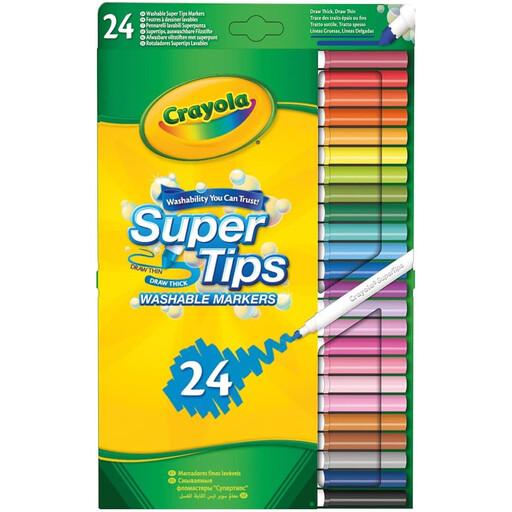
Why this product suits this profile: This set is suitable for first drawing exercises, schoolwork and creative activities on a manageable scale. According to the product information, the markers are washable and intended for children aged four and over.
The product description specifies a tip for fine and bolder lines, as well as washable ink. This makes the essential application properties clearer than with unlabelled mixed sets.
24 coloured markers, variable lines depending on how the pen is held and washable ink according to the product information.
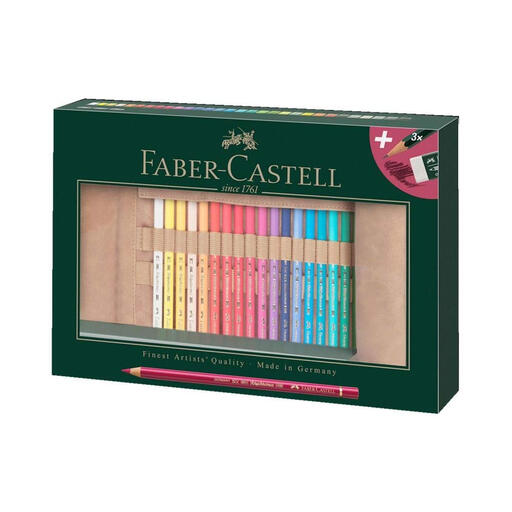
Why this product suits this profile: This set is aimed at illustrators, ambitious hobby artists and users who want to work with layers, fine details and dry blending techniques.
The product details specify the core, hardness properties, lightfastness and water resistance. This makes it easier to choose materials suitable for drawings intended to be kept for the long term.
30 Polychromos coloured pencils, 3 additional CASTELL-9000 pencils, an eraser and a carrying case.
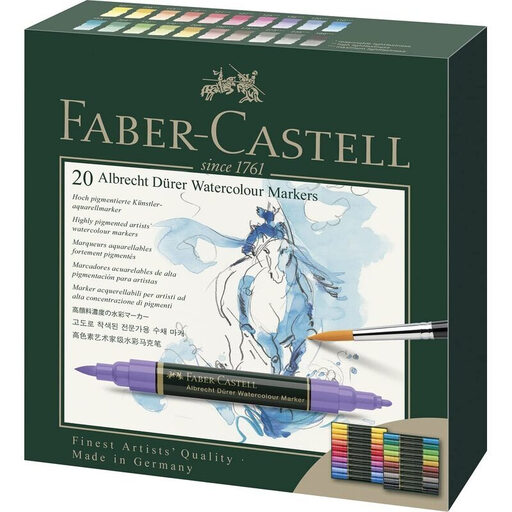
Why this product suits this profile: For watercolour sketches, urban sketching and mobile drawing projects, this set offers two tips per marker and compact storage.
The product description explicitly mentions water-soluble ink, watercolour paper and two different tips. This makes it easier to match the technique, paper and desired line control.
20 watercolour markers, brush and fibre tips, plus water-based, water-soluble ink according to the product information.
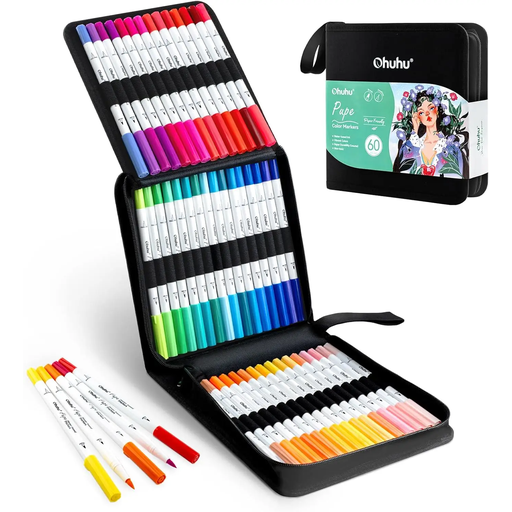
Why this product suits this profile: The combination of a fineliner and brush pen is suitable for hand lettering, calendar design, note-taking and colourful illustrations.
The tip sizes of 0.4 mm and 1–5 mm are specified. The pens are also described as using water-based ink that can be blended on suitable paper.
59 colours plus a colourless blender, two tips per pen and a storage case according to the product description.
We have put together a complete, regularly updated list of products that fully meet these strict selection criteria and the safety regulations applicable in the EU.
For outlines and technical drawings, fineliners with clearly defined line widths are suitable. Pastel pencils and charcoal, on the other hand, create soft transitions and often require fixative and a protected work surface. With pastel materials, you should also consider dust production and the stability of the core.
Children’s colouring pencils and washable markers should be bought with information on age suitability, warnings and the type of ink. Small caps can pose a choking hazard. According to the product information, sets such as the CRAYOLA SuperTips include a case and paper, which can be practical for school, travel and craft projects.
Watercolour pencils and watercolour markers with water-soluble ink or water-soluble pigments are designed for this purpose. Where possible, use watercolour paper and test the colour reaction on a scrap at the edge first.
Their lifespan depends on use, paper, the cap and storage. Close each pen immediately after use and store water-based markers according to the manufacturer’s instructions, often horizontally. Heavily used brush tips may wear out sooner, regardless of how much ink remains.
The price mainly depends on pigment quality, the number of colours, tip construction, accessories and packaging. A smaller set is often sufficient for occasional drawing. If you illustrate regularly, it is better to look for refillable colours, lightfastness, suitable paper types and replacement tips.