
Lieferung heute & morgen

Qualitätsgarantie

Willkommens-Angebote freischalten: KOSTENLOSE Lieferung | Bis zu 80 % RABATT | Kostenlose 30-Tage-JoyPlus-Testphase
App herunterladen
An articulating borescope is an indispensable diagnostic tool for anyone needing precise views into hard-to-reach areas—whether in an engine bay, inside air conditioning units, or behind walls. However, the market is flooded with models whose specifications often overpromise and underdeliver. Making the wrong choice not only leads to inaccurate diagnoses but also to unnecessary expenses. This guide will help you identify the crucial features and avoid common purchasing pitfalls.
Many users invest in a device that proves to be useless in practice. Pay close attention to these three pitfalls to avoid a poor investment:
To ensure your articulating borescope meets the demands of your projects, you should carefully examine the following technical features. These determine the device's functionality and utility in daily work.
The diameter of the camera probe is one of the most important criteria. For an automotive borescope camera, especially for inspecting combustion chambers, the diameter should be smaller than the spark plug hole (typically under 8.5 mm). Probes with a diameter of 5.5 mm or 6 mm offer high compatibility here. The length of the probe, often a flexible cable, determines its reach. For work on vehicles or HVAC systems, lengths between 1 and 1.5 meters are usually sufficient.
The mobility of the camera head is the core feature of an articulating borescope. A two-way articulating borescope allows the probe tip to be moved in two opposite directions (e.g., up and down) via a control wheel on the handle.
A clear image is essential for a reliable diagnosis. Don't rely solely on the megapixel count.
Instead of presenting a confusing list, we have selected one model that is well-suited for a specific type of user.
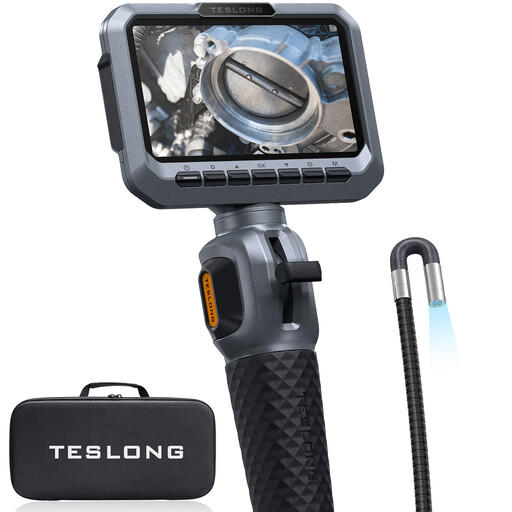
Why This Fits Their Persona: This Teslong borescope is designed for professional auto mechanics, HVAC technicians, and industrial mechanics who need a reliable tool for daily diagnostics. The combination of precise control and high-quality imaging enables efficient and accurate inspections.
With a 210° articulation angle, it bypasses the limited-view trap. The slim 5.5 mm probe fits into tight access points, while the 5-inch IPS display and bright LEDs ensure clear images even in dark areas.
The two-way thumbwheel control allows for intuitive and precise handling. The device is a standalone unit (no smartphone needed) and comes with a rugged carrying case.
We've compiled a complete, up-to-date list of products that fully meet these strict selection criteria and German safety regulations.
For inspecting engine cylinders through the spark plug hole, a probe diameter of less than 8.5 mm is required. When in doubt, measure the inner diameter of the opening. A 5.5 mm or 6 mm model is a safe bet for most modern petrol engines. For other areas, such as inspecting body panels or behind the dashboard, a thicker probe may also be suitable.
A two-way articulating borescope can be steered in two directions (e.g., up/down). This is sufficient for most linear inspections, such as in pipes or cylinders. A four-way borescope offers additional freedom of movement (up/down and left/right). These models are often more expensive and are needed for very complex inspections requiring multi-directional navigation in large cavities.
An inspection camera with a screen offers significant advantages in terms of usability. It is a standalone tool that is ready to use immediately. You don't have to worry about app compatibility, Wi-Fi connection drops, or your smartphone's battery level. For professional and regular use, a device with an integrated monitor is the more reliable and efficient solution.