
Lieferung heute & morgen

Qualitätsgarantie

Willkommens-Angebote freischalten: KOSTENLOSE Lieferung | Bis zu 80 % RABATT | Kostenlose 30-Tage-JoyPlus-Testphase
App herunterladen
By: Joybuy Product Recommendation OfficerDate: August 30, 2026
For professionals in automotive engineering, aviation, or industrial maintenance, a clear and unrestricted view into hard-to-reach areas isn't an option—it's a necessity. An articulating industrial endoscope is a critical tool for this purpose. However, the market is saturated with a confusing variety of options, and not every device lives up to its marketing promises. This guide will help you avoid common purchasing pitfalls and make an informed decision.
Many users invest in a device that quickly proves inadequate for professional use. Two problems are particularly common:
To avoid a poor investment, you should verify three core technical parameters before purchasing. These factors are crucial in determining the performance and longevity of your tool.
The key function of an articulating endoscope is its manoeuvrability. Two aspects are critical here:
Image quality depends directly on the sensor in the probe tip. A high-resolution display is of little use if the data source is weak.
The cable, also known as the probe or insertion tube, must be able to withstand the conditions of the operating environment.
Based on these criteria, we have selected devices suitable for different professional requirements.
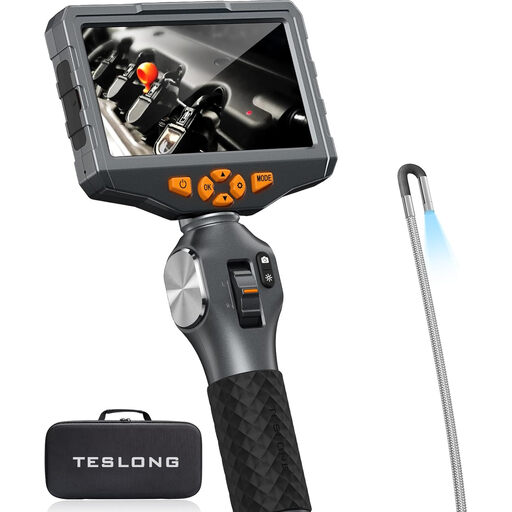
Why This Fits Their Persona: Ideal for users who work in extremely tight spaces like modern engines, turbines, or electronic components and require precise control around corners. The very small probe diameter is the decisive factor here.
The device features a robust articulation mechanism, controlled directly from the handle, which enables precise, lag-free movement, thus avoiding the pitfall of unstable joints.
3.9 mm probe diameter for minimally invasive inspections. 210° bidirectional articulation for a comprehensive view. 2.0-megapixel sensor for clear images.
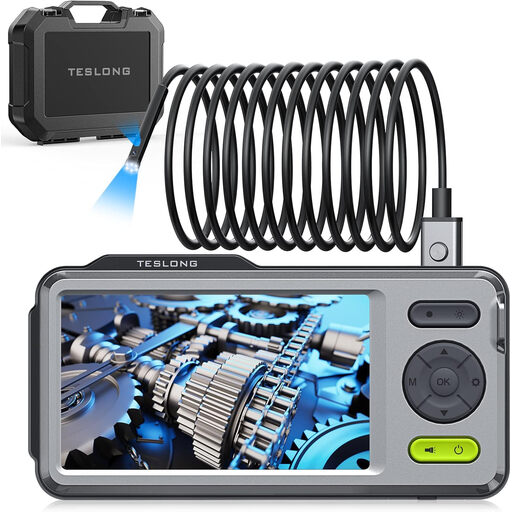
Why This Fits Their Persona: A practical choice for users who don't need full articulation but want a reliable forward and side view. Well-suited for inspecting pipes, drains, or straight cavities.
This model forgoes a mechanical joint, instead using a second, side-facing camera. This eliminates the risk of mechanical failure at the joint while still providing a 90-degree view.
Dual-lens system for quickly switching between front and side views at the push of a button. Large 5-inch IPS screen for a clear and direct display.
We have compiled a complete, real-time list of products that fully satisfy these strict selection criteria and UK safety regulations.
1. How long does the articulation mechanism on an industrial endoscope last? The lifespan heavily depends on the quality of the construction and its usage. On high-quality models designed for professional use, the mechanism is engineered for many thousands of bending cycles. For more affordable devices, the lifespan can be significantly shorter. Proper handling, where the joint is not forced beyond its maximum angle, is crucial for longevity.
2. Can I use an automotive endoscope to inspect engine cylinders with residual fluids? Yes, provided the device has the appropriate protection rating. An IP67 certification means the probe is protected against dust ingress and temporary immersion in water. This typically includes resistance to oils and fuels. However, it is recommended to carefully clean the probe after each use in liquids to preserve the materials.
3. Is a higher resolution always better for an inspection camera? Not necessarily. A high resolution is only beneficial if the camera sensor and optics are also of high quality. A 2.0-megapixel sensor generally delivers sharper and more detailed images than a 1.0-megapixel sensor. However, an extremely high resolution on a small sensor can lead to increased image noise in low-light conditions. More important than the raw pixel count is a balanced system of sensor, optics, and illumination that delivers a clear, noise-free image.