
Lieferung heute & morgen

Qualitätsgarantie

Willkommens-Angebote freischalten: KOSTENLOSE Lieferung | Bis zu 80 % RABATT | Kostenlose 30-Tage-JoyPlus-Testphase
App herunterladen
An artificial Christmas tree promises a festive atmosphere without the falling needles and annual disposal hassle. However, the sheer number of options can quickly become overwhelming. Many buyers only realise after unboxing that their tree doesn't meet their expectations. To help you make the right choice, we'll highlight the most common pitfalls and show you which features truly matter.
The disappointment after buying a new tree can often be traced back to three recurring problems caused by non-transparent product descriptions.
plastic Christmas tree stand or a poorly constructed metal one can easily tip over, especially when the tree is decorated.To avoid these pitfalls, you should focus on a few objective criteria. These will help you evaluate a model's quality, independent of marketing claims.
A tree's density is the most important criterion for a natural look. A high number of tips is the key indicator here. For example, an artificial Christmas tree 180 cm should have at least 800 tips to ensure good fullness. Larger models require correspondingly more. Most trees are made of PVC (polyvinyl chloride), a durable and flame-retardant material that offers a good balance between cost and quality. Finding a dense artificial fir tree means putting the number of tips in relation to the height.
A solid base is essential. A Christmas tree with a foldable stand made of metal generally offers significantly more stability than simple plastic stands. Look for rubber caps on the feet to prevent scratches on the floor. There are two common assembly systems: the hinged system, where branches are attached to the trunk and just need to be folded out, and the hook-in system, where branches are attached individually. Hinged systems are typically faster and easier to set up.
Modern artificial fir trees offer a variety of designs. An artificial Christmas tree with lights saves you the tedious task of stringing light chains. Models like a flocked artificial Christmas tree or a white artificial Christmas tree create a special winter atmosphere and add specific decorative accents.
Based on the quality features mentioned, we have compiled a few models for different needs and preferences.
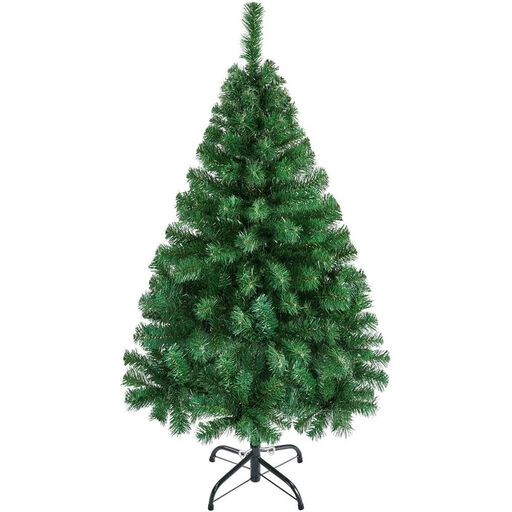
Why This Fits Their Persona: Ideal for apartments with limited space or as a secondary tree. Its compact 124 cm size and straightforward assembly make it a practical choice for anyone looking for a simple, reusable solution.
Despite its small size, it comes with a foldable metal stand, which is superior to the wobbly plastic stands typical of smaller models and ensures a secure base.
Very space-efficient storage thanks to its collapsible design and foldable stand. Quick assembly in just a few minutes.

Why This Fits Their Persona: Perfect for those who prefer a wintry, snow-covered aesthetic. The combination of flocked branches and real pinecones creates an atmospheric look that requires little additional decoration.
With 920 tips on a 180 cm frame, this tree offers high density, avoiding the sparse patches common in many flocked models. The flocking is applied durably.
Pre-decorated with real pinecones for a natural appearance. The flame-retardant PVC material provides added safety.

Why This Fits Their Persona: For anyone seeking a large, impressive tree with maximum density. With its stately height of nearly 2.20 m, it fills tall rooms and becomes the centrepiece of any holiday decor.
With an exceptionally high count of 1446 tips, this tree looks extremely full, leaving no visible gaps. The hinged branch system significantly simplifies the assembly of this large tree.
Very dense and luxurious appearance. The sturdy, foldable metal stand with non-slip rubber feet ensures a secure base, even when fully decorated.
A sturdy stand is the foundation of any Christmas tree. If your current stand is no longer secure or you're looking for a more robust alternative, we have the right solutions for you.
The lifespan of an artificial Christmas tree depends heavily on the material quality and how it's stored. A high-quality model made of durable PVC with a sturdy metal stand can easily last 10 years or more with careful handling and storage in a dry, dark place.
The secret to a bushy tree is to carefully fan out the branches, a process also known as "fluffing." After assembly, start with the bottom branches and work your way up. Pull each individual small branch away from the main stem and bend it in different directions—up, down, and to the side. This creates volume and closes gaps to the central pole.
PVC tips (polyvinyl chloride) are the classic option. They are made from flat sheets of plastic cut into strips, resembling the structure of a bottle brush. They are cost-effective and very durable. PE tips (polyethylene) are made using an injection-moulding process that mimics the shape of real fir needles. They look and feel more realistic. Many trees combine both materials: PE tips on the outer, visible branches for a natural look, and PVC tips on the inside to provide fullness and density.