
Lieferung heute & morgen

Qualitätsgarantie

Willkommens-Angebote freischalten: KOSTENLOSE Lieferung | Bis zu 80 % RABATT | Kostenlose 30-Tage-JoyPlus-Testphase
App herunterladen
An artificial mini Christmas tree fits on sideboards, desks, windowsills or mantelpieces and takes up considerably less space than a large tree. Models with integrated lights, battery operation and a snowy winter finish are particularly popular. However, product images and marketing wording can conceal important details.
If you focus only on the height or number of LEDs before buying, you can easily overlook a base that is too small, an impractical cable system or flocking that sheds fibres whenever it is touched. The following criteria will help you choose a small Christmas tree that suits your space and intended use.
A 90 cm tree can take up considerably more floor or surface space because of its spreading branches and pot or concrete base. Always check the stated measurements for height, diameter and base. For a narrow windowsill, a compact diameter is often more important than a taller tree.
A mini Christmas tree with LED lights may feature warm white or cool white lights, mains operation or battery power. What matters is whether the lighting is convenient to use in everyday life. A timer or dimmer can be practical on a larger model. For a tabletop Christmas tree without a nearby socket, however, a battery compartment with an easily accessible switch is more important.
Also check whether batteries are included. Several products, for example, require three AA batteries, which must be purchased separately.
A snow-frosted mini Christmas tree creates a wintry look, but heavy rubbing or frequent repositioning can cause it to shed flocking fibres. Built-in pine cones and berries save you from adding extra decorations, but they limit the scope for personal styling. Small parts should also be kept out of the reach of children and pets.
For an artificial Christmas tree in a pot or a tabletop tree, the base should be proportionate to the height. A 90 cm tree needs a level, stable surface and should not be placed near an edge. Concrete or metal bases may be heavier and therefore more stable than lightweight plastic feet. Even so, no base can reliably prevent a tree from toppling if children or pets pull on the branches.
Measure the following before ordering:
A battery-operated Christmas tree can be placed independently of a power socket, making it suitable for windowsills, hallways or offices. However, there are ongoing costs when the batteries need replacing. If the tree will not be used for an extended period, remove the batteries to prevent damage caused by leakage.
Mains-powered models require a socket and a neatly routed cable. Use only the supplied power adapter and switch the lights off when leaving the room or going to sleep. For indoor use, also follow the manufacturer's instructions regarding use in dry environments.
Plastic branches made from PVC or PE are easy to care for and can usually be shaped carefully. With a model featuring integrated LEDs, do not modify or attempt to repair the electrical components yourself. Also check whether additional baubles or hanging decorations are intended and what maximum load the manufacturer specifies.
Warm white LEDs usually create a subtle effect in living rooms and bedrooms. A Christmas tree with many LEDs may be suitable for larger spaces, while fewer lights will feel less overpowering on a small table.

Why this product suits this profile: At 60 cm high, this compact tabletop Christmas tree is ideal for smaller surfaces, offices or bedrooms. It runs on three AA batteries, which are not included.
The stated overall height and concrete base make it easier to plan the required surface space. The required batteries are clearly specified.
60 cm height, 35 warm white LEDs, flexible PVC branches and a sturdy concrete base.

Why this product suits this profile: This 90 cm model combines a pot-style base, snow-frosted branches and 50 warm white LEDs. It is designed for decorative indoor placement, so the surface should be chosen carefully.
The product data lists the height, number of tips, number of LEDs, metal stand and protective mat. This makes it easier to assess the specification before buying.
355 tips, 50 warm white LEDs, snow-frosted appearance and a metal stand with protective mat.
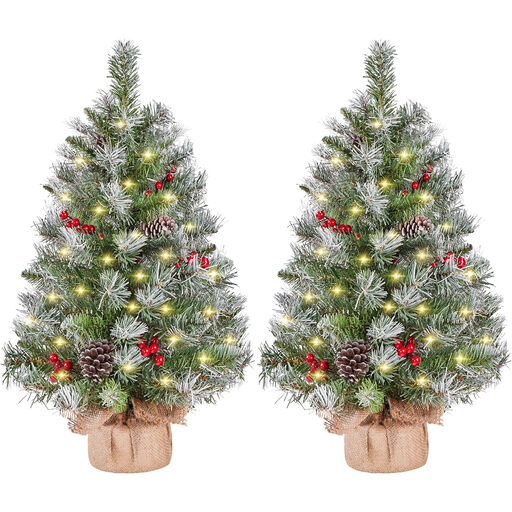
Why this product suits this profile: The two 92 cm trees can, for example, be used in pairs by windows, on two sideboards or in entrance areas. Both feature battery operation, flocking, berries and pine cones.
The specification is given for each tree: 50 LEDs, three AA batteries and an individual base per tree. This makes it easier to plan the ongoing requirements for both locations.
Set of two trees, 100 warm white LEDs in total, 20 real pine cones and 70 artificial berries.
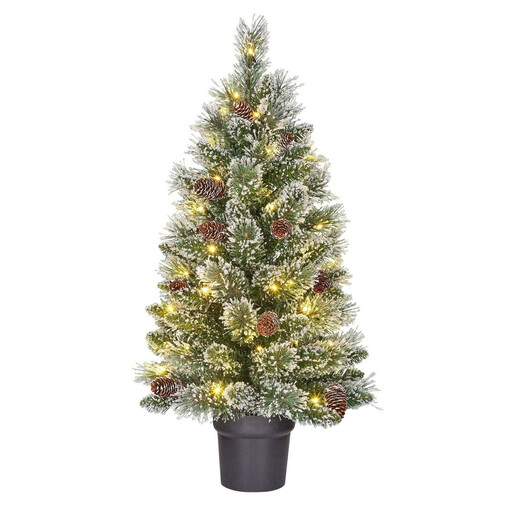
Why this product suits this profile: At 90 cm high and with a diameter of 48 cm, this model is suitable for flexible placement on the floor or a larger piece of furniture. The integrated LEDs are battery-operated.
The height and diameter are clearly specified. The product information also points out that flocking fibres may shed and that the tree must be placed on a stable surface.
90 cm height, 48 cm diameter, 96 tips, 40 integrated LEDs and a pot-style base.
We have put together a complete, regularly updated list of products that fully meet these strict selection criteria and the safety regulations applicable in the EU.
Place the tree on a level, dry and stable surface. Carefully spread out the branches, starting at the bottom. With flocked models, avoid rubbing the fibres too vigorously. Keep the tree away from candles, radiators, naked flames and other heat sources.
The actual lifespan depends on use, storage and the design of the tree. With many products, integrated LEDs cannot be replaced individually. For this reason, check the cables, battery compartment and switch for visible damage before each season. Remove the batteries during extended storage and keep the tree dry and protected from direct sunlight.
The cost depends on the number of LEDs, how long the lights are switched on each day and the type of battery used. A tree with 35 LEDs may have different power consumption from a model with 50 LEDs when used for the same amount of time. If available, a timer reduces the daily operating time. For products without a timer, switching the lights off manually helps avoid unnecessary battery consumption.