
Lieferung heute & morgen

Qualitätsgarantie

Willkommens-Angebote freischalten: KOSTENLOSE Lieferung | Bis zu 80 % RABATT | Kostenlose 30-Tage-JoyPlus-Testphase
App herunterladen
Artificial plants and flowers are a practical way to decorate homes, offices, entrance areas or events all year round. They need neither watering nor a suitable spot with natural daylight. However, materials, dimensions, fastening methods and finishing details can vary considerably. If you buy based solely on photos or the word “realistic”, you may end up with a product that looks too small in its intended location, stands unstably or is difficult to arrange.
An artificial plant can look larger in a product photo than it does in a real room. So check the height, width, pot diameter and, where applicable, the length of individual stems. Compact artificial succulents are ideal for shelves, while potted artificial trees need more floor space and sufficient ceiling height.
Artificial plants used outdoors are exposed to wind, moisture, changing temperatures and UV radiation. The product name alone does not indicate how long the colours and plastics will withstand these conditions. Look for specific information on outdoor use, UV resistance and fastening. If this information is missing, a sheltered position on a covered patio or balcony is usually the lower-risk option.
Glossy plastic, uniform leaves or a pot that is too lightweight can make a plant look more artificial. With artificial flowers, flexible stems, varied leaf shapes and visible texture often create a more natural appearance. Presentation after unpacking also matters: many branches and leaves initially need to be pulled apart and positioned by hand.
Artificial plants for indoor use are often made from plastic, textile, polyester, wire and plastic coatings. Fabric or silk flowers may have a softer surface, while plastic leaves are generally more resistant to losing their shape. Flexible stems with a wire core can be bent and adapted to vases, hanging baskets or wall decorations.
Also check whether the pot is included and what has been used to add weight. Pebbles or a solid filling material can improve stability. For small arrangements, a sturdy ceramic or concrete pot can also form part of the overall design.
Make a note of the available space before buying. Important details include:
Artificial hanging plants require a secure fixing point. With flexible trailing stems, the final length may vary depending on how they are positioned. For event decorations such as weddings or parties, the packed dimensions and the ability to shape the plant individually are also relevant.
Low-maintenance decoration does not mean completely maintenance-free. Dust can generally be removed with a soft, dry cloth or a gentle brush. Avoid vigorous rubbing and excessive moisture with fabric flowers. A slight material odour after opening can usually be reduced by airing the product for one to two days in a well-ventilated room.
For bathrooms, kitchens, offices and bedrooms, consider the surface material and proximity to heat sources. An artificial plant should not be placed directly next to radiators, naked flames or permanently damp areas. For outdoor spaces, additional information from the supplier about weather resistance is essential.
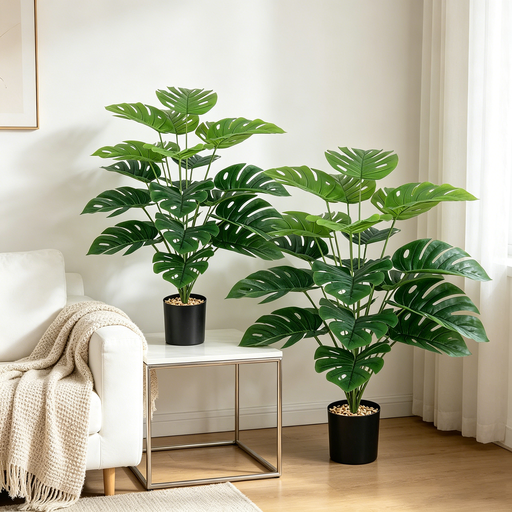
Why this product suits the profile: This two-piece set of two 85 cm-tall potted plants is ideal for shoppers who want to add greenery to several smaller areas in their home or office. The plants can be placed on shelves, side tables or sideboards.
The height and package contents are clearly specified. The leaves and stems need to be arranged before use, allowing the shape to be adapted to its location.
Two pots included, plastic construction and, according to the product description, no watering or sunlight required.
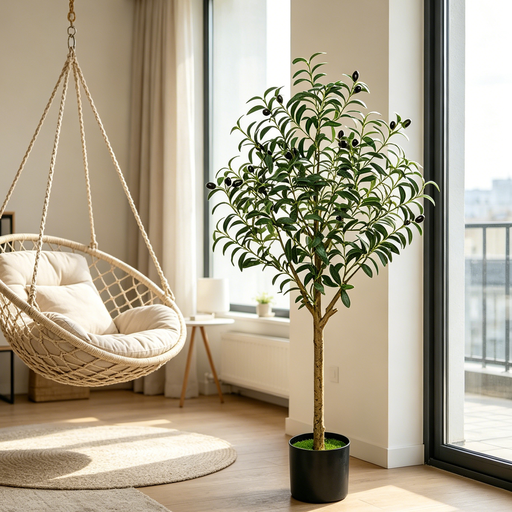
Why this product suits the profile: This 1.2 m-tall artificial olive tree in a pot is designed for entrance areas, living rooms, bedrooms, offices or shops where a single vertical decorative feature is needed.
The height is clearly stated and the black plastic pot is already included. This removes the uncertainty of finding a suitable planter separately.
Wood-effect trunk, artificial fruit and a pre-assembled pot according to the product description; care is limited to occasional dusting.

Why this product suits the profile: Two flexible 78 cm-long trailing stems are suitable for hanging baskets, walls, staircases, cafés, weddings and seasonal decorations. According to the product description, the stems can be bent or trimmed.
The trailing stems can be adapted to the available decorating area instead of being used in just one fixed shape. For outdoor use, however, shoppers should still check the specific UV and weather-resistance information.
Two-piece set, flexible wire and plastic stems, plus 19 branches per trailing stem according to the product description.
We have put together a complete, regularly updated list of products that fully meet these strict selection criteria and the safety regulations applicable in the EU.
For desks, windowsills and small shelves, artificial succulents in compact pots are a practical choice. A set of six small plants can be arranged separately or together. For an entrance area or an empty corner, on the other hand, artificial olive trees or other potted artificial trees are ideal. Check beforehand whether the pot is heavy enough or needs additional securing.
Artificial hanging plants can add structure to bare walls, shelves and room dividers. At events, artificial flowers can be combined with vases, table decorations or wall installations. Flexible stems make it easier to adapt them to different containers. For a hydrangea arrangement with seven flower heads and a length of approximately 33 cm, the compact size is particularly useful for table displays and smaller vases.
There is no single standard lifespan. It depends on the material, workmanship, location, dust exposure and UV radiation. Indoor spaces without direct sunlight can help preserve the appearance for longer. Outdoors, choose products with explicitly stated weather and UV-resistant properties, and secure the decoration in strong winds.
Many artificial plants are packaged to save space. First, carefully open out the branches and bend flexible stems in the desired direction. With potted plants, the leaves and branches can be spread out by hand. A dry, well-ventilated location can help if the material has a slight odour at first.
Compared with real plants, there is no need for watering, fertiliser, soil or regular repotting. Ongoing effort mainly involves occasional dusting and, where necessary, replacing damaged parts. In outdoor areas, additional costs may arise for weatherproof fastening or a sheltered storage location.