
Lieferung heute & morgen

Qualitätsgarantie

Willkommens-Angebote freischalten: KOSTENLOSE Lieferung | Bis zu 80 % RABATT | Kostenlose 30-Tage-JoyPlus-Testphase
App herunterladen
Artificial plants are a practical way to add greenery to living rooms, offices, shelves and covered outdoor spaces all year round. They don’t need watering or a suitable spot by a window. However, materials, workmanship, stability and proportions can vary considerably. If you choose based on product photos alone, you risk ending up with décor that looks unnatural in its intended spot or quickly proves impractical.
Artificial plants often look larger in product photos than they do in a real room. For example, a 90 cm artificial banana plant might fit on a sideboard, but won’t fill a tall corner of a room. Trailing plants around 78 cm long are better suited to shelves, wall baskets or hanging planters than to floor-to-ceiling greenery.
Before you buy, measure:
A natural look comes from more than just colour. Key features include leaves of different sizes, visible veins, varied growth directions and an irregular arrangement. Uniform plastic leaves or highly glossy surfaces can make the plant’s artificial origins more obvious.
Some models need their branches and leaves arranging after unpacking. This isn’t a fault, but it’s worth bearing in mind when planning where to place them.
Fabric flowers, plastic leaves and wire or plastic stems respond differently to dust, moisture and direct sunlight. A product description saying it’s suitable for indoor and outdoor use doesn’t replace checking the specific spot where you plan to put it. Covered spots are generally a more reliable choice for balconies, patios and entrances than areas that are permanently exposed to the elements.
Plastic leaves are easy to clean and keep their shape. Potted artificial plants may also come with decorative pebbles or a fitted insert. Fabric flowers and leaves often have a softer look, but should be dusted gently. Flexible wire stems make it easier to bend, trim and adjust the arrangement, as with an artificial trailing plant.
Also check whether a planter is included. A pot or bowl supplied with the plant saves you having to find one separately and creates a coordinated overall look.
Compact artificial succulents or small eucalyptus arrangements are well suited to desks, windowsills and shelves. Larger models need a sufficiently deep surface and should be kept away from places where they could easily be knocked over.
For hanging arrangements, both the length and the width of the stems matter, as does how they’re secured. A product with 19 branches per stem may look fuller than a single, narrow stem of the same length.
Low-maintenance plant décor doesn’t mean it never needs cleaning. For most models, all you need to do is:
It’s not possible to give a reliable estimate of lifespan without knowing how the plant will be used. Frequent exposure to sunlight, high humidity and physical knocks can have a greater impact on its appearance and shape.
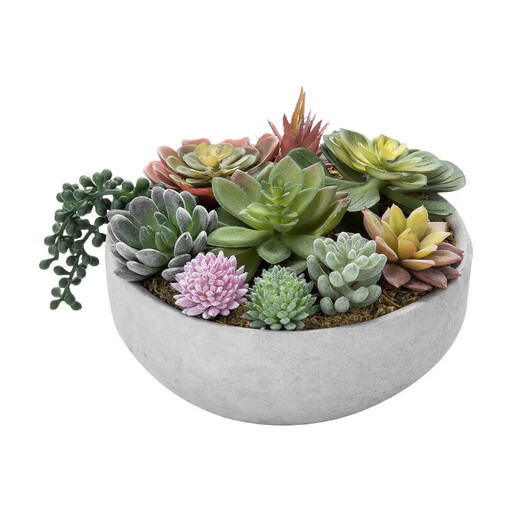
Why it suits this profile: The compact bowl shape is ideal for desks, shelves, worktops and windowsills. It comes with an arrangement of artificial succulents in a grey concrete planter.
The stated dimensions of around 24.6 × 20.6 × 12.2 cm make it easier to plan where to place it. Its low profile reduces the risk of a tall plant looking unstable in a small space.
The concrete bowl, plastic succulents and moss filling are all included. No assembly or watering is needed.
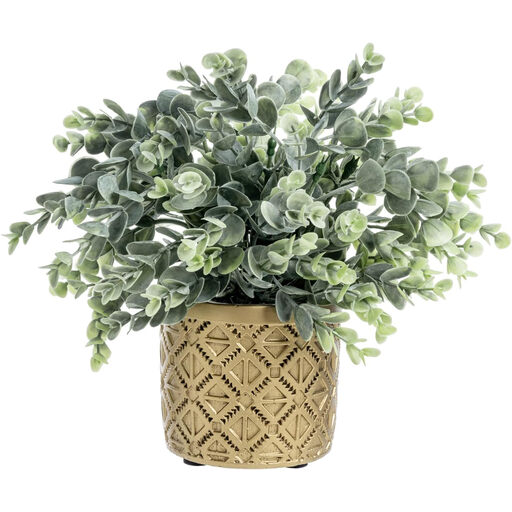
Why it suits this profile: This artificial eucalyptus combines plastic foliage with a geometric cement pot, making it a stylish choice for tables, shelves or reception areas.
The product arrives fully assembled. Its stated dimensions of around 24.9 cm high and 22.1 cm in diameter help you gauge how much space it will take up before you buy.
The cement pot has four protective pads on the base. The product description states that the arrangement is suitable for indoor and outdoor use; care is limited to occasional dusting.

Why it suits this profile: Two trailing vines, each around 78 cm long, are suitable for wall baskets, vertical spaces, shelves, parties, cafés or covered outdoor areas.
The flexible stems can be bent, trimmed and arranged to suit different displays. This means you don’t have to use the vine in exactly the shape it arrives in.
According to the product details, each vine has 19 branches, as well as fabric flowers and leaves. The two vines let you decorate a wider area.
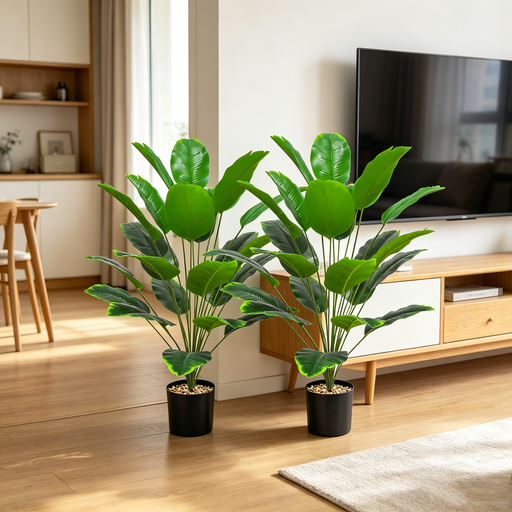
Why it suits this profile: Two artificial banana plants, each around 90 cm tall, are suitable for offices, living rooms, bathrooms, kitchens or placing beside furniture.
The stems and leaves can be arranged to suit your space. This lets you adjust the shape to fit the area available, rather than having to settle for a fixed silhouette.
The set includes two pots with pebbles already inside. The plastic construction means there’s no need for watering or sunlight, making the plants easy to use indoors.
We’ve put together a complete, regularly updated list of products that meet these strict selection criteria and the safety regulations in force in the EU.
Small artificial plants in pots can stand on any flat surface. For artificial hanging plants, you’ll need a suitable hook, a sturdy wall bracket or a suitable hanging basket. Before fitting, check the weight of the arrangement and the condition of the wall or ceiling.
Lifespan depends on the material, location and how the plant is used. Indoor spaces without direct sunlight or excessive moisture are generally less demanding on colours and surfaces. Regular dusting and careful handling of flexible stems can help maintain their decorative appearance.
You won’t usually need to spend money on water, fertiliser or grow lights. They still need the occasional clean, but otherwise require very little care. For outdoor spaces, also check whether the specific model should be kept sheltered from direct exposure to the weather.