
Lieferung heute & morgen

Qualitätsgarantie

Willkommens-Angebote freischalten: KOSTENLOSE Lieferung | Bis zu 80 % RABATT | Kostenlose 30-Tage-JoyPlus-Testphase
App herunterladen
An artist marker set can make sketching, illustration, hand lettering and colouring projects much easier. However, markers vary considerably in their ink, nib shape, colour palette and compatibility with different types of paper. A large number of pens alone therefore says little about how suitable a set really is.
If you want to buy markers in Germany, there are three common purchasing misconceptions you should avoid:
Water-based markers and watercolour markers are suitable for sketches, journaling and watercolour-style blends. On watercolour or mixed-media paper, the colour can be spread further with water and a brush. The result depends heavily on the paper weight, absorbency and working speed.
Water-resistant markers are useful when you want lines to remain as stable as possible after drying. Permanent markers such as Sharpie are one example. They can be used on paper, plastic, metal or wood. On porous surfaces, the ink may no longer be removable, according to the product description. Testing it first on an inconspicuous area is therefore recommended.
Alcohol-based markers usually dry quickly and are suitable for layering and blending. However, they can bleed through thin paper and should be used in well-ventilated rooms. For children and simple school projects, washable children’s felt-tip pens with water-based ink are generally more practical.
The nib determines how versatile a set of drawing pens can be:
With a dual-tip marker, it should also be clearly stated which two nibs are included. A brush pen with a fineliner covers different tasks from a marker with a fine and broad fibre tip.
For portraits, skin-tone markers with graduated beige, rose, brown and terracotta shades are more useful than a set containing lots of random primary colours. For calligraphy and journaling, however, 60 or more numbered colours can be worthwhile if a colour chart is provided for documenting them.
Cases or boxes with a secure fastening are practical. They make sorting easier and protect the pens during transport. If you use your markers frequently, it is worth checking whether replacement nibs are available. If they are not, a single dried-out marker can make the entire set less economical.
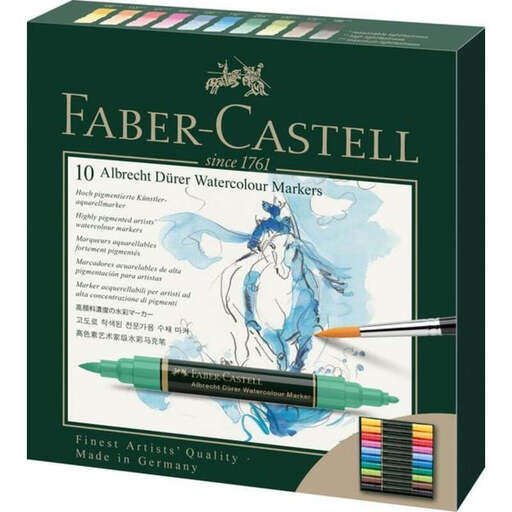
Why this product suits this profile: The set contains 10 markers, each with two nibs, and is suitable for exploring watercolour techniques, sketching and creating on the go.
The manageable number of colours reduces unused duplicates. The water-soluble ink makes the watercolour function easy to understand.
Two nibs per marker, water-based ink and a compact case.
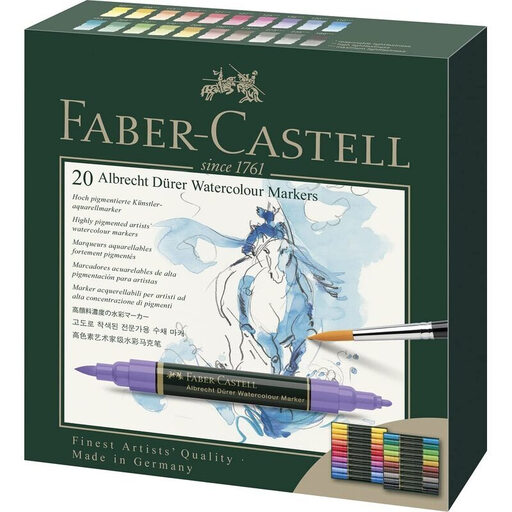
Why this product suits this profile: 20 colours offer more choice for illustrations and watercolour work, while the brush tip and fibre tip cover different drawing tasks.
The information on the ink type, nibs and recommended paper makes it easy to choose for water-based techniques.
20 shades, two nibs per pen and, according to the product details, high lightfastness.
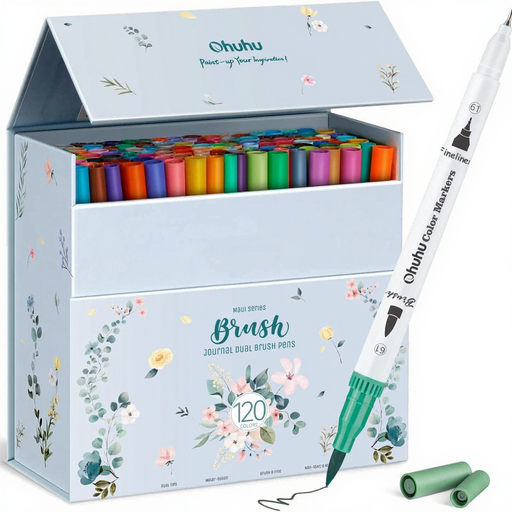
Why this product suits this profile: Illustrators, students and journaling fans get 120 numbered colours, a fineliner and a flexible brush pen in each marker.
The DIY colour chart helps with sorting and comparing colours. Replacement nibs are included, which is practical for frequent use.
0.4-mm fineliner, 1–6-mm brush tip, 120 colours, storage case and eight replacement nibs.
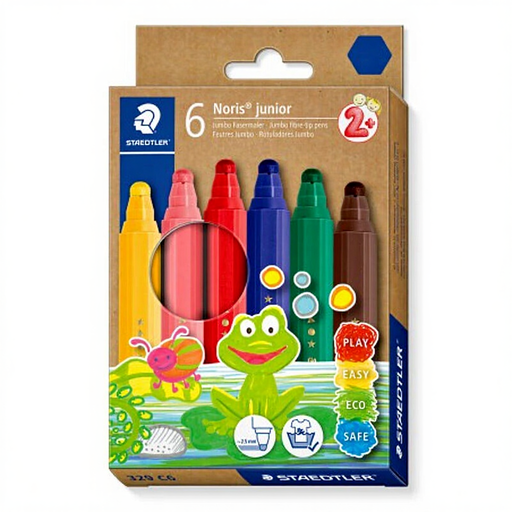
Why this product suits this profile: The broad, rounded fibre tip and hexagonal barrel are designed for small children’s hands.
The washable, water-based ink is more practical for everyday colouring than permanent ink. The ventilated safety cap meets common safety requirements.
Six colours, broad break-resistant tip, washable ink and ventilated cap in accordance with ISO 11540 and BS 7272-1/2, according to the product details.
We have put together a complete, regularly updated list of products that fully meet these strict selection criteria and the safety regulations applicable in the EU.
Before starting a larger project, test every colour on the paper you will actually be using. This helps you spot bleeding, uneven areas and unexpected shades at an early stage. Creating your own colour chart is particularly useful with larger sets.
Markers should be closed securely after every use. According to the product information provided by many manufacturers, water-based brush pens should preferably be stored horizontally so that the ink remains evenly distributed. Direct sunlight and extreme temperatures can affect storage.
For children under three, caps and replacement nibs pose a choking hazard. Even washable ink can stain textiles. A covered work surface and adult supervision are therefore advisable.
Watercolour markers with water-soluble, water-based ink are designed to be worked with water and a brush. Suitable watercolour paper improves control over blends and reduces bleeding.
How long it lasts depends on how often it is used, the pressure applied, the paper and how securely it is closed. The brush tip in particular can wear out more quickly under heavy pressure. A tight seal and suitable storage help prevent the ink from drying out. For some ranges, replacement nibs can extend the usable life of the markers.
Water-resistant markers are not always the most practical choice for children’s projects, as stains can be difficult to remove. For younger children, age-appropriate washable children’s felt-tip pens with a ventilated cap and parental supervision are generally more suitable.