
Lieferung heute & morgen

Qualitätsgarantie

Willkommens-Angebote freischalten: KOSTENLOSE Lieferung | Bis zu 80 % RABATT | Kostenlose 30-Tage-JoyPlus-Testphase
App herunterladen
Choosing the right artist pencil set can be a challenge given the sheer number of options. Whether for detailed sketches, expressive shading, or technical drawings, the right tool is crucial. Yet, grandiose product descriptions and seemingly comprehensive sets often lead to disappointment. Many buyers find their new set contains useless hardness grades or that the pencils break on the very first sharpening.
This guide will help you navigate the common pitfalls. We focus on the objective criteria that define a high-quality drawing set, so you can make an informed decision and purchase the right drawing supplies for your needs.
To avoid these problems, you should focus on a few core technical parameters that determine the quality and usability of an artist pencil set.
The marking on a pencil indicates its hardness grade. The scale ranges from H (Hard) to B (Black/Soft).
A good set for artists should include pencils of various hardness grades, ideally from at least 2H to 8B, to ensure maximum stylistic freedom.
Professional graphite pencils are distinguished by a high-quality lead that draws smoothly and without scratchy inclusions. A crucial but invisible feature is the secure bonding of the lead to the wood casing. Manufacturers like Faber-Castell use special processes for this (e.g., "SV bonding"), which significantly increases the lead's break resistance. This ensures the pencil won't break, even under heavy pressure or when sharpened with a knife.
Consider what type of pencils you need. A pure graphite pencil set is the foundation. However, there are also specialised sets:
Ensure the set contains the tools relevant to you in good quality, rather than being dazzled by a high count of filler items.
Here are some recommendations tailored to different needs and use cases.
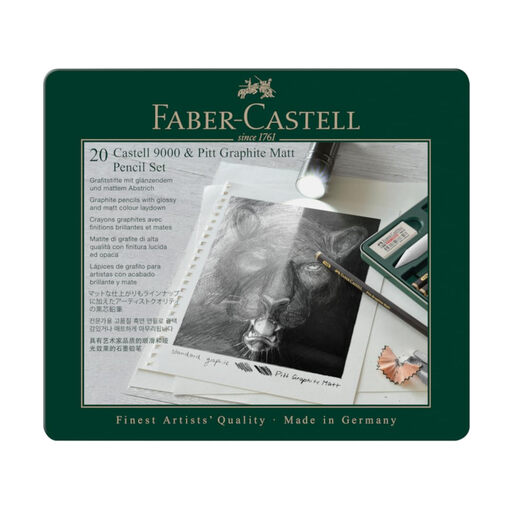
Why This Fits Their Persona: This set is ideal for beginners who want to work with high-quality materials from the start. It combines the classic Castell 9000 pencils with the innovative, low-reflection Pitt Graphite Matt pencils, covering an enormous range of applications.
It bypasses the useless accessory trap, as all included items (kneadable eraser, sharpener, paper stump) are of Faber-Castell quality. It also offers an extremely broad and practical range of hardness grades from HB to 14B.
Combination of classic and matte graphite pencils for maximum creative control. High break resistance due to SV bonding. All housed in a sturdy metal case.
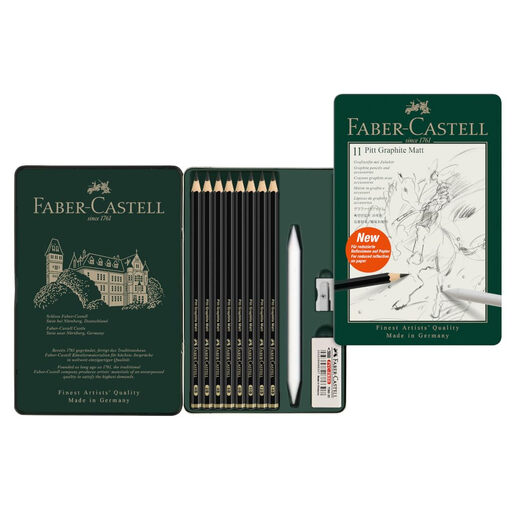
Why This Fits Their Persona: For professional artists and illustrators who digitise or exhibit their work. The matte finish of the graphite reduces light reflections, which significantly simplifies photographing or scanning artworks and ensures a deep black effect.
This set is highly specialised and avoids the 'one-size-fits-all' trap. It focuses on a single, innovative feature—the matte graphite laydown—and delivers it in professional quality.
Extremely matte graphite laydown for reduced reflections. High pigment density for maximum depth. Includes useful accessories like a sharpener and eraser.
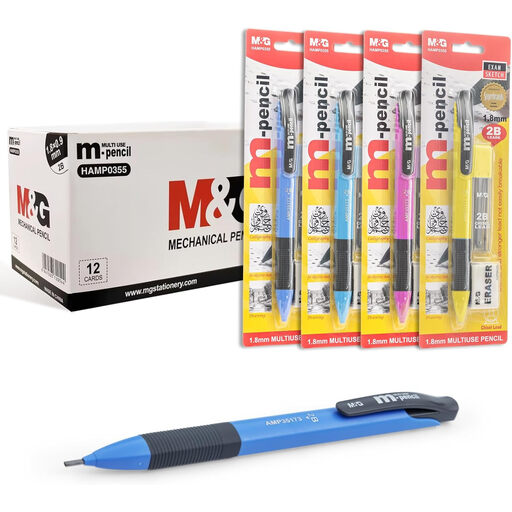
Why This Fits Their Persona: Perfect for students, designers, and anyone who sketches a lot daily. A lead holder system is more cost-effective and eco-friendly in the long run, as only the leads need to be replaced and there is no wood waste from sharpening.
This set completely bypasses the problem of leads breaking during sharpening. The robust 1.8 mm lead is stable and advanced with a simple click. The set also includes a large supply of replacement leads and erasers.
No sharpening necessary, always a consistent line width. Economical due to refillable leads. Large set with 12 pencils, 12 tubes of replacement leads (2B), and 12 erasers.
We have compiled a complete, up-to-date list of products that fully meet these strict selection criteria and safety regulations.
The letters and numbers on pencils describe the hardness and blackness of the graphite lead. H stands for "Hard" and produces light, precise strokes. The higher the number before the H (e.g., 6H), the harder and lighter the lead. B stands for "Black" and indicates a soft lead for dark, rich strokes. The higher the number before the B (e.g., 8B), the softer and darker the laydown. HB is a balanced midpoint, while F stands for "Firm" and is slightly harder than HB.
Very soft pencils (6B and up) have a naturally more break-prone lead. To avoid breakage, you should use a high-quality sharpener with a sharp blade. Many artists prefer to sharpen soft pencils with a sharp craft knife or scalpel. This allows for a longer, more stable point to be shaped, which can withstand more lateral pressure and enables more versatile strokes. Slowly rotate the pencil in your hand while shaving off thin slivers of wood with the knife.
While the price difference may seem high at first, established brands often offer objective advantages that justify the purchase. These include higher pigment quality for more intense colours and blackness, consistent quality across all batches, better lightfastness for your drawings, and above all, reliable break resistance due to sophisticated bonding processes. This leads to less frustration, reduced material waste, and ultimately, better artistic results.