When recording an audio drama, the first thing to consider is how many microphones need to record separate tracks at the same time. Two microphone preamps may be enough for roles recorded one after another; for several voices recorded simultaneously, you may need four. Plan your headphone listening points separately, and bear in mind that an interface won’t fix room echo or a poorly positioned microphone.
Who records an audio drama?
Ensemble recording dialogue simultaneously
If several voices need to be recorded on separate tracks, count the microphone preamps and headphone listening points separately. Specifications from Audient, Steinberg, Tascam and RØDE show that the available connections vary by device.
Audio drama makers recording in a reverberant room
Microphone distance and the room itself also affect how clear speech recordings sound. RØDE points out that placing the microphone too far away can make room echo and background noise more noticeable.
Flexible recording team
If you want to record scenes away from a permanently set up computer, you could consider a portable recorder with a documented interface mode, such as the Zoom H6essential.
What should you consider when choosing?
First decide whether several voices need separate microphone tracks at the same time. Then consider listening points, the room and the recording location as separate requirements.
| Requirement |
What to check when buying |
Who it matters to |
| Simultaneous voices on separate tracks |
Check the number of microphone preamps, not just the total number of analogue inputs; line inputs don’t count as additional microphone preamps. |
If I want to record several dialogue voices separately at the same time, I count the actual microphone inputs. Around 36% of consumers put separate tracks for simultaneous dialogue first. |
| Clear speech in a home setting |
Make a test recording at the planned speaker position and assess the microphone distance and room. |
If I’m recording in a reverberant room, I check how clear the speech sounds in the space rather than expecting extra interface features to correct the echo. Around 29% of consumers put clear speech in a home setting first. |
| Shared headphone monitoring |
Match the number of listening points you need to the number of headphone outputs and the planned signal routing. |
If several people need to listen in during a take, I count their listening points separately from the microphone inputs. Around 21% of consumers prioritise shared headphone monitoring. |
| Recording in different locations |
Check the specific model’s storage media, power supply, interface mode and monitoring options. |
If I want to record scenes away from a fixed computer setup, I check how the recorder works and how easily I can switch to using it with a computer later. Around 14% of consumers put recording in different locations first. |
Common buying misconceptions
-
Four inputs means four microphone preamps
On the fourth-generation Scarlett 4i4 and the MOTU M4, two of the four analogue inputs are additional line inputs. So neither offers four direct microphone preamps.
When checking how many speakers you can record simultaneously, compare the stated number of microphone preamps specifically.
-
Four microphone inputs means four headphone listening points
The number of direct headphone outputs may differ from the number of microphone preamps. Audient lists two headphone outputs for the EVO 8, while RØDE lists four for the RØDECaster Pro II.
Plan microphone tracks and listening points as separate requirements.
-
Phantom power works regardless of the USB connection
According to Audient, all four inputs on the EVO 8 can receive phantom power at the same time when the USB-C port supplies 1.5 A. With USB-A, a maximum of two phantom-powered channels can be used simultaneously.
Check which microphones need phantom power and whether the USB-C port you plan to use provides the specified power output.
-
A different interface will fix room echo
RØDE points out that placing the microphone too far away can make room echo and background noise more noticeable. An interface is no substitute for suitable microphone placement and room planning.
Test the room and microphone position with a short voice recording before relying on extra device features to address the issue.
Key brands at a glance
Focusrite
Focusrite lists two microphone preamps for both the fourth-generation Scarlett 2i2 and 4i4, which are computer audio interfaces.
- According to Focusrite, the 4i4 adds two line inputs.
- These additional line inputs are not two more microphone preamps.
Audient
According to Audient, the EVO 8 combines four microphone preamps with two independent headphone outputs.
- Four microphone inputs may be useful for recording several voices at the same time.
- According to Audient, powering all four channels with phantom power simultaneously requires a USB-C port supplying 1.5 A; a maximum of two channels can be powered this way via USB-A.
Steinberg
Steinberg lists four D-PRE microphone preamps and two headphone outputs for the UR44C.
- This combination of connections may suit several microphones and two direct listening points.
- The DSP effects listed by the manufacturer don’t demonstrate that the device can improve room acoustics.
Tascam
Tascam lists four microphone preamps and two headphone outputs for the US-4x4HR.
- Four direct microphone inputs allow you to plan for several voices recorded at the same time.
- If you need more than two direct headphone listening points, you’ll need to plan your monitoring separately.
RØDE
According to RØDE, the RØDECaster Pro II has four combo microphone inputs, four headphone outputs and supports multitrack recording to storage media or a computer.
- The connections and recording options listed can accommodate several speakers and direct listening points in a single device.
- Check that the extra production features suit your editing workflow; they’re no substitute for good microphone technique or room planning.
Zoom
According to Zoom, the H6essential is a portable recorder with four XLR/TRS inputs and a documented audio interface mode.
- Recorder mode may be useful when recording in different locations.
- Check that its interface mode works for your computer setup and provides the monitoring options you need.
Joybuy products
Here you’ll find audio mixer and interface kits whose titles mention one or two included microphones. Before choosing, check that the connections and recording workflow suit your audio drama setup.
 No image available
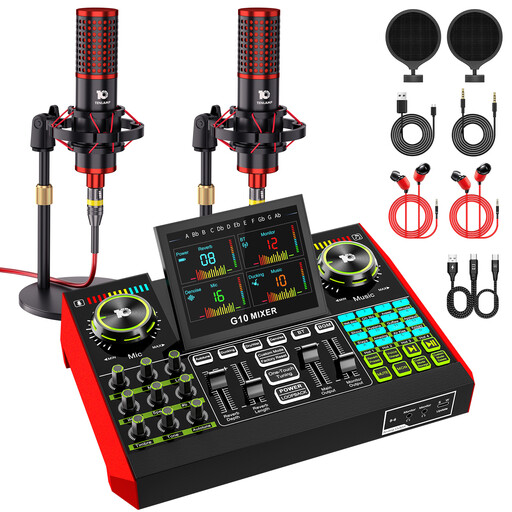
Yinkaer G10-P17-P17 podcast kit with two 3.5 mm condenser microphones
If you’re looking for a kit that includes two microphones for your audio drama setup, this could be an option combining microphones and a mixer.
The product title lists two 3.5 mm condenser microphones and an audio mixer.
View at Joybuy
 No image available
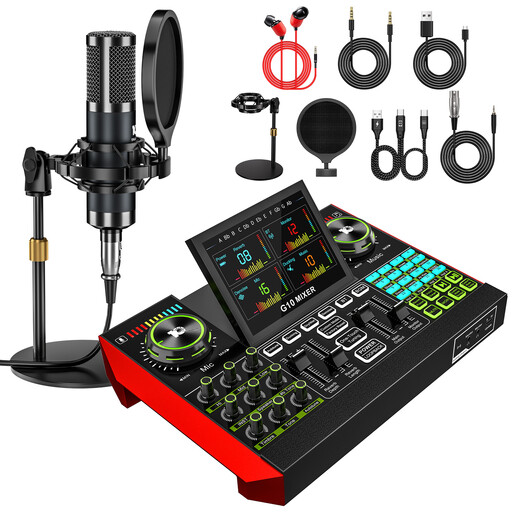
Yinkaer G10-P15 podcast microphone kit with 3.5 mm condenser microphone
If you’re looking for a kit that includes one microphone, this could suit your recording setup.
The product title lists a 3.5 mm condenser microphone, an audio mixer and an audio interface.
View at Joybuy
Frequently asked questions
Are four connections labelled ‘inputs’ enough for four speaker microphones?
Not necessarily. According to the respective manufacturers, two of the four analogue inputs on the fourth-generation Scarlett 4i4 and the MOTU M4 are additional line inputs. If you want to connect four microphones directly, check specifically whether the device has four microphone preamps.
When should I check the USB connection on the Audient EVO 8?
The USB connection matters if four microphones need phantom power at the same time. According to Audient, this requires a USB-C port capable of supplying 1.5 A; a maximum of two phantom-powered channels can be used simultaneously via USB-A.
How can I check whether voices will sound clear in the room?
Make a test recording at the planned speaker position and listen for room echo and background noise. RØDE points out that placing the microphone too far away can make both more noticeable; the best position also depends on the microphone you’re using.
What warranty applies if an interface bought from a trader in the EU is faulty?
If you buy as a consumer from a trader in the EU, you’re generally entitled to a minimum two-year legal guarantee from the date you receive the item, as explained by Your Europe. Claims for faulty goods should be made to the seller; any voluntary manufacturer’s warranty is separate. These EU rules don’t apply in the same way to private sales.
What should I check to make sure a product complies with German regulations?
As part of its market surveillance, the German Federal Network Agency checks matters including CE marking, product identity and manufacturer information. The EU explains that the CE marking indicates that the manufacturer declares the product meets the relevant requirements; for a specific listing, check the product identity and documentation.
Can I publish an audio drama featuring someone else’s text or music?
Choosing an audio interface doesn’t give you the rights to use someone else’s work. Section 15 of the German Copyright Act (UrhG) sets out the author’s exclusive right to make their work available to the public. Whether you can use a particular text, piece of music or sound effect without further permission depends on the work and the rights granted.


