Solo dialogue editor
You usually listen to cleaned-up speech on your own through headphones or a pair of monitors, and need simple level controls.


When reviewing speech files that have already been cleaned up, suitable headphone and speaker outputs, easy-to-reach level controls, and compatibility with your computer and editing software matter more than having lots of microphone inputs. Extra recording or monitoring options are worthwhile if you record speech yourself or listen back with another person. Direct monitoring, however, does not replace playing the edited file from your software.
You usually listen to cleaned-up speech on your own through headphones or a pair of monitors, and need simple level controls.
You review files and also record commentary tracks or new lines of dialogue. That means you need suitable inputs and should understand the difference between direct monitoring and monitoring through your software.
You listen through edits with another person or check them through multiple output routes, so you need the right connections and level controls.
| What you need | What to check before buying | Who is it important for? |
|---|---|---|
| The right monitoring route | Compare the headphone socket with the published specifications for the relevant load. If you use monitors, check the outputs and level controls too. | If you want to assess dialogue details on your own using headphones or monitors you already own, having the right monitoring route is key. Around 36% of consumers say solo monitoring is their top buying consideration. |
| Software and routing | Check the operating system and driver requirements, as well as the output device selected in your editing software. | If you want to listen reliably to edited files through your software, choosing the right playback route is essential. Around 29% of consumers put the connection between their computer, software and outputs first. |
| Recording your own speech | Check how many microphone inputs you need to use at once, along with your microphones’ connection and power requirements. | If you also record new lines of dialogue or commentary tracks, you need inputs that suit your recording needs. For around 21% of consumers, recording their own speech is their main consideration. |
| Listening with someone else | Check the signal routing, separate level controls and any extra outputs you need for the exact model. | If someone else will be listening too, or you plan to use an additional output route, the specific connections and level controls matter. Around 14% of consumers prioritise listening with someone else or having extra outputs. |
According to Focusrite, the Scarlett Solo 4th Gen sends the same signal feed to its headphone and line outputs, even though their levels can be adjusted separately.
If you need different mixes, check the signal routing for the exact model rather than just counting the controls.
On the Focusrite model described, the direct input path bypasses the computer and its effects. So it won’t automatically play back the edited speech file.
To compare before and after, select playback from your software. Direct monitoring can be useful when recording speech.
RME describes the two sockets on the Babyface Pro FS as parallel outputs. By contrast, SSL lists two headphone outputs with their own volume controls for the SSL 2+ MKII.
Consider separately whether you need two sockets, two adjustable levels or genuinely different mixes.
The Scarlett Solo 4th Gen is a compact option for solo monitoring and occasional microphone recording.
The M2 could suit a workspace where two input signals and level meters are useful.
The SSL 2+ MKII is an option for group listening sessions and extra physical outputs.
The iD4 MKII is a compact option if one microphone input is enough and headphone output specifications matter to you.
The Babyface Pro FS may be worth considering if your workflow calls for more advanced monitoring and extra connections.
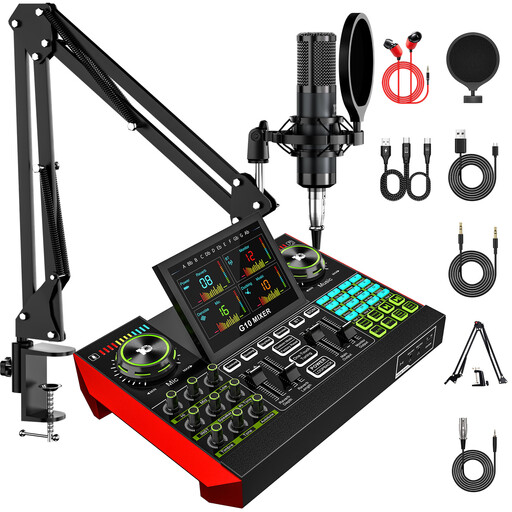
The selection below includes a podcast microphone kit described as a streaming audio interface. To play back edited dialogue, make sure its connection and software routing are suitable for your workspace.
 No image available
The product description presents this as a kit for podcasting and live streaming. Before buying, check that its connection and playback route work with your computer and editing software.
It includes a 3.5 mm condenser microphone and a microphone arm.
Not through the direct input path: Focusrite describes this as a signal route that bypasses the computer and its effects. To hear the edited file, select playback from your software and check the output device there.
Connect your headphones and, if applicable, monitors to the sockets that are right for your specific interface. Install a driver if required by the manufacturer and your operating system. Start at a low volume and take breaks: the World Health Organization points out that volume and listening duration together affect the risk to your hearing.
A high maximum sample rate alone does not prove that an interface is better for dialogue editing. Match the format to your project and your software’s output settings. EBU R 128 treats programme loudness and True Peak as separate measurements.
Equipment placed on the EU market must meet the applicable conformity requirements. It must carry CE marking where the relevant harmonised legislation requires it. According to Your Europe, the manufacturer is responsible for conformity. The mark is not an independent seal of sound quality and does not prove that a particular listing is compliant.
Take the device to a separate collection point for waste electrical equipment; do not put it in household rubbish. The German Environment Agency advises that electrical equipment should be disposed of separately.