For a single vocal with an analogue XLR microphone, an interface with one suitable microphone input is usually enough. What matters more is being able to control the recording level and having a useful headphone monitoring setup. An interface won’t get rid of noisy neighbours or room echo: Musikhaus Korn recommends matching the microphone connection to your microphone, and Shure points out that no microphone can automatically distinguish completely between wanted and unwanted sounds.
Which setup is right for you?
Solo singers in noisy surroundings
If you sing alone and can hear background noise or room echo, consider microphone distance, direction and recording position as well as the interface. Musikhaus Korn and Shure explain why your choice and positioning of microphone can affect what ends up in the recording.
Beginners recording on their own
If you’re singing and controlling the levels yourself, clearly visible level meters, headphone monitoring or automatic level assistance could make your recording process easier. Focusrite User Guides, Audient and MOTU describe these features on their respective models.
Singers who may add extra tracks
If you might want to use two microphones at the same time later, check the actual number of microphone inputs. Musikhaus Korn, Focusrite User Guides, Audient and MOTU distinguish between microphone connections and other types of input.
What matters when buying?
First, check what’s causing problems at your recording spot. Then compare the microphone connections, level controls and computer requirements with the way you plan to record.
| Consideration |
What to check |
Who will find this important? |
| Room noise and echo |
Make a test recording in the intended spot; check the microphone position and background noise while singing. |
If I can hear traffic, voices or echo in my recordings, I want to know what’s reaching the microphone at my recording spot first. Around 40% of consumers put quieter room recordings first. |
| Levels and headphone monitoring |
Check the level meter, gain control, headphone connection and monitoring path. |
If I’m singing and operating the equipment on my own, I want to control the level and hear my voice alongside the backing track. Around 33% of consumers prioritise easy level control and monitoring. |
| Microphone inputs |
Check the number of XLR microphone inputs and whether you need 48 V phantom power. |
If I want to connect an XLR microphone or use two microphones at the same time later, I count the actual microphone inputs. Around 17% of consumers prioritise suitable or additional microphone connections. |
| Computer and extra requirements |
Check the model’s system requirements, what’s included and any software conditions. |
If my computer or existing accessories affect how I record, I want to check compatibility in advance. Around 10% of consumers prioritise their computer setup and the overall amount of effort involved. |
Common misconceptions
-
A low-noise interface soundproofs the room
Electronic self-noise and sound reaching the microphone are two different things. An interface won’t automatically remove neighbours’ voices, traffic noise or room echo.
Make a test recording where you plan to record and check the microphone position and surroundings before choosing an interface based only on its specifications.
-
“Two inputs” means two microphone inputs
Both the Scarlett Solo 4th Gen and the AudioBox GO combine one microphone input with another input designed for a different purpose.
Compare the connections with your microphone and check whether you want to record several sources at the same time.
-
A higher bit depth always prevents clipping
Steinberg lists 32-bit integer for the UR22C. By contrast, RØDE describes 32-bit float for the NT1 5th Generation as applying to the USB-C signal path and compatible software. These formats and signal paths are not the same.
Check the recording format and connection path for the specific device instead of comparing bit depth alone.
-
A software trial is included permanently
PreSonus describes the software listed with the AudioBox GO as a six-month trial.
Check how long you can use it and the terms that apply, as well as which software you actually need.
If you want to keep using the software after the trial, extra costs may apply.
Brands to consider
Focusrite
The number of microphone inputs varies between Scarlett models, generations and configurations.
- According to Focusrite User Guides, the Scarlett Solo 4th Gen has one XLR microphone input, 48 V phantom power, a level meter and Direct Monitoring.
- The Scarlett Solo’s second input is a jack socket, not a second XLR microphone input. Information about the Scarlett 2i2 3rd Gen doesn’t necessarily apply to other generations.
Audient
The EVO 4 is aimed, among others, at people recording on their own who want automatic level assistance or two microphone preamps.
- Audient lists two microphone preamps and its automatic Smartgain level function.
- Smartgain doesn’t reduce noise in the room. A 2020 review by Bonedo also notes that the headphones and speakers mute each other, which is a limitation.
MOTU
The M2 could be worth considering for recordings that need two independently controlled microphone inputs and visible level monitoring.
- MOTU lists two XLR/TRS inputs, individually switchable 48 V phantom power and level meters.
- Check the published operating system requirements against your computer; the device specifications don’t show that it can reduce room noise.
PreSonus
The AudioBox GO is a compact interface for one microphone connection and, if needed, an instrument.
- PreSonus lists one microphone/line combo input, a separate instrument input and a mix control for monitoring.
- The instrument input is not a second XLR microphone input. The listed software is a six-month trial.
Steinberg
The UR22C may be suitable for two microphone sources and monitoring with documented DSP effects.
- The Steinberg manual lists two microphone preamps and DSP monitoring, including REV-X.
- The specified 32-bit integer format is neither a promise of 32-bit float recording nor protection against room noise.
Suitable products on Joybuy
Joybuy product selection for singing, with the microphones listed in each set.
 No image available
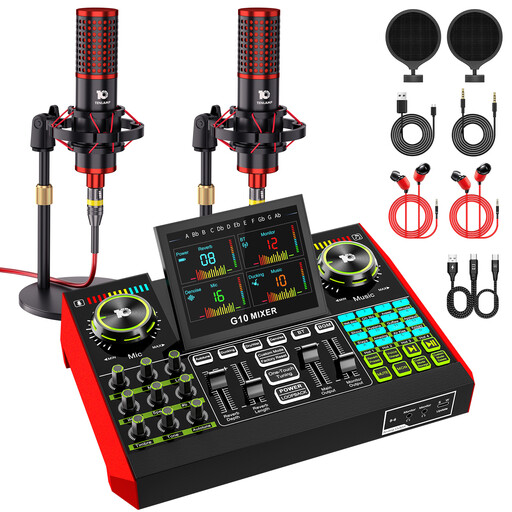
Yinkaer G10-P17-P17 podcast kit with two microphones
The set is described as suitable for singing and livestreaming from a computer or phone; check that the microphones and connections listed work with your recording setup.
The product title lists two 3.5 mm condenser microphones and desktop stands. The advertised noise reduction doesn’t prove that it will eliminate room noise or noise from neighbours in a noisy flat.
View on Joybuy
Frequently asked questions
Do I need two microphone inputs for one vocal?
You generally don’t need a second microphone input for a single analogue XLR microphone. If you might want to use two microphones at the same time later, check the number of microphone inputs specifically: an additional instrument input doesn’t count.
How do I set up a vocal recording in a noisy room?
Use a test recording to try different microphone distances and positions, and reduce distracting noise or reflective surfaces where you can. Shure points out that no microphone can automatically distinguish completely between wanted and unwanted sounds.
What if the interface isn’t suitable or is faulty?
For a consumer purchase from a business seller, statutory rights apply if the goods are faulty. The European Union explains that these rights last for a minimum of two years from the date you receive the goods. Online purchases generally come with a 14-day right to cancel, although you should check the conditions and exceptions that apply to your specific purchase. Cancelling a purchase and claiming your rights for faulty goods are different things.
Can I record vocals at any time in a rented flat in Germany?
You can’t assume there’s a single rule that allows singing at any volume and at any time. The Umweltbundesamt refers to state law, local rules and tenancy agreements; Berlin’s Service Portal explicitly classifies singing as domestic music-making. Check the rules where you live and respect any applicable quiet hours.


