Which setup is right for you?

A duo with separate violin tracks

If you want to record each violin with its own microphone and edit the tracks separately later, you’ll need two microphone preamps that can be used simultaneously. The total number of inputs alone isn’t what matters.

A duo with a natural stereo image

If you want to hear both instruments as an ensemble, with their spatial arrangement intact, you could try a stereo pair and experiment with different microphone positions in the practice room. DPA Microphones describes stereo recording as using two channels, which also captures the room acoustics.

A duo sharing headphone monitoring

If you both want to listen through headphones while recording, check the number of outputs, their level controls and the signal routing. Two sockets don’t automatically mean you can set up two independent mixes.

What to look for when buying

Two separate violin tracks

Best for: Using one microphone for each violin and editing both signals separately later.

Trade-off: You need two microphone preamps that can be used simultaneously; extra line inputs aren’t a substitute.

A shared stereo pair

Best for: Capturing the position of both violins and the sound of the room. Shure and DPA Microphones describe stereo miking as a way to capture spatial sound.

Trade-off: The room acoustics will be captured too, so test microphone positions in the practice room you’ll be using.

A stereo pair plus additional microphones

Best for: Recording additional microphones alongside the stereo pair, simultaneously and on separate tracks.

Trade-off: Count all the microphone signals you need: according to Focusrite, the 3rd Generation Scarlett 8i6 has two microphone preamps and additional line inputs; according to Behringer, the UMC404HD has four microphone preamps.

Priority What to look for when buying Who is it important to?
Separate violin tracks Two microphone preamps that can be used simultaneously; suitable phantom power if your microphones require it. If each violin has its own microphone, I want to be able to edit the two tracks separately later. Customers who prioritise separate violin tracks account for around 33%.
The duo as a stereo image Two suitable microphone inputs and the ability to test microphone positions in the room. If I want to preserve the performance, including the spatial arrangement and sound of the room, I’d like to try a stereo pair. Customers whose main priority is a natural stereo image account for around 27%.
Listening together on headphones Number of headphone sockets and level controls; check the routing if you need different mixes. When we play together, I want us both to be able to listen while recording. Customers whose main priority is shared headphone monitoring account for around 20%.
A portable setup that works with a computer System requirements and drivers for the specific model version; connection and power requirements. If I want to move the interface between my computer and the practice room, compatibility with my computer is essential. Customers who prioritise a portable setup that works with a computer account for around 20%.

Common buying mistakes

  • Assuming eight inputs means eight microphone inputs

    According to Focusrite, the 3rd Generation Scarlett 8i6 has two microphone preamps and additional line inputs.

    Before you buy, count all the microphones you want to record at the same time and check the input type for each channel.

  • Assuming two headphone sockets mean two independent mixes

    According to Focusrite, the headphone outputs on the 3rd Generation Scarlett 8i6 are each assigned to specific pairs of analogue outputs.

    Check separately for each player which signals are available and whether you can assign the mix you want.

  • Overlooking the sound of the practice room when using a stereo pair

    A stereo recording captures the room acoustics as well as the spatial arrangement of the instruments. Close miking can also change the violin’s natural sound. DPA Microphones notes that its violin-miking suggestions aren’t universal.

    Compare short test recordings with different microphone positions before switching interfaces in the hope of changing the sound of the room.

Relevant brands and product ranges

PreSonus

The Studio 24c is an option for two microphone signals.

  • PreSonus lists two microphone preamps in its specifications.
  • Two built-in microphone preamps aren’t enough for a stereo pair plus additional individual microphones.

Focusrite

The 3rd Generation Scarlett 2i2 is designed for two microphone signals; choose the 3rd Generation Scarlett 8i6 if extra line inputs or two headphone outputs matter to you.

  • Focusrite lists two microphone preamps on the 3rd Generation Scarlett 8i6, as well as two headphone outputs with individual level controls.
  • The additional inputs are line inputs; the ‘8’ in the model name doesn’t mean it has eight built-in microphone preamps. The headphone routing needs to suit the mix you want.

MOTU

The M2 is a two-channel option if separate phantom power and clearly visible input levels are important to you.

  • MOTU lists two XLR/TRS microphone inputs, individual 48 V switches and a level meter.
  • According to the specifications, the M2 has one headphone output. The additional RCA outputs mirror the main outputs; they don’t provide a second independently assignable stereo path.

Roland

The Rubix22 is a two-channel option for a two-microphone setup.

  • Roland lists two XLR combo microphone inputs and MIDI connections.
  • You’ll need more than the two existing microphone preamps if you want to add a room microphone.

Behringer

The UMC202HD is designed for two microphone signals; the UMC404HD is an option for four microphones.

  • Behringer lists two microphone preamps, switchable 48 V phantom power, clip indicators and USB bus power for the UMC202HD.
  • According to Behringer, the UMC404HD has four microphone preamps and requires the supplied power adapter. These specifications don’t establish how the units compare in sound quality.

Audio products for a two-microphone setup

This selection focuses on an audio set for a two-microphone setup.
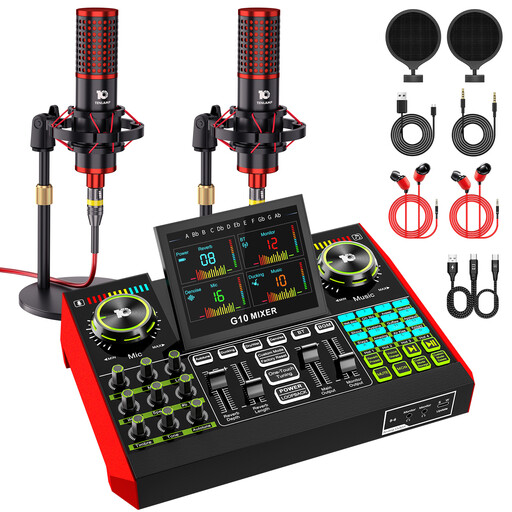
Yinkaer G10-P17-P17 podcast kit with two microphones

Yinkaer G10-P17-P17 podcast kit with two microphones

This set is designed for a two-microphone setup. Before buying, check that the connections and signal routing suit the way you want to record your duo.

The product title lists two supplied 3.5 mm condenser microphones and stands. The description lists PC, Mac and mobile devices as compatible.

View at Joybuy

Frequently asked questions

Do I need two inputs or two microphone inputs for two violins?

If each violin has its own microphone, or you’re using a stereo pair of two microphones, plan for two microphone inputs that can be used simultaneously. According to Focusrite, the other inputs on the 3rd Generation Scarlett 8i6 are line inputs, not additional built-in microphone preamps.

Should I switch on 48 V as soon as I connect two microphones?

No. Only switch on phantom power if your connected microphones require it. Condenser microphones often need it; Focusrite warns that phantom power may damage older passive ribbon microphones.

How can I check whether we can both listen on headphones at the same time?

Compare the number of headphone sockets and their level controls. If you need different mixes, check the signal routing too. Focusrite describes the 3rd Generation Scarlett 8i6 as having two headphone outputs, assigned to different pairs of outputs.

Will a different interface make up for poor microphone placement in the practice room?

No. Microphone placement affects how much of the instrument and the room is captured. Compare several positions using short test recordings; DPA Microphones notes that its violin-miking suggestions won’t suit every situation.

Can I record a duo rehearsal if it captures a confidential conversation?

Section 201 of the German Criminal Code (StGB) makes it a criminal offence to record another person’s non-public speech without authorisation. If a conversation of this kind takes place, check whether you’re authorised to record it. This doesn’t mean that every recording of a duo rehearsal consisting solely of music is automatically legal or illegal.