Interviewers in a busy event space
You want to capture individual voices clearly despite people changing seats and background noise. Microphone placement and, where appropriate, a close-worn microphone matter more than high bit depth alone.


For long interviews at a school reunion, microphone placement and power supply matter more than bit depth alone or a headline recording-time figure. A voice recorder with internal storage makes it easier to get started. A handheld recorder with a suitable microphone input or selectable recording pattern gives you more flexibility, but depending on the model, it may require a memory card and extra preparation.
You want to capture individual voices clearly despite people changing seats and background noise. Microphone placement and, where appropriate, a close-worn microphone matter more than high bit depth alone.
You’re planning several lengthy conversations without changing the battery or memory card mid-recording, so you need to check the stated recording time for the format you intend to use.
You want to transfer and find your recordings easily after the reunion. Internal storage, file format and connectivity are particularly important.
First, check that the microphone covers the seats you plan to use. Then compare the power supply and available storage with the length of recording and mode you have in mind.
| What matters | What to check before buying | Who will find this particularly important? |
|---|---|---|
| Clear voices | Microphone pickup pattern, suitable microphone inputs and headphone monitoring; try a test recording from the seats you plan to use. | If interviewees speak quietly, turn away or sit further off, I want to be able to assess how well their voices come through from the recording position. Around 36% of consumers put clear voices first. |
| Long recordings without interruptions | Power source and available recording time in the format you’ll actually use; check the card and charge level, and arrange backup power if needed. | For several long conversations in a row, I don’t want to have to stop because the battery has run out or there’s no storage left. Around 29% of consumers prioritise uninterrupted long recordings. |
| A reliable start to recording | Check the recording status and start controls; make a short test recording before each interview. | When switching between interviewees, I want to be able to start recording quickly and see that it’s actually running. Around 21% of consumers focus above all on a simple, reliable start. |
| Transferring and finding files | Check supported formats, transfer options and available storage for your chosen mode; decide how you’ll organise your files. | If I have lots of interviews to identify and transfer later, I want suitable file formats and a straightforward way to organise them. Around 14% of consumers put transferring and finding files first. |
Philips quotes a recording time of up to 36 hours for the DVT4110 when recording in MP3 at 8 kbit/s. Don’t assume this figure applies to other settings.
Plan around the format you’ll actually use, and test the recorder for a sufficiently long period.
Changing the battery or power supply could interrupt a long conversation.
According to the manual, the Zoom H1essential cannot record or play back audio without a microSD card inserted.
Check in advance whether your chosen model has internal storage or needs a compatible card, and test that it can play back a saved recording.
You’ll need to budget for a suitable microSD card with the H1essential.
The recording format doesn’t tell you whether the microphone will pick up voices clearly from the seats you plan to use.
Use a test recording to decide whether the built-in microphones, a selectable recording pattern or a compatible external microphone will work for your seating arrangement.
Zoom’s H1essential is a compact handheld recorder, while the H2essential lets you choose between different recording patterns.
Tascam describes the DR-05XP as a stereo handheld recorder with built-in microphones and a connection for an external microphone.
The DVT4110 is a voice recorder with internal storage, designed for repeated interviews.
The ICD-UX570 is a compact voice recorder with internal storage and a PC connection.
The LS-P5 combines internal storage with a choice of pickup direction for its three-microphone system.
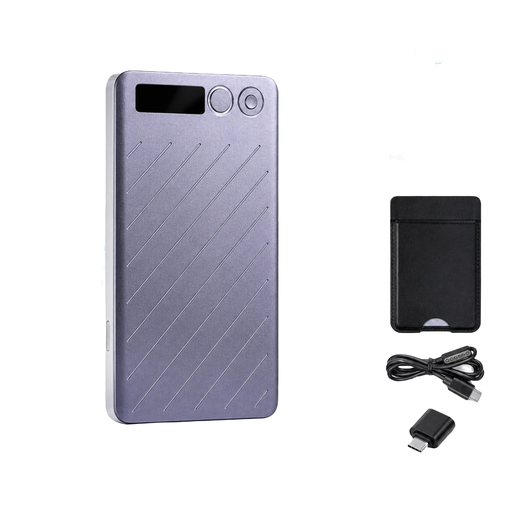
The Joybuy products below are voice recorders for interviews and longer conversations.
 No image available
The product title lists interviews as a potential use; the product details include a transcription function.
The product description lists 64 GB of storage, 36 hours of battery life, a weight of 32 g and six dual microphones. Test the recording from the position you plan to use and check the battery life for your interview session.
Check the available storage and power supply, then listen back to a short test recording made from the seats you plan to use. If your recorder requires a card, make sure the right one is inserted. According to the manual, the Zoom H1essential cannot record or play back audio without a microSD card.
No. Zoom and Tascam list 32-bit float as a recording mode, but you’ll need to assess microphone placement and room acoustics separately. Check how clear the voices sound in a test recording made at the actual interview location.
No. Verbraucherzentrale distinguishes between your statutory claim against the seller if a product is faulty and a voluntary guarantee with its own terms and conditions. Keep your proof of purchase and, if a guarantee is offered, check exactly what it covers.
Under § 201 para. 1 StGB, recording private conversations without authorisation is a criminal offence. So before recording, tell everyone involved and get their consent. Any later sharing or publication should be considered separately. When processing personal data, you’ll also need an appropriate legal basis under data protection law.