Character voice with room sound
If you want the reverberation of the actual room to become part of your doll’s voice, try different positions and listen to how spacious the recording sounds before you record the final take.


First decide whether you want the sound of the actual room to be part of your doll’s voice. For a sense of space, consider a stereo handheld recorder that you can position around the room. If clear speech is your priority, microphone placement and getting closer to the source matter more than a higher bit depth. Record a few short tests in the intended spot, then check which storage, power supply and file format suit your recording and editing workflow.
If you want the reverberation of the actual room to become part of your doll’s voice, try different positions and listen to how spacious the recording sounds before you record the final take.
If you’re recording in a reverberant room but want the words to remain clear, pay particular attention to keeping the microphone in a consistent position and try recording from closer up.
If the volume changes during a take or you want to compare different recordings on your computer later, check the recording modes and file formats, as well as compatibility with your editing software.
A good fit if: You want the sound of the actual room to be audible in your recording and would like to compare different recorder positions.
Trade-off: More room ambience can make the spoken words harder to understand.
A good fit if: You want the character’s dialogue to stay clear, even in a reverberant room. Start by trying a closer, consistent microphone position.
Trade-off: A closer recording captures less of the room sound you may be looking for.
Shure explains that a microphone can’t separate direct speech from reflected sound simply because of the recording format. That’s why you should assess the room, microphone position and distance in the actual place where you plan to record.
| What matters to you | What to check before buying | Who this matters most to |
|---|---|---|
| Control the amount of room reverberation | Check that the recorder can be positioned as needed and has stereo microphones. If relevant, look for selectable microphone configurations and listen to test recordings made from different positions. | If you want to hear the actual room as part of your doll’s voice, try different set-ups. Around 36% of consumers prioritise the room sound they want. |
| Keep speech clear despite the reverberation | Check whether the recorder can be placed securely close to the speaker and whether it has a suitable input for an external microphone. | If you want every word to be clear in a reverberant room, a suitable, repeatable microphone position is important. Around 29% of consumers prioritise clarity. |
| Volume changes and editing | Make sure the recording mode and file format work with your planned editing software. If needed, check whether you can adjust the stereo image later. | If your character’s voice includes both quiet and loud sections and you want to compare takes on your computer, think about your post-production workflow. Around 21% of consumers put this flexibility first. |
| Recording and saving files | Check the storage, power supply, items included and the file format you need for the specific model. | If you want to start recording without interruption, make sure you have the required storage media and power supply ready beforehand. Around 14% of consumers prioritise a straightforward start to recording. |
A digital recording format doesn’t change the room’s acoustics. Even a wide digital recording level range can’t stop reflected speech from masking the direct voice.
First, test the amount of reverberation you want and check that the speech is clear with a recording in the intended spot. Then choose a format that suits your workflow.
Tascam describes the DR-05XP as having omnidirectional microphones, while the DR-07XP has a switchable A-B or X-Y configuration. Their set-up options are therefore not the same.
Compare the microphone specifications for the exact model and assess the recording in your intended spot, rather than assuming that all recorder designs will produce the same sound in a room.
According to its user manual, the Zoom H1essential can’t record or play back audio without a microSD card inserted. A Bonedo review from 19 March 2024 also noted that the tested device didn’t include certain accessories.
Check the specific listing to find out which memory card and accessories you’ll need for your intended use and whether they’re included.
The H1essential and H2essential handheld recorders offer different options for stereo recording and shaping the sense of space.
According to Tascam, the DR-05XP and DR-07XP differ in their microphone configuration and recording set-up options.
According to the manufacturer, the LS-P5 combines different recording fields with internal storage.
The ICD-UX570 is a voice recorder with internal storage and a built-in battery.
The VoiceTracer DVT6115 is a recorder with internal storage and a remote control app.
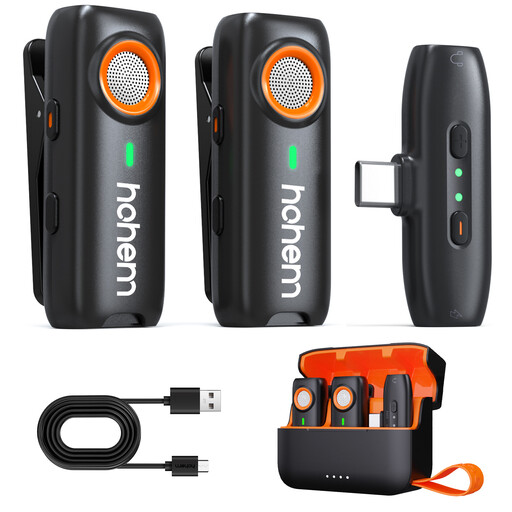
The Joybuy product below is a wireless lavalier microphone system with local recording, which could be a useful addition for recording a character voice. It isn’t a replacement for a stereo handheld recorder designed to capture the sound of a room.
 No image available
For recording a character voice with a wireless lavalier microphone and local recording to a TF card. This system isn’t a stereo handheld recorder designed to capture the sound of a room.
The product specifications list three DSP noise reduction levels, 48 kHz/16 bit, a range of 100 m and a battery life of 20 hours. A TF card isn’t included.
Only if you want more room ambience and the words remain clear when you listen to a test recording. Shure explains that reflections can mask direct speech if the microphone is positioned at an unsuitable distance. Try several positions rather than assuming there’s one distance that works for everyone.
No. 32-bit float relates to the digital recording format and how levels are handled. The amount of room reverberation captured depends above all on the room and microphone position. Even the right format can’t replace a test recording.
Check your storage media and power supply, and make sure the recorder can be positioned securely where you’ll be recording. According to its user manual, the Zoom H1essential can’t record or play back audio without a microSD card inserted. The Sony ICD-UX570, on the other hand, has internal storage and a built-in battery.
Under German law, statutory warranty claims are generally made against the seller; these are separate from any voluntary guarantee. Section 438 of the German Civil Code (BGB) generally sets a two-year limitation period for movable goods, starting from delivery. How this applies in practice depends on the purchase and the fault in question.
Section 201(1) of the German Criminal Code (StGB) makes it a criminal offence to record another person’s non-public spoken words without authorisation. If other people might be in the room, check with them before recording.