Which recorder setups are right for you?

Reporters who need their voice to come through clearly

If you’re speaking from the touchline or the stands, your voice needs to remain clear above the crowd. Plan to use a suitable microphone or position one close to you, and check the sound with a test recording at the venue.

Producers who want a separate stadium ambience track

If you want to mix your commentary and the atmosphere of the crowd separately later, check that the inputs and tracks suit your microphone setup.

Occasional reporters working alone

If you’re short on time to set up and are happy to record your voice and the surrounding sound together, a compact recorder with built-in microphones could be a good option. What matters is whether your voice remains clear in a test recording at the planned location.

What should you look for?

What you need What to check before buying Who is this important for?
Clear reporting voice Check whether you can connect and position a suitable microphone close to the speaker. Listen back to a test recording made with real crowd noise. If I’m speaking from the touchline, I want my voice to remain clear above the chanting, so I need a suitable microphone position and a test at the venue. Around 36% of consumers say clear reporting speech is their main concern.
Editing your voice and the crowd separately Count how many microphones you need to use at the same time, then check the inputs and separate tracks. If I want to adjust the balance between commentary and stadium atmosphere when editing, I need to record the sources separately. Around 29% of consumers prioritise being able to edit the voice and crowd separately.
Quick mobile setup Check the controls, power supply and storage media. Test monitoring and file transfer before the event, too. If I’m recording alone and have little time to prepare, I want a straightforward setup that lets me start recording quickly. Around 21% of consumers prioritise a simple mobile workflow.
Wind and sudden changes in volume Check that you have suitable wind protection and make a test recording during a loud passage. Choose a recording format that suits your editing workflow. If I’m recording outdoors, or the crowd and speech vary significantly in volume, I want to keep wind noise and peaks under control. Around 14% of consumers say handling wind and changing volume is their main concern.

Which assumptions should you avoid?

  • Assuming 32-bit float will suppress crowd noise

    The recording format can help you handle changes in recording levels. How clearly your voice is captured against the background still depends on the microphone and its position.

    Choose your speech microphone and its position first, then decide on the recording format and tracks.

  • Buying a multitrack recorder without planning the full microphone setup

    Extra inputs alone won’t ensure your voice is captured clearly from close by. The microphone, connection and, where needed, power supply all need to suit your setup.

    Check the microphone type, connector, power requirements and items included together.

    Depending on your setup, you may need additional equipment such as a suitable microphone, cable, wind protection or storage media.

  • Assuming wind protection will suppress crowd noise

    Wind hitting the microphone capsule and crowd noise reaching it acoustically are two different problems.

    Use suitable wind protection when it’s windy. Microphone position and, where needed, separate tracks are what matter when balancing your voice against the crowd.

  • Assuming that being able to record means you have permission to record at an event

    Some competitions have rules covering media access and reporting. Section 201 of the German Criminal Code (StGB) is also relevant to recording words spoken in private without permission.

    Before you go, check your access, reporting rights and permission to make any planned interview recordings.

Which brands are relevant to this question?

Zoom

The H1essential is a compact recorder with built-in X/Y microphones. The H4essential offers four tracks and two XLR/TRS inputs for setups using external microphones.

  • Zoom specifies 32-bit float for both models.
  • The recording format and extra inputs alone don’t guarantee clear speech above the crowd.

Tascam

The DR-05XP is a compact stereo recorder, while the DR-40XP adds more tracks and XLR/TRS inputs for external sources.

  • Tascam specifies 32-bit float for both models. The built-in microphones on the DR-05XP have an omnidirectional pickup pattern.
  • With the DR-40XP, the connection, power supply and any accessories need to suit the external microphone. The older DR-40X is a different model and, according to Tascam, is no longer manufactured.

OM SYSTEM

The LS-P5 is a compact recorder with a built-in three-microphone system and adjustable directivity.

  • OM SYSTEM says you can adjust the directivity from a wider to a narrower recording area.
  • Only a test recording will show whether your voice remains clear at the location in question. Adjustable directivity doesn’t mean the recorder automatically separates your voice from the crowd.

Joybuy products for recording speech

These Joybuy product options are listed for portable voice recording. Make a test recording to check whether your voice remains clear at your planned reporting location and whether the setup suits your needs.
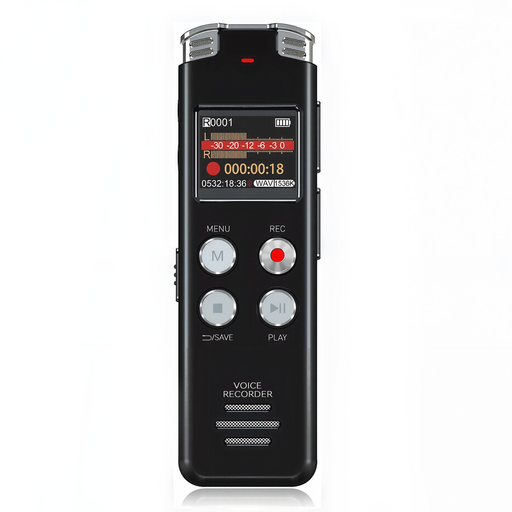
Rexsun L357 portable voice recorder in grey

Rexsun L357 portable voice recorder, 128 GB

For reporting on the go, make a test recording to check whether the sound is clear at your planned location.

The product name specifies 128 GB, an LCD display and a grey finish.

View at Joybuy

Digital voice recorder with 64 GB and transcription function

Digital voice recorder, 64 GB, with transcription function

If you’re recording a report, make a test recording in advance to check whether your voice is clear at the intended location.

The product name specifies 64 GB and a transcription function.

View at Joybuy

Frequently asked questions about audio recorders for sports reporting

How do I test the recorder before reporting?

At the planned location, record a short piece to camera and a noisy passage with the crowd, then listen back to both through headphones. Point a suitable microphone towards your voice. If you can hear wind, try suitable wind protection or a low-cut filter to reduce low-frequency rumble.

Do I need a memory card for the Tascam DR-05XP?

Yes. The Tascam user manual lists inserting a microSD card as part of preparing to record. Before you use it, also check the power supply and make sure a test recording has actually been saved.

Can I record conversations around the event without permission?

No, you can’t assume that you have permission in every case. Section 201 of the German Criminal Code (StGB) makes it an offence to record another person’s words spoken in private without authorisation. Check that you have permission before conducting an interview or recording a conversation. Whether a particular situation counts as public or private depends on the circumstances.

Does buying a recorder give me permission to record at a Bundesliga match?

No. The Bundesliga’s regulations for the 2026/27 season cover accreditation, work areas and permitted activities at Bundesliga, 2. Bundesliga and relegation matches, as well as the Franz Beckenbauer Supercup. Check the rights and access arrangements for your specific assignment; these rules don’t automatically apply to every other sporting event.

Do wireless microphones in Germany always need an individual frequency allocation?

No. The Federal Network Agency sets out general frequency allocations, each with technical and operational conditions that must be followed. Individual allocations may be required for other frequency uses. Check the frequency band used by your wireless system against the applicable allocation. This frequency question doesn’t apply to a wired microphone.