Which microphone is right for you?

Speakers who can hear their booth in recordings

If ventilation, outside noise or reflections stand out in your voice recordings, a controllable distance and a repeatable microphone position are important factors to consider. RØDE and Shure offer guidance on recording environments and microphone placement.

Speakers in a quiet recording booth

In a quiet booth, capturing subtle vocal details and controlling plosive sounds may be priorities when recording long chapters. RØDE and LEWITT publish model-specific information about their condenser microphones, but testing one in your own room is still important when making your choice.

First-time audiobook recorders using a computer

If you record on your own at a computer, check the connection, headphone monitoring and included accessories together. Audio-Technica and RØDE publish details of the different USB and XLR options available for their respective models.

What should you look for when buying?

What to consider What to check Who this matters most to
Room sound and background noise Record a voice sample with quiet and loud sentences in your usual recording spot; check the position and polar pattern of the specific model. If I can hear ventilation or reflections in a test recording from my small booth, I want to check the distance and position first rather than rely on the microphone’s design alone. Around 36% of consumers put room sound and background noise first.
Nuanced vocal reproduction Compare recordings of the same script excerpt in your own room; consider the manufacturer’s self-noise specifications separately from the results of your booth recording. In a quiet booth, recording long chapters, I want to capture subtle vocal details clearly without assuming that the manufacturer’s technical figures reflect the results I’ll get in my room. Around 29% of consumers prioritise nuanced vocal reproduction.
Connection and monitoring Check the model name, computer connection, interface inputs and any phantom power requirements; confirm that the specific model has a headphone socket and mix control. If I record on my own at a computer, I want to keep the signal path simple and monitor my voice while recording. Around 21% of consumers put connection and monitoring first.
Consistent positioning and plosives Check that there’s room for a stand or boom arm, and check the positioning, pop filter and shock mount included with the specific model; record a test in your usual seated position. If I record several chapters in the same seated position, I need a repeatable setup and want to control plosives and impact noise. Around 14% of consumers prioritise consistent positioning and controlling these sounds.

Common buying mistakes to avoid

  • Assuming a small booth is automatically acoustically controlled

    Even in a small room, reflections, ventilation noise or sounds from outside can be audible in a recording.

    Before choosing a model, listen to a voice recording made in the spot where you’ll actually be recording.

  • Confusing similarly named XLR and USB models

    The Audio-Technica AT2020 and AT2020USB-X have different connections. The XLR signal path for the RØDE NT1 5th Generation requires 48 V phantom power.

    Check the full model name, connection and included accessories together.

  • Expecting 32-bit float or a low self-noise figure to solve booth noise

    With the RØDE NT1 5th Generation, 32-bit float depends on using a compatible USB signal path and suitable software. A model’s self-noise figure doesn’t tell you how much ventilation noise or room reflections will be picked up in your booth.

    Check the signal path and software compatibility, and make a test recording in your booth separately.

Key brands at a glance

Shure

The dynamic, XLR-connected SM7B vocal microphone may suit speakers with a compatible recording chain who want to record reliably at close range.

  • Shure specifies a cardioid polar pattern, windscreen and swivel mount for the SM7B.
  • The manufacturer notes that a powerful preamp is required. The polar pattern doesn’t guarantee that booth noise will be eliminated completely.

RØDE

The NT1 5th Generation offers both USB and XLR, making it an option if your recording setup might change in future.

  • According to RØDE, the package includes a shock mount, pop filter and both cables.
  • XLR operation requires 48 V phantom power. 32-bit float applies when using a compatible USB setup and software. The manufacturer’s sound and noise figures aren’t an independent audiobook recording test.

Audio-Technica

The AT2020USB-X is a USB option for recording solo at a computer; the AT2020 is a separate XLR model.

  • Audio-Technica specifies headphone monitoring and a mix control for the AT2020USB-X.
  • The included desk stand may not offer the right vibration-resistant setup for a small booth. Check the full model name when buying.

LEWITT

The LCT 440 PURE is an XLR condenser microphone with a cardioid polar pattern, designed for use with an existing studio microphone setup.

  • LEWITT specifies a self-noise level of 7 dB(A) and lists a shock mount and pop filter as included accessories.
  • These manufacturer specifications describe the model, not the volume of ventilation noise or reflections in your booth.

sE Electronics

The dynamic V7 is a documented XLR option if its supercardioid polar pattern and careful positioning suit your existing setup.

  • sE Electronics specifies a supercardioid polar pattern and an internal windscreen.
  • Manufacturer claims about sound and isolation don’t prove that this model is better than others for audiobook recording.

Microphones for voice recording at Joybuy

The options below are dynamic USB/XLR microphones for voice recording at a computer. Mounting options, monitoring and accessories vary by model.
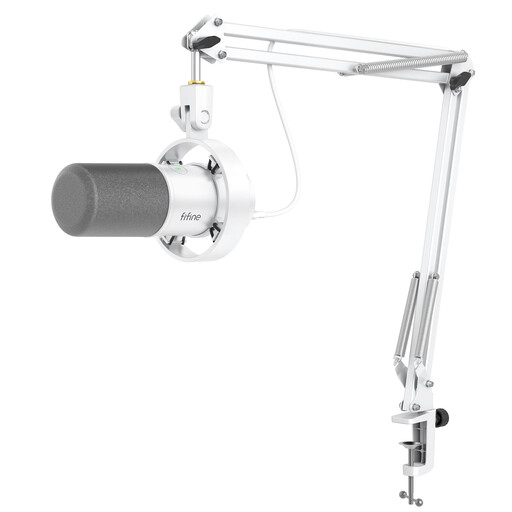
FIFINE K688CTW dynamic microphone with boom arm

FIFINE K688CTW with boom arm

For recording voice at a computer when you want to choose between USB and XLR and adjust the microphone position using a boom arm.

Dynamic microphone with USB and XLR connections and a unidirectional polar pattern.

The listed contents include an adjustable boom arm, shock mount, headphone socket and mute function. The product description states that an XLR cable isn’t included.

View at Joybuy
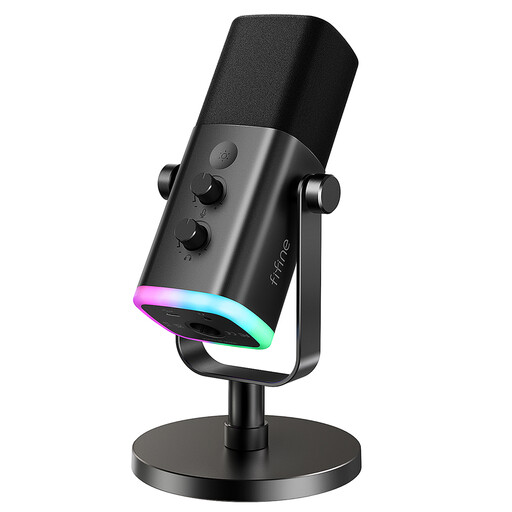
FIFINE AM8 dynamic USB/XLR microphone with desk stand

FIFINE AM8 USB/XLR

For recording voice at a computer when you want to use headphone monitoring and test the microphone position on the desk stand.

Dynamic microphone with USB and XLR connections and a unidirectional polar pattern.

The description lists headphone monitoring, volume control and a mute function. It states that an XLR cable and boom arm aren’t included.

View at Joybuy
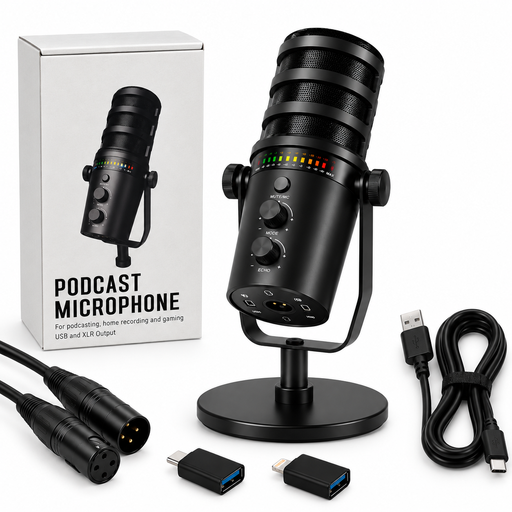
Dynamic USB/XLR microphone set with desk stand

Dynamic USB/XLR microphone set with desk stand

For recording voice at a computer when you want to use USB or XLR and monitor through headphones while recording.

Dynamic microphone set with a cardioid polar pattern and USB-C and XLR connections.

The product description lists a headphone socket, gain control, mute function and desk stand. It also describes mounting the microphone on a boom arm.

View at Joybuy

Frequently asked questions

Can I connect the RØDE NT1 5th Generation to a computer using XLR without any other equipment?

Not through a standard USB connection alone. For the analogue XLR signal path, RØDE specifies an interface or similar device and 48 V phantom power. The NT1 5th Generation can also be connected directly to a computer via USB; it shouldn’t be confused with other NT1 models.

What can help with plosives and handling noise during long recording sessions?

Position the microphone so that the correct side faces you, attach a pop filter, and test the stand or boom arm in your usual speaking position. RØDE describes the pop filter and shock mount supplied with the NT1 5th Generation as helping to reduce plosives and movement noise. Check the results with a test recording using your own setup.

What extra equipment should I check when buying an XLR microphone?

Check the interface or preamp, power requirements, cables, mount and pop filter against the contents listed for the specific model. Sufficient preamp gain is particularly relevant for the SM7B; Audio-Technica states that the XLR cable for the AT2020 is sold separately.

How should I clean a microphone after a recording session?

Follow the instructions for the specific model. Shure recommends keeping liquids away from the microphone element on its wired microphones and not cleaning the element itself. This manufacturer guidance isn’t a general care instruction for other brands.

Can I record and publish someone else’s book as an audiobook in Germany?

Not simply because you read the text aloud yourself: Section 16 of the German Copyright Act (UrhG) also covers the transfer of a work to a sound carrier, and Section 19a of the UrhG concerns making a work publicly available. You’ll need to check separately whether you have the necessary rights for the specific text and intended use, or whether a legal exception applies. Section 201 of the German Criminal Code (StGB) also concerns the unauthorised recording of another person’s non-public speech; it doesn’t apply generally to every reading you record yourself. The Federal Ministry of Justice and the Federal Office of Justice provide the legal texts.