A single Wi-Fi repeater may be enough to fix a dead spot on another floor, provided it still has a stable connection to the router where you plan to place it. If that connection is already weak, consider an access point connected via Ethernet or a powerline adapter with Wi-Fi. If you need coverage in several rooms, a compatible mesh system could be a good fit. The peak Wi-Fi speeds quoted by manufacturers don’t tell you how quickly an audiobook will download at its destination.
Which solution is right for you?
Audiobook fans with a Wi-Fi dead spot
If you want to download audiobooks on another floor and only need to cover one poorly served area to start with, find a suitable spot for your repeater. FRITZ! stresses that a wireless repeater needs a stable connection to the router while also being within good range of your Wi-Fi devices.
Homes with a tricky connection between floors
If floors or distances make the wireless connection between levels difficult, it’s worth comparing Ethernet and powerline options. devolo points out that sockets and sources of electrical interference can affect powerline transmission.
Users with an existing mesh router
If you want to keep using your existing mesh router, check whether that specific router and repeater combination supports the mesh features you want to use together. FRITZ! and TP-Link require compatible devices for mesh integration.
What to look for when buying
First, check whether there’s still a usable connection to the router at the potential installation point. Then consider the connection type, mesh compatibility and how much set-up you’re happy to do.
A single Wi-Fi repeater
Suitable if: Wi-Fi is weak in just one area on another floor, and the repeater can still get a stable connection to the router from an intermediate position.
Bear in mind: You won’t fix a poor wireless connection by plugging the repeater in right in the dead spot.
Mesh with multiple access points
Suitable if: You need coverage in several rooms or on several floors, and your router and repeater combination supports shared mesh features.
Bear in mind: You’ll need several devices and a few set-up steps; the word ‘mesh’ alone doesn’t guarantee compatibility.
Ethernet bridge or wired access point
Suitable if: You have, or can run, a network cable to the other floor.
Bear in mind: The cable route and intended operating mode need to be suitable; having an Ethernet port alone doesn’t guarantee this.
Powerline with Wi-Fi
Suitable if: There’s no usable wireless connection or suitable Ethernet cable route, and your sockets are suitable for powerline.
Bear in mind: Performance depends on your electrical wiring and potential sources of interference. Test the connection using the sockets you plan to use.
| What you need |
What to check before buying |
Who it matters most to |
| Reception at an intermediate position |
Check potential sockets between the router and the dead spot, then check the reception and connection indicator after setting up the device. |
If I only want to fix a dead spot on one floor, a stable connection at a potential intermediate position matters most to me. Around 31% of consumers have this as their main priority. |
| Connection between floors |
Check whether an Ethernet cable is an option; if not, test powerline using the intended wall sockets. |
If the connection between floors is already weak where I could place a repeater, I need another way to connect. Around 25% of consumers have this inter-floor connection as their main priority. |
| Connecting to your existing router |
Check your router model, the mesh combinations it supports and the intended set-up mode. |
If you want to keep using an existing mesh router, check that it supports the specific router and repeater pairing. Around 25% of consumers have mesh compatibility as their main priority. |
| A straightforward set-up |
Consider the devices and connections you’ll need, as well as the connection at the intended location. If downloads are slow, check your internet connection too. |
If I’m looking for the simplest way to download audiobooks, I want a suitable wireless connection without unnecessary extra devices. Around 19% of consumers value keeping additional set-up to a minimum most. |
Common misconceptions
-
Plugging the repeater in where the router’s Wi-Fi already drops out
A wirelessly connected repeater still needs a usable connection back to the router.
First, try an intermediate position where both the router and the area you want to cover are still within range. If you can’t get a stable connection there, consider Ethernet or powerline.
-
Assuming an advertised peak speed is your download speed
A device’s quoted speed doesn’t tell you how well it will perform in your home or how fast your internet connection is. FRITZ! describes placement as an important part of the wireless connection. The Federal Network Agency offers a broadband test to compare your connection’s data rate with the rate agreed in your contract.
Check the connection at the planned installation point. If downloads are slow, test your internet connection too rather than choosing a device based only on its quoted Mbps speed.
-
Assuming powerline is unaffected by your electrical wiring
devolo notes that some sockets may deliver low transmission speeds and that electrical interference can affect performance.
Test the wall sockets you plan to use and check whether nearby electrical devices are affecting the connection.
-
Assuming ‘mesh’ guarantees compatibility with your router
A repeater may work with a router in standard repeater mode without supporting its shared mesh features. TP-Link requires an EasyMesh-compatible router for the EasyMesh features it describes.
Check the router and repeater models, as well as the intended operating mode, before buying.
Key brands at a glance
FRITZ!
FRITZ!Repeaters such as the 1200 AX are worth considering if you want to extend an existing FRITZ! mesh network. FRITZ! also lists Gigabit LAN as a feature of the 1200 AX.
- Mesh integration may be possible with a compatible FRITZ!Box.
- Check your router combination and where you’ll place the repeater; manufacturer specifications don’t prove how well it will perform across multiple floors.
TP-Link
TP-Link describes the RE705X as a repeater with an alternative access point mode and EasyMesh support.
- With a suitable Ethernet connection, access point mode can be an alternative to wireless repeater mode.
- TP-Link requires an EasyMesh-compatible router for the EasyMesh features it describes; quoted wireless speeds aren’t measurements taken across multiple floors.
devolo
devolo Magic 2 WiFi 6 next is a powerline kit with Wi-Fi, offering an alternative when the wireless connection between floors isn’t strong enough.
- The manufacturer offers starter kits and multi-room kits.
- devolo notes that some sockets may deliver low transmission speeds and that electrical interference can affect performance; powerline isn’t the same as a single wireless repeater.
Telekom
Speed Home WLAN is worth considering if you use a compatible Speedport or a mesh configuration supported by the manufacturer.
- Telekom describes both Wi-Fi and Ethernet connections, as well as compatibility with specific router models.
- According to Telekom, Speed Home WLAN can work with a non-mesh router as a repeater without mesh. Check your router model before buying.
Joybuy products
This selection includes devices for a single Wi-Fi dead spot, a mesh kit for several rooms and an access point connected via Ethernet.
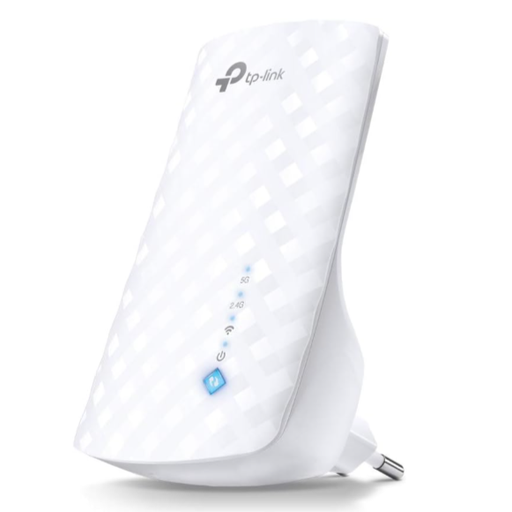 No image available
TP-Link RE190 AC750 Wi-Fi Repeater
For a single poorly served area; in repeater mode, the device needs to be within range of the router’s Wi-Fi.
Product specification: AC750, 433 Mbps, white.
View at Joybuy
 No image available
MERCUSYS ME80X Wi-Fi 6 Range Extender
For a single poorly served area; in repeater mode, the device needs to be within range of the router’s Wi-Fi. Access point mode requires an Ethernet connection to the router.
Dual-band: 574 Mbps at 2.4 GHz and 2402 Mbps at 5 GHz; Gigabit port; AP mode.
View at Joybuy
 No image available
TP-Link RE235BE BE3600 Wi-Fi 7 Range Extender
For a single poorly served area; the repeater needs to be within range of the router’s Wi-Fi. Shared EasyMesh features require compatible devices.
Dual-band; 2.5 Gigabit port; EasyMesh-compatible according to the product specification.
View at Joybuy
 No image available
MERCUSYS Halo H25BE Mesh Wi-Fi Kit (2-pack)
For several rooms: the product description recommends connecting one main unit to the modem and using a second unit to extend the mesh network. The second unit needs to be within range of the first.
Wi-Fi 7 BE3600; three Gigabit ports per unit.
View at Joybuy
 No image available
Ubiquiti UniFi U6+ Wi-Fi 6 Access Point
For providing Wi-Fi at a location with an Ethernet connection to the network. The access point requires PoE; set-up and management are handled through the UniFi Network application.
Dual-band; Gigabit Ethernet; PoE.
View at Joybuy
Frequently asked questions
Where should I place a wireless repeater?
Place it somewhere it can still get a stable connection to the router while also covering the area you want to reach. Check the connection after set-up; a socket in the middle of a dead spot isn’t automatically a suitable location. FRITZ! gives the same advice when explaining where to place its repeaters.
Can any repeater advertised as ‘mesh’ create a shared mesh network with my router?
No. The product description alone doesn’t tell you that. TP-Link requires an EasyMesh-compatible router for the EasyMesh features described for the RE705X; Telekom also distinguishes between mesh and standard repeater modes.
What should I check if downloads are slow even right next to the router?
Check your internet connection too, rather than assuming a repeater is the answer. The Federal Network Agency’s broadband test lets you compare your actual data transfer rate with the rate agreed in your contract.
Do I need an individual frequency allocation in Germany for ordinary 2.4 GHz Wi-Fi?
Devices that meet the conditions of the general allocation for 2400.0 to 2483.5 MHz may use these frequencies under that allocation. The Federal Network Agency lists this allocation under § 91 TKG; it doesn’t replace checks for product compliance or for other frequency bands under the rules that apply to them.


