
Lieferung heute & morgen

Qualitätsgarantie

Willkommens-Angebote freischalten: KOSTENLOSE Lieferung | Bis zu 80 % RABATT | Kostenlose 30-Tage-JoyPlus-Testphase
App herunterladen
An outdoor wall light should do more than simply decorate your exterior wall. It needs to suit its installation location, the level of brightness you want and the available power supply. Yet poor purchases are often caused not by a lack of choice, but by misleading product claims.
For an LED outdoor light, wattage is primarily a measure of energy consumption. The luminous flux, measured in lumens, is a better indicator of the amount of light produced. A light with a moderate power consumption can emit more light than a higher-wattage model if it uses more efficient LED technology.
Directional lighting is often sufficient for entrances and paths. For a courtyard or larger driveway, a wide beam angle or floodlight is a better choice.
The degree of protection is indicated by the IP code. An IP44 outdoor light is protected against solid objects measuring 1 mm or more, as well as splashing water. It may be suitable for a partially sheltered entrance, for example, but shouldn’t be exposed to a pressure washer or prolonged, heavy driving rain.
An IP65 outdoor light is dust-tight and protected against water jets from various directions. This can be beneficial for exposed exterior walls, garage driveways or other areas that are more exposed to the elements. However, the IP rating doesn’t replace correct installation or a properly sealed cable entry.
An outdoor light with a motion sensor needs as clear a field of view as possible. Hedges, projecting walls or passing vehicles can trigger it unnecessarily. The installation height and detection angle also affect its performance.
With a solar light, you’ll also need to consider its position: the solar panel needs several hours of direct sunlight. A shady north-facing balcony or a wall covered by trees can significantly reduce charging efficiency.
An outdoor solar wall light can be installed without running a power cable, making it particularly suitable for garden paths, fences, sheds and out-of-the-way areas. Before you buy, check:
A hard-wired LED outdoor light, on the other hand, provides a constant power supply. Depending on the model, installation on a 220–240-volt connection may need to be carried out by a qualified electrician.
Luminous flux, measured in lumens, helps you compare brightness. Warm white light of around 2700 to 3000 Kelvin creates a subtle effect around entrances and patios. Neutral white or daylight white can provide clearer visibility for courtyards and paths.
Also consider whether the light shines downwards, forwards or upwards and downwards. Adjustable spotlights are useful if you want to light a garage, gate and driveway in different ways.
Materials such as aluminium, glass, plastic and metal affect a light’s weight and maintenance requirements. Before ordering, check the wall surface, available space and fixing points. With a light that takes a replaceable E27 bulb, you can change the colour temperature later. With integrated LEDs, however, the light source usually can’t be replaced separately.
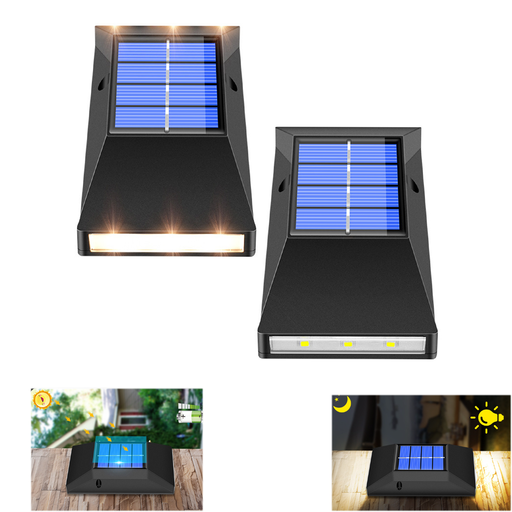
Why this product suits this type of user: This two-light set is suitable for balconies, garden paths, verandas or entrances without an existing mains connection.
The stated IP65 rating and solar power address exposure to the elements and the lack of wiring; charging performance still depends on the amount of sunlight.
Two lights, a 600 mAh battery per unit according to the product details, and tool-free installation.
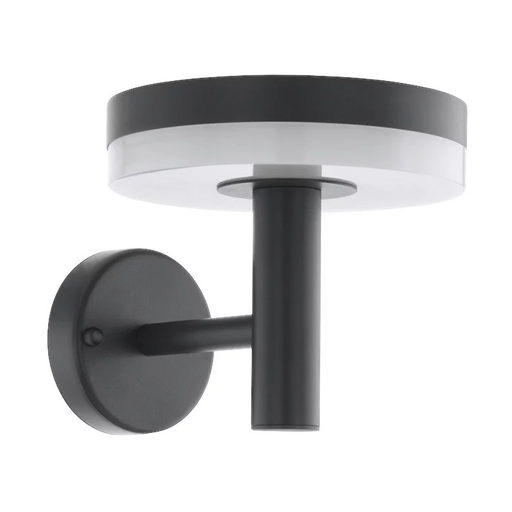
Why this product suits this type of user: For entrances and patios with an existing mains connection, this model combines an integrated LED with a compact housing.
The product details give specific figures rather than just the wattage: 11 W, 950 lm and 3000 K.
Integrated 11 W LED module, 950 lm and an anthracite metal and plastic housing, according to the product description.
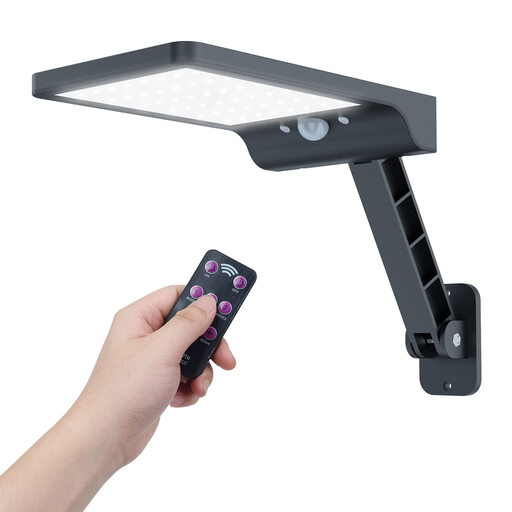
Why this product suits this type of user: Suitable if you want a flexible solar light with a motion sensor for a gate, steps, garage or path.
Three operating modes and a stated 120° PIR detection angle let you choose between continuous lighting and motion activation.
48 LEDs, a 2200 mAh lithium-ion battery, IP65 rating and remote control, according to the product details.
We’ve put together a complete, regularly updated list of products that meet these strict selection criteria and the safety regulations in force in the EU.
An IP44 outdoor light may be sufficient for partially sheltered areas. For exposed walls or areas more exposed to the elements, an IP65 outdoor light is often more suitable. The installation location, orientation and a properly sealed installation are still key considerations.
Run time depends on battery capacity, sunlight, temperature and how often the sensor is triggered. Manufacturer claims such as six to eight hours of charging time or a specified lighting duration should therefore be understood as applying to defined usage conditions, rather than as a guarantee for every season.
For a mains-powered light, energy consumption depends on its power rating and how long it’s used each day. Solar lights don’t use mains electricity, but their active lighting time can vary depending on the battery, sensor and weather. As well as the purchase price, check whether the bulb or batteries can be replaced.