
Lieferung heute & morgen

Qualitätsgarantie

Willkommens-Angebote freischalten: KOSTENLOSE Lieferung | Bis zu 80 % RABATT | Kostenlose 30-Tage-JoyPlus-Testphase
App herunterladen
For many film and series lovers, having a dedicated home cinema is a long-held dream. The idea of experiencing blockbusters on a giant screen is alluring. However, the path to the perfect picture can be fraught with challenges, especially when you fall for misleading marketing promises. Before you make a decision, it's crucial to understand the common pitfalls that often lead to disappointment and unnecessary expense.
As your Joybuy Product Recommendation Officer, I'm here to help you separate the wheat from the chaff. We'll focus on the facts and the technology that truly matter, so you can make an informed choice for your home cinema.
The projector market is saturated with technical specs and advertising slogans. Two issues in particular frequently lead to a poor purchasing decision:
To avoid the problems mentioned above, you should focus on three technical features. These are the primary determinants of your projector's image quality and user-friendliness.
Look for the 1080p Native specification. Many cheap models advertise "4K supported" but only have a low native resolution (e.g., 720p). This means the device can process a 4K signal, but it downscales it to a lower pixel count. The result is a blurry image that lacks detail. A Full HD projector with a native resolution of 1920x1080 pixels is the standard for a clear and detailed home cinema experience.
A projector's brightness is measured in ANSI Lumens. This is a standardised procedure that allows for reliable comparisons between different models. For a home cinema in a darkened or dimly lit room, a value of 700 ANSI Lumens or more is a solid benchmark. Such an LED projector for home cinema will still deliver a vibrant and high-contrast image even when the room isn't completely dark.
Modern projectors take the complicated setup off your hands. An auto-focus home cinema projector automatically sharpens the image as soon as you move the device. An automatic projector with keystone correction ensures the image is perfectly rectangular, even if the projector isn't placed exactly in the centre of the screen. These two functions are crucial for straightforward and flexible use. Complemented by a projector with Wi-Fi and Bluetooth, streaming content and connecting external speakers becomes a breeze.
Based on the criteria above, we have identified models that stand out for their hassle-free operation and solid technical specifications.
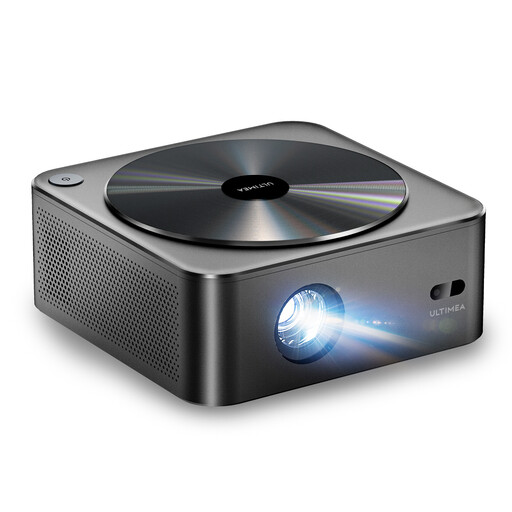
Why This Fits Their Persona: Ideal for users who want to get started immediately without any technical expertise. The device is designed for a quick, uncomplicated setup and delivers a compelling picture for a living room movie night, right out of the box.
The Apollo P40 bypasses the setup hassle with fully automatic focus and 6D keystone correction. The brightness is transparently stated as 700 ANSI Lumens, which ensures reliable performance.
The combination of native 1080p resolution and HDR10 support ensures a sharp, high-contrast image. The fully sealed optical engine protects against dust, securing long-lasting picture quality.
Why This Fits Their Persona: Perfect for users who won't just use the projector in one fixed location, but also for gaming nights with friends, home office presentations, or as a portable music player in the garden.
Thanks to dual-band Wi-Fi (2.4/5.8 GHz) and Bluetooth 5.1, the device offers stable, low-latency connections for streaming and audio. This prevents the connection drops and buffering issues that are common with cheaper models.
The bi-directional Bluetooth allows the projector to be used as a standalone 10W speaker. Its wide range of connectivity options (HDMI, USB, AV) ensures compatibility with game consoles, laptops, and TV sticks.
We have compiled a complete, up-to-date list of products that fully meet these strict selection criteria and all relevant quality and safety standards.
These two functions automate the image setup process. The auto-focus sharpens the image on its own, while keystone correction compensates for trapezoidal distortions that occur when the projector is not placed directly in front of the screen. Together, they ensure you get a perfect, rectangular, and sharp image in seconds, without needing to make manual adjustments.
A projector with 700 ANSI lumens is primarily designed for use in dark or dimly lit rooms. In these conditions, it delivers a bright and high-contrast image. In direct daylight, the image will be noticeably paler. For optimal image quality, it is therefore recommended to darken the room as much as possible.
Native resolution is the most important factor for image sharpness. It indicates how many physical pixels the projector's image is composed of. A projector with a native 1080p resolution (1920x1080 pixels) produces a significantly sharper and more detailed image than a model that only "supports" 4K but has a lower native resolution, such as 720p. For a true home cinema experience, a native Full HD resolution is a solid foundation.