
Lieferung heute & morgen

Qualitätsgarantie

Willkommens-Angebote freischalten: KOSTENLOSE Lieferung | Bis zu 80 % RABATT | Kostenlose 30-Tage-JoyPlus-Testphase
App herunterladen
An automatic pet feeder can make it easier to stick to regular feeding times in your day-to-day routine. It’s just as useful for busy cat and dog owners as it is for people who are often away from home. However, feeders vary considerably in portion size, ease of use, cleaning and suitability for households with more than one pet.
If you focus only on app control or a large capacity, it’s easy to overlook important details. Three common buying mistakes are particularly worth avoiding:
A portion-controlled feeder should let you set the daily food amount as accurately as possible. Look for details such as grams per portion, the number of meals and any minimum or maximum amounts. Some feeders don’t dispense directly by weight in grams, but use units or rotations instead. Depending on the shape of the kibble, this can result in different amounts.
Also check the permitted diameter of the dry food. The PETKIT model, for example, is designed for kibble, air-dried food and freeze-dried food measuring less than 12 mm. The CATLINK FRESH 2 LUX specifies a food size of under 16 mm. The automatic feeders mentioned here aren’t designed for wet food.
The capacity should suit your pet’s food requirements. A Wi-Fi automatic feeder with a capacity of 3 or 4 litres may hold enough for one cat for several days, but can run out much sooner when you have more than one pet. The amount of food it holds depends not only on the stated capacity in litres, but also on the food’s density and the portion size you set.
A secure lid, a sealed food outlet and a dry location are all useful features. According to the product description, the PETKIT Smart Pet Feeder SOLO has a 3-litre container, a sealing strip and a desiccant sachet. The CATLINK FRESH 2 LUX has a 4-litre container, an automatic outlet closure and a desiccant.
An app isn’t a substitute for planning ahead in an emergency. Check whether the feeder will keep working if the Wi-Fi goes down, whether it has battery backup and how to protect the cable from chewing or tripping hazards.
Removable bowls make regular cleaning easier. Depending on the model, stainless steel bowls may be dishwasher-safe, but electrical base units must not be immersed in water. Always unplug the feeder before cleaning it.
In a multi-cat household, an ordinary feeder often won’t be enough if each cat needs a specific portion. An RFID feeder for multiple cats can use a linked collar tag to identify which cat is at the bowl. However, this won’t automatically stop pets from going to each other’s bowls. Your home set-up and your cats’ behaviour still matter.
For larger dogs or pets with particular eating habits, an adjustable-height feeding bowl may be more practical. A slow-feeder bowl uses a patterned surface to make mealtimes last longer without changing the amount of food.
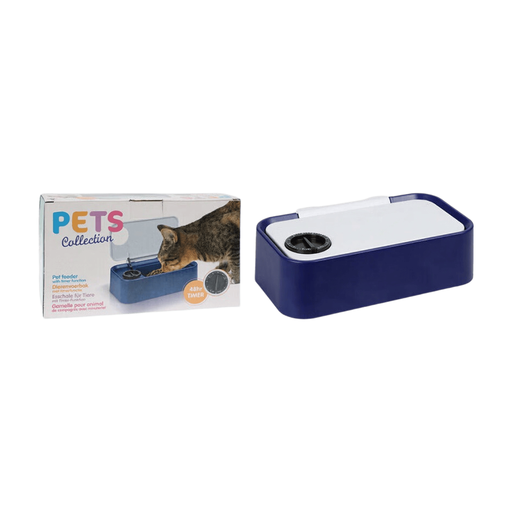
Why it suits this profile: This timer-controlled food container is a good choice for cat owners who want set feeding times and straightforward operation. Its compact dimensions of 24,2 × 13,8 × 7,7 cm make it easy to place without taking up much room.
The visible food level makes it easier to spot when the container is running low. Before buying, check that it supports the portion schedule and type of food you need.
Timer function, compact design and clearly stated suitability for dry food.
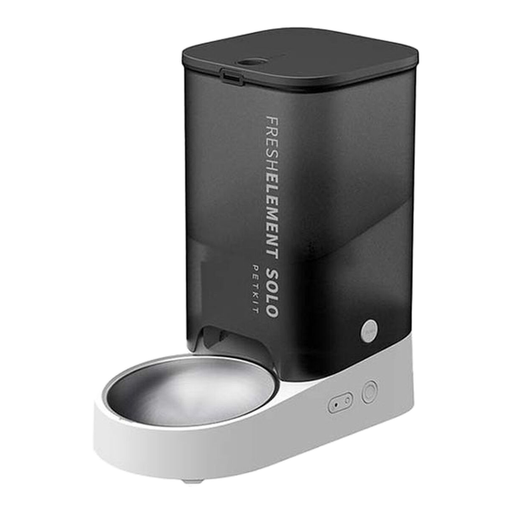
Why it suits this profile: The PETKIT feeder combines app control via 2,4-GHz Wi-Fi and Bluetooth with a 3-litre container and a 304 stainless steel bowl.
The stated food size of under 12 mm clearly sets out which food is suitable. Notifications for low food levels, battery status and desiccant help you keep on top of maintenance.
1 to 10 meals a day, 1 to 5 portions per meal, app notifications and a stainless steel food bowl.
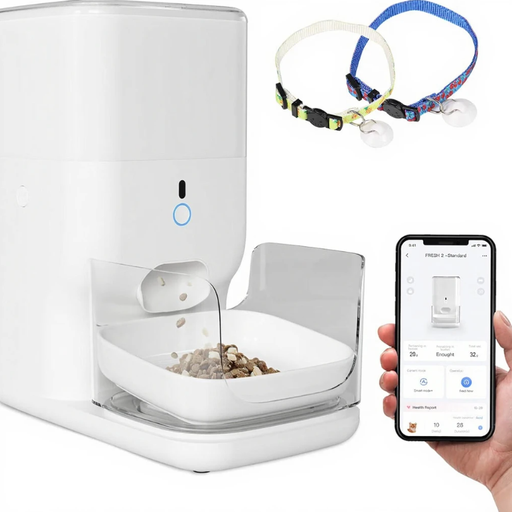
Why it suits this profile: The CATLINK feeder is designed for multi-cat households, where RFID collar tags can be used to support individual pet profiles and portions.
RFID identification tackles a common drawback of shared bowls. Cats need to wear their assigned tags for the system to work, and a stable 2,4-GHz Wi-Fi connection is required to set up the app.
4-litre container, two RFID tags, app-based feeding records and offline operation, according to the product information.
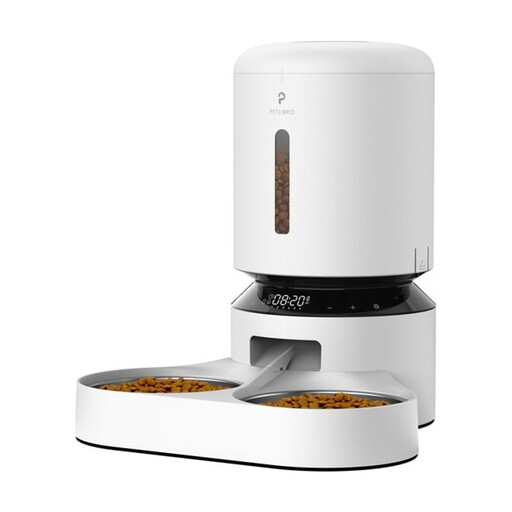
Why it suits this profile: Two separate food bowls and individual schedules make this a good option for households with two cats or small dogs that don’t need an RFID system.
Splitting the food between two bowls reduces the risk of one pet getting the entire shared supply. You’ll still need to supervise where or when the pets eat.
5 litres total capacity, up to six meals a day and portion settings of 2 to 50 g per bowl.
We’ve put together a complete, regularly updated list of products that meet these strict selection criteria and fully comply with the safety regulations in force in the EU.
Not every feeding set-up needs an app. The Blinkit 0159-1 2-in-1 combines a slow-feeder bowl with a floating water bowl and four height settings of 10, 23, 27 and 31 cm. This could be useful for cats and dogs of different sizes. For smaller pets, the Pecute Slow Feeder Bowl includes a 400-ml slow-feeder bowl, a 400-ml water bowl made from 201 stainless steel and a non-slip silicone mat.
A cat water fountain is a separate product category. According to the product description, the CATLINK Pure 2 W02 has a capacity of 2,6 litres, a cordless pump and app features for recording drinking data. These records are for monitoring purposes and don’t replace advice from a vet.
Place the feeder on a flat, stable surface, fill it only with the approved type of food and test several dispensing cycles manually first. A feeder with an app will usually need a 2,4-GHz Wi-Fi connection. Then check that the actual portion size matches your pet’s individual feeding plan.
Its lifespan depends on cleaning, food type, frequency of use and mechanical wear. Regularly remove food residue from the dispensing chute and rotor. Desiccants are consumables and need to be replaced according to the manufacturer’s instructions. Check the cable, lid, seals and moving parts for wear every time you clean the feeder.
On top of the purchase price, you may need to pay for electricity, batteries, filters or desiccant. A water fountain will also need regular filter replacements. So, compare not only the features, but also the consumables, cleaning requirements and availability of compatible spare parts.