
Lieferung heute & morgen

Qualitätsgarantie

Willkommens-Angebote freischalten: KOSTENLOSE Lieferung | Bis zu 80 % RABATT | Kostenlose 30-Tage-JoyPlus-Testphase
App herunterladen
A large cat tree is more than just a piece of furniture; it's a vertical paradise for indoor cats. A sturdy, well-equipped climbing tree is essential, especially for owners of large breeds like Maine Coons or for multi-cat households. It not only provides an outlet for climbing, scratching, and observing but also protects your furniture. However, the market is flooded with models that look impressive at first glance but quickly prove to be a poor investment. As your Joybuy Product Recommendation Officer, I'll help you identify the crucial features to make an informed choice.
Many cat owners invest in an impressive cat tree, only to find it's ignored by their pets or becomes unstable after a short time. This is often due to three common flaws that aren't always apparent in the product description.
To avoid these pitfalls, you should carefully check three technical aspects before buying. These are the primary factors that determine the cat tree's stability, durability, and acceptance by your cat.
A sturdy cat tree stands or falls with its base. Look for a heavy, wide base plate that balances the tower's weight, even during wild climbing manoeuvres. Models with a reinforced or double-layered base offer a clear advantage here. For a very tall cat tower, especially a floor-to-ceiling cat tree, an included anti-tip kit for wall mounting is an essential safety feature. This stabilises the entire structure and prevents it from toppling over.
The scratching posts are the most heavily used components. For large cat breeds or a cat tree for 2 cats, a post diameter of at least 9 cm is recommended, ideally 11 cm or more. The posts should be fully wrapped with a thick, robust, natural sisal rope. This allows the cat to fully stretch while scratching and effectively maintain its claws.
A good cat climbing tree offers more than just a place to scratch. Look for a thoughtful layout with various levels. A cat tree with a condo and hammock creates important retreats, while high-up observation platforms satisfy the need to watch over their territory. In a multi-cat household, multiple lounging areas are crucial to avoid competition and stress.
Here are some models that are suitable for different needs and households based on their objective features.
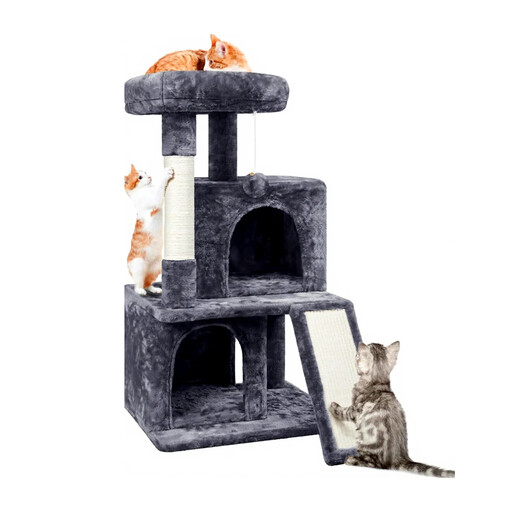
Why This Fits Their Persona: This model offers a solid basic setup for households with normal-sized cats who need a stable and functional solution without a large budget. It is compact yet versatile.
The wide base (49 x 45.5 cm) and the included anti-tip kit counteract the risk of instability often found in cheaper models.
Offers a good combination of scratching posts, a scratching ramp, a condo, and an observation platform in a compact footprint. The material consists of FSC-certified engineered wood panels.
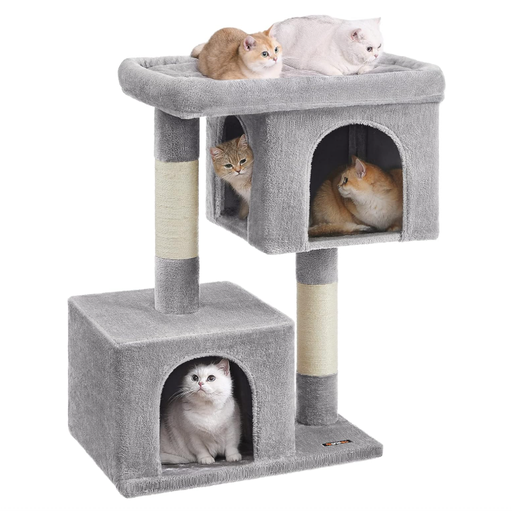
Why This Fits Their Persona: Specifically designed for the needs of large and heavy cat breeds up to 20 kg. Anyone looking for a Maine Coon-ready cat tree will find a suitable solution here.
Directly addresses the pitfalls of undersizing: The extra-large perch (68 x 48 cm) and the thick posts with an 11 cm diameter provide stability and comfort for heavy cats.
The robust construction with a reinforced base and anti-tip kit is designed for heavy loads. Two spacious condos offer ample retreat space even for large pets.
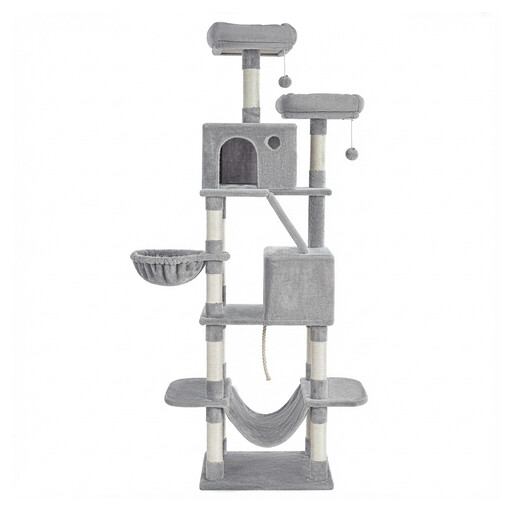
Why This Fits Their Persona: Ideal for households with multiple, highly active cats that need plenty of vertical space to climb, play, and rest. The enormous height and variety of features prevent boredom and territorial disputes.
The high static load capacity of up to 75 kg and the reinforced base plate ensure the necessary stability for such a tall tower. With 13 scratching posts, there are enough scratching options for everyone.
Exceptionally tall and feature-rich design with 2 condos, 2 platforms, a hammock, and a basket. It provides a complete vertical playground across multiple levels.
We have compiled a complete, up-to-date list of products that fully meet these strict selection criteria and local safety regulations.
Always place the cat tree on a level, solid surface. Be sure to use the included anti-tip kit and attach it to a load-bearing wall (not just drywall). In the first few weeks, and periodically thereafter, check that all screws are still tight.
Give your cat time to get used to the new object. Make the tree more interesting by hiding treats on the different levels or playing on it with a teaser wand. Rubbing the sisal posts with catnip can also help. An appealing location, such as in front of a window, increases its attractiveness.
A durable cat tree is built on a solid construction of engineered wood panels (e.g., MDF or particleboard). The posts are usually made of sturdy cardboard tubes or wood and should be wrapped with natural, robust sisal rope. The cover for the lounging areas should be made of a durable and soft plush fabric that can be cleaned if necessary.