
Lieferung heute & morgen

Qualitätsgarantie

Willkommens-Angebote freischalten: KOSTENLOSE Lieferung | Bis zu 80 % RABATT | Kostenlose 30-Tage-JoyPlus-Testphase
App herunterladen
A dead battery always happens at the worst possible time—whether you're on your way to an important meeting, navigating an unfamiliar city, or capturing special moments. A power bank is the obvious solution, but the market is confusing and full of technical pitfalls. Many buyers invest in a portable charger that fails to meet their expectations because marketing promises obscure its actual performance.
As your Joybuy Product Recommendation Officer, I'm here to help you identify these pitfalls. We'll focus on the objective criteria that truly matter, so you can make an informed decision and find a device that reliably fits your daily life.
Before we dive into the technical details, let's highlight the three most common reasons for a bad purchase. Understanding these will help you better evaluate exaggerated advertising claims.
To avoid the pitfalls mentioned above, you should focus on three core parameters. These define the actual performance and utility of a power bank.
Capacity, measured in milliampere-hours (mAh), describes the amount of energy stored in the battery cells. As mentioned, the rated capacity is the crucial figure. Reputable manufacturers often list this value in the fine print (e.g., '6000mAh at 5V/2A').
Charging power is measured in watts (W) and determines the speed. Modern devices benefit from specific fast-charging protocols:
Ensure the power bank has both a USB-C input for quickly recharging the battery itself and a USB-C output with Power Delivery for your devices.
The physical characteristics are crucial for daily usability.
Here are some recommendations tailored to specific user profiles that meet the criteria mentioned above.
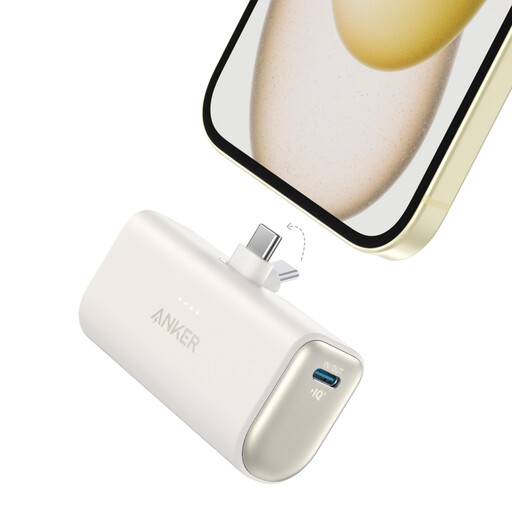
Why it's a match: This model is extremely compact and solves the biggest problem for commuters: the forgotten charging cable. The integrated, foldable USB-C connector allows you to charge your smartphone directly without any cable clutter.
It bypasses the impractical design trap. Thanks to its integrated connector and small size, it's always ready to use and fits in any pocket.
22.5W Fast Charging: Delivers enough power for modern smartphones. Compact Design: Fits easily in your pocket.
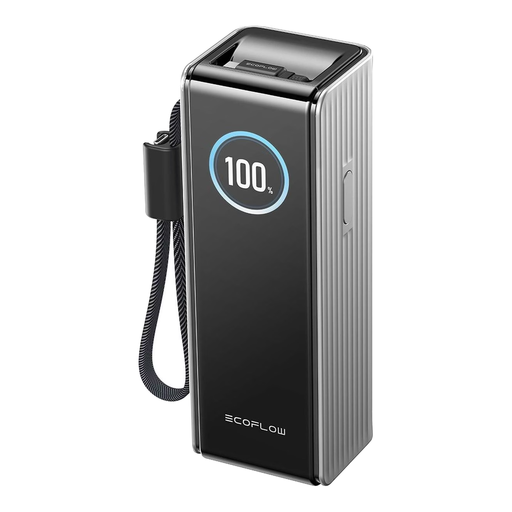
Why it's a match: For users who need to charge a laptop, tablet, and smartphone on the go. With 25,000 mAh and up to 100W of power per USB-C port, it's a full-fledged mobile charging station that can even power demanding devices like a MacBook Pro.
It debunks the vague 'fast-charging' promise by delivering a clearly specified, high output of 100W via Power Delivery, which is proven to be suitable for laptops.
170W Total Output: Charges up to four devices simultaneously. TFT Display: Shows detailed charging information in real-time.
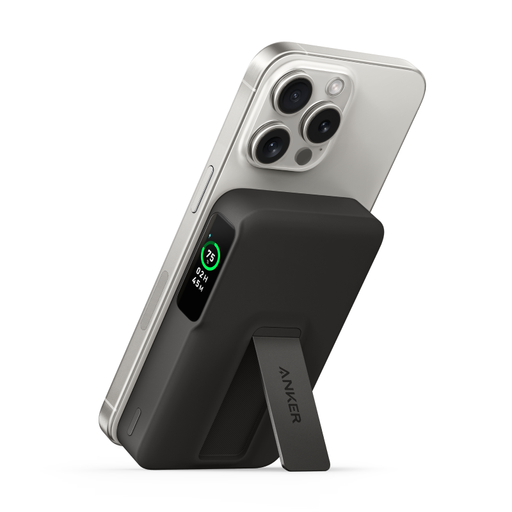
Why it's a match: This Anker power bank is designed for users of an iPhone (12 series or newer). The Qi2 certification enables fast 15W wireless charging, and the integrated kickstand is perfect for watching videos while charging. The magnetic connection ensures perfect alignment.
It offers certified, fast wireless charging (Qi2) that goes far beyond the slower 5W or 7.5W of many basic Qi chargers, thus delivering on the promise of speed.
Qi2-Certified 15W Charging: Twice as fast as standard wireless charging. Integrated Kickstand: Convenient for media consumption.
We have compiled a complete, up-to-date list of products that fully meet these strict selection criteria and all relevant safety standards.
This depends on your smartphone's battery capacity and the power bank's rated capacity. As a rule of thumb: A 10000mAh power bank with a typical rated capacity of around 6,500 mAh can charge an iPhone 15 (approx. 3,350 mAh) just under two times, or a Samsung Galaxy S23 (approx. 3,900 mAh) about 1.5 times.
Yes, power banks are allowed on airplanes, but they must be carried in your carry-on luggage. Most airlines limit the capacity to 100 watt-hours (Wh). A 20,000 mAh power bank has about 74 Wh, and a 25,000 mAh power bank has about 90-92.5 Wh, so both are typically within the allowed limit. However, always check your airline's specific regulations before you travel.
Power Delivery (PD) is a universal fast-charging standard that works via the USB-C port. A power bank with PD can intelligently communicate with the connected device to negotiate the optimal charging voltage and power. This allows for significantly faster and more efficient charging for a wide range of devices, from smartphones to laptops.