
Lieferung heute & morgen

Qualitätsgarantie

Willkommens-Angebote freischalten: KOSTENLOSE Lieferung | Bis zu 80 % RABATT | Kostenlose 30-Tage-JoyPlus-Testphase
App herunterladen
Solar lights promise a simple and cost-effective way to showcase your garden, patio, or balcony. Installation requires no wiring, and there are no electricity costs. However, the market is crowded, and many products fail to live up to their descriptions. Before you make a decision, it's crucial to know the most common pitfalls to avoid a bad investment.
As your Joybuy Product Recommendation Officer, I'm here to help you separate the wheat from the chaff. This guide focuses on the objective criteria that define a durable and functional solar light.
Many buyers are disappointed with their choice after a short time. The reasons are often the same and can be traced back to three core problems:
To avoid these issues, you should be guided not by marketing promises, but by verifiable technical specifications. Three metrics are particularly important here.
The IP rating (Ingress Protection) indicates how well an electrical device is protected against the ingress of foreign objects and water. For outdoor solar garden lights, this is an essential quality benchmark.
solar path lights or a solar ground stake in an exposed flowerbed, IP65 is the recommended choice for a long lifespan.The brightness of an outdoor LED solar light is not determined by the number of LEDs, but by the luminous flux, measured in lumens (lm). A light with 10 lm serves as a pure orientation light, while models with 100 lm or more can actively illuminate smaller areas.
The light colour, measured in Kelvin (K), sets the atmosphere:
Warm white solar lights (approx. 2,000–3,000 K): Produce a cosy, yellowish light reminiscent of candlelight or incandescent bulbs. Ideal for seating areas and creating a relaxed mood.Colour-changing solar lights (RGB): Offer the ability to set different colours and are primarily suited for decorative and festive accents.A garden lighting without electricity system is only as good as its power source. The battery capacity, measured in milliampere-hours (mAh), is a key factor in determining the illumination time after dark. A higher mAh value generally means a longer operating time.
At the same time, the solar panel must be able to efficiently charge the battery during the day. Monocrystalline solar panels often have a higher efficiency rating than polycrystalline or amorphous panels, especially on cloudy days.
Based on these objective criteria, we have identified some products that are well-suited for specific use cases.
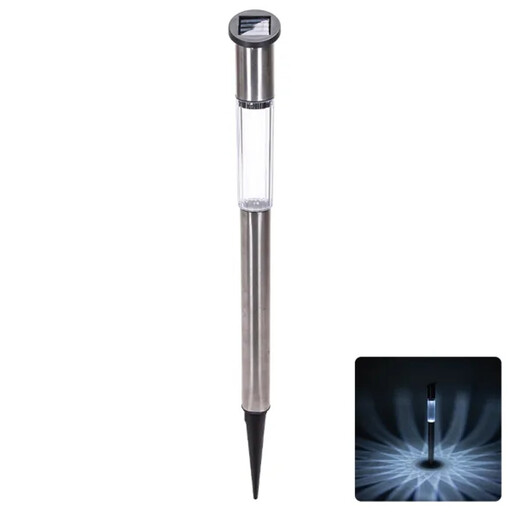
Why This Fits Their Persona: Ideal for users looking for functional and reliable lighting for garden paths or flowerbed borders. The focus is on orientation and safety, not on complex decorative effects.
The plastic and stainless steel construction avoids the "stainless steel look" trap by using the real material in visible areas. The cool white 6500K light provides clear visibility, countering the "disappointing brightness" trap for orientation purposes.
Robust construction for good durability; clear, bright light for path marking; easy installation as a solar ground stake.
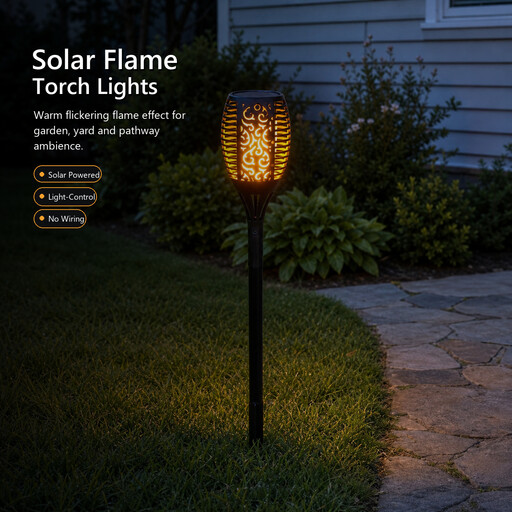
Why This Fits Their Persona: Perfect for anyone looking for atmospheric and dynamic lighting. These solar garden torches imitate a dancing flame, creating an inviting, warm atmosphere on the patio or along garden sections.
With an IP65 rating, this torch is explicitly protected against water jets, thus avoiding the trap of poor weather resistance. The 96 LEDs create a convincing flame effect that goes far beyond a faint glow.
High weather resistance (IP65); realistic, dynamic flame effect; automatic on/off at dusk.
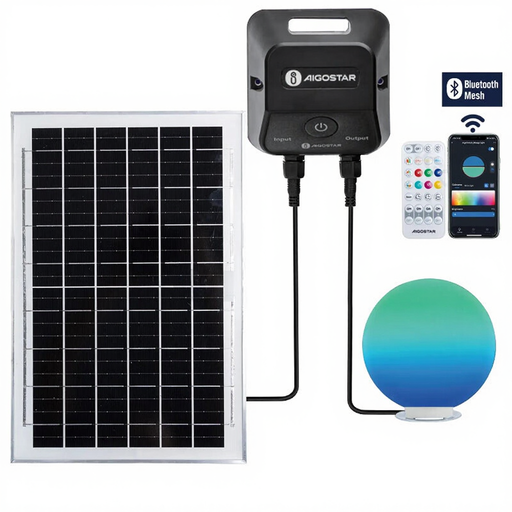
Why This Fits Their Persona: For users who want maximum control and performance. This smart light can be controlled via an app to adjust brightness, colour temperature (2700K-6500K), and RGB colours, and can be networked with other lights.
This model addresses all three core problems: The IP65 certification ensures weather resistance. With 350 lumens and a large 8000mAh battery, it bypasses the traps of dim light and short duration. The high-quality materials (ABS, PE) are designed for outdoor use.
Full app control (Bluetooth Mesh); high brightness (350 lm) and large battery capacity; adjustable colour temperature and RGB colours.
We have compiled a complete, up-to-date list of products that fully meet these strict selection criteria and relevant safety standards.
The lifespan heavily depends on the quality of the components. High-quality models can function for several years. The component with the shortest lifespan is typically the battery, which loses capacity after 1-3 years, depending on the model. On some solar lights, the battery can be easily replaced, which significantly extends the product's useful life. The LEDs themselves have a very long lifespan, often 15,000 hours or more.
Yes, they generally work in winter, but with limitations. The shorter days, lower sun angle, and more frequent cloud cover mean the solar panels can absorb less energy. This results in a shorter illumination time during the night. Models with high-efficiency (e.g., monocrystalline) solar panels and a large battery capacity are better suited for winter operation.
No, one of the biggest advantages of solar lights is the simple, DIY setup. Most models are designed as a solar ground stake and are simply pushed into the ground. Other versions can be mounted on walls or placed on surfaces without any wiring. This makes them a flexible and straightforward solution for garden lighting without electricity.