
Lieferung heute & morgen

Qualitätsgarantie

Willkommens-Angebote freischalten: KOSTENLOSE Lieferung | Bis zu 80 % RABATT | Kostenlose 30-Tage-JoyPlus-Testphase
App herunterladen
A baby activity cube for 1–3-year-olds combines several ways to play in a relatively compact format. This can be practical for parents, grandparents, and relatives: instead of buying several individual toys, children can explore spinners, buttons, gears, and role-play elements in a single product.
However, a long list of features alone says little about how practical a toy is for everyday use. Some activity cubes are too loud, while others include controls that are difficult to reach or take up more space than expected. Before buying, it is therefore worth checking the safety information, dimensions, and whether the product is genuinely suitable for the child’s age.
Terms such as “multifunctional” or “learning centre” may sound impressive, but the quality of the experience can vary considerably. What matters is whether a child can operate the features independently. Large buttons, smooth-moving components, and clearly recognisable cause-and-effect interactions are usually easier for 1- to 3-year-olds to understand than complex electronic menus.
A Montessori activity cube should therefore offer more than a large number of elements. It is important that children can press, turn, slide, or choose something and immediately observe a response. This encourages playful exploration without making promises about specific developmental outcomes.
A musical baby toy with melodies, voices, or light effects can capture a child’s attention. That does not automatically translate into a measurable learning benefit. For electronic developmental toys for toddlers, adjustable volume, an on/off switch, and a varied but not overloaded design are practical features to look for.
During longer play sessions, parents should keep the volume low and observe whether the child is responding well to the sensory input. An activity cube is not a substitute for playing together, reading aloud, or unstructured play.
The CE mark is an important indication that the product meets the required conformity standards within the European Economic Area. However, it is not an independent quality seal and does not replace your own checks. Also verify the following:
A baby busy board or activity cube often combines plastic components, wooden surfaces, and electronic elements. For plastic products, precise material information is helpful. According to the product details, the product featured here is made from ABS plastic, is described as BPA-free, and has rounded edges. These claims should nevertheless be checked against the labelling on the packaging.
Make sure that buttons, covers, and decorative elements cannot be removed easily. Even products without specifically identified small parts should be checked regularly for damage. If cracks or loose components appear, the toy should no longer be used.
The activity cube is listed as measuring 23 × 23 × 24 cm. These dimensions are generally suitable for a dedicated play area on the floor, but they still require sufficient clear space. A carry handle can make transportation easier, but it is not a substitute for safe storage.
Stability is especially important for children who are beginning to pull themselves up. An activity cube should not be used as a walking aid. Initially, allow the child to play close to the floor and supervise them whenever they use objects for support.
Electronic learning toys for children aged 1 and above often require batteries. Check whether batteries are included, which type is required, and whether the compartment can only be opened with a tool. For products with music, lights, and piano keys, the volume should be adjustable or at least switchable.
With an activity cube with piano, the layout and accessibility of the controls also matter: Can small hands reach the keys? Are the keys large enough? Are there mechanical elements that work without batteries? A balanced combination of electronic and tactile features expands the ways the toy can be used.

Why This Fits Their Persona: This compact cube brings together eight play modes, making it a practical choice for families looking for a versatile toddler developmental toy that takes up minimal space.
Alongside the piano, guitar, and telephone functions, the cube features mechanical gears and a rotating element. This means play does not depend entirely on electronics.
Suitable age listed as 1–3 years, dimensions of 23 × 23 × 24 cm, ABS plastic, and rounded edges according to the product description.
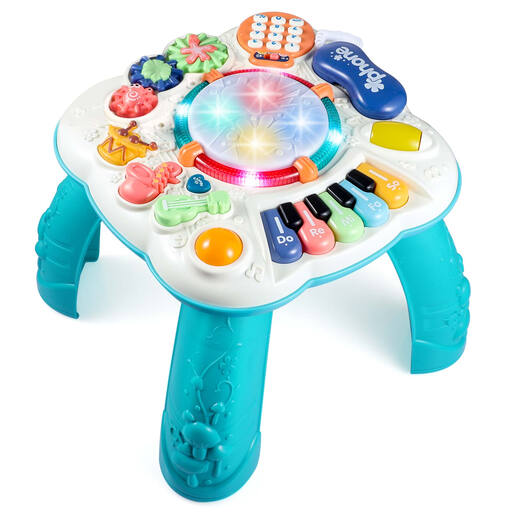
Why This Fits Their Persona: Designed for households looking for a larger floor- or standing-play station with multiple control panels and flexible ways to play.
According to the product description, the legs can be removed. This allows the table to be used as a flat play surface and later as a table, provided the child’s stage of development makes that appropriate.
Six play zones, volume control, and BPA-free ABS plastic with rounded edges according to the supplier’s information. Batteries are not included.
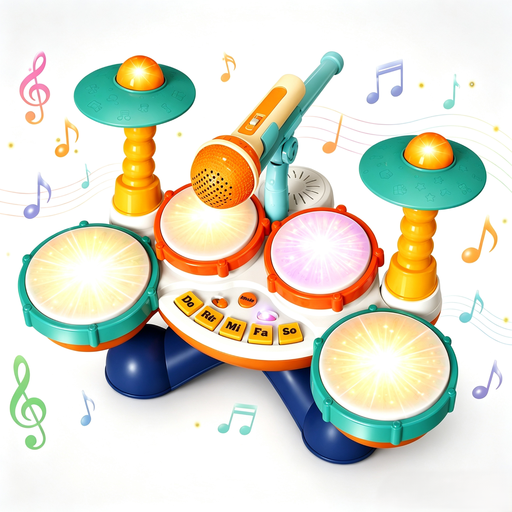
Why This Fits Their Persona: A strong choice for families where music, rhythm, and active play take centre stage and an activity cube with piano keys alone would not be enough.
A volume control is included, allowing the sound level to be adjusted to suit the home environment. Nevertheless, suitability should be assessed based on the actual volume and the level of supervision provided.
Four illuminated drum surfaces, two cymbals, a microphone, and three play modes according to the product description. Batteries are not included.
A sensory toy for toddlers should be used on a level, dry surface. Wipe plastic surfaces according to the manufacturer’s instructions and avoid harsh cleaning products unless the material has been confirmed as compatible. Batteries should be removed if the toy will not be used for an extended period.
For use on the go, a cube with a carry handle is more practical than a large activity table. Before travelling, parents should check that all flaps are closed and that no loose accessories are being carried separately. When choosing a birthday gift for toddlers or a Christmas gift for 1- to 3-year-olds, the age recommendation is one of the most important selection criteria.
The full selection includes more products for birthdays and suitable activity ideas. Before buying, continue to check the age recommendation, safety information, dimensions, and battery requirements.
That depends on the specific age recommendation and the features included. According to the product information, the cubes and tables featured here are intended for age ranges starting at 6 or 12 months, respectively. The manufacturer’s information on the product page and packaging is always decisive. Children should be supervised while playing.
There is no reliable way to specify a fixed service life. It depends on the materials, frequency of use, falls, moisture, and how the controls are handled. Check the cube regularly for cracks, loose parts, and damaged battery compartments. Any toy showing visible damage should be removed from use.
Mechanical cubes generally do not incur ongoing costs. Depending on their features, electronic models require batteries, so check whether batteries are included and which type is needed before buying. A volume control or automatic shut-off function can also help reduce unnecessary battery consumption.