
Lieferung heute & morgen

Qualitätsgarantie

Willkommens-Angebote freischalten: KOSTENLOSE Lieferung | Bis zu 80 % RABATT | Kostenlose 30-Tage-JoyPlus-Testphase
App herunterladen
A baby activity cube for 1–3 years should keep toddlers entertained, engage several senses and remain interesting for as long as possible. In practice, however, models vary considerably in terms of materials, volume, operation and everyday practicality. Eye-catching packaging or the label ‘Montessori’ alone says little about how suitable a product really is.
An activity cube with a piano, telephone, gears and music sounds versatile. What matters, however, is whether the individual elements are easy to reach and intuitively designed for small hands. Very small buttons, stiff rotating parts or cluttered play surfaces can mean that the toy is no longer used after a short time.
For this reason, look for clearly recognisable controls, rounded edges and a sturdy design. Multiple play modes are particularly useful when they are available without frequent adjustments or complicated assembly.
Lights, melodies and sounds can capture a child’s attention. However, they are no substitute for an age-appropriate play concept. A sensory toy for babies should allow for a range of actions: pressing, turning, sliding, grasping or sorting. This creates a direct connection between movement and response.
The term Montessori busy board is not a protected quality mark either. Check specifically which materials, functions and age recommendations are stated.
A CE mark is a legally required manufacturer’s marking, not an independent test seal. Buyers should also pay attention to the stated age range, warnings, stability and any small parts. For battery-operated products, the battery compartment, volume control and the information ‘Batteries not included’ should also be checked before buying.
Even toys without loose parts should be inspected regularly for damage. If the plastic is cracked, parts are loose or cables are damaged, the toy must no longer be used.
For a motor skills toy for 1–3 years, the recommended age should match the child’s developmental stage. One-year-olds often need larger functions that are easy to activate. Two-year-olds may already be able to use rotating mechanisms, simple role-play features and matching activities. Three-year-olds are often more interested in combinations, music and playing independently.
The age recommendation is a guideline, not a prediction of development. Children should be supervised while playing, particularly if a product has small openings, detachable parts or batteries.
For plastic models, details such as ABS, BPA-free and rounded edges are relevant product information. These should be stated clearly in the description. According to the manufacturer’s information available, the models featured here are made from BPA-free ABS plastic and have smooth, rounded edges.
The EN 71 standard covers toy safety requirements in Europe. A CE marking indicates the manufacturer’s declaration of conformity. Nevertheless, check that warnings, manufacturer details and clear instructions for use are provided.
A cube measuring approximately 23 × 23 × 24 cm can be used in a child’s bedroom or on a table. Thanks to its carry handle, it can also be used while travelling. For trips, the product should not be too heavy and should be easy to store securely in your luggage.
A volume control is particularly practical for musical toys for toddlers. Without one, the noise level can become disruptive during longer periods of use. Also check which batteries are required and whether they need to be purchased separately. An on/off switch and a quiet mode can be helpful in everyday life with other family members or in a home with several households.

Why this product suits this profile: This compact cube combines eight play areas in one product, making it suitable for families looking for a variety of functions without having to buy several individual toys. It measures 23 × 23 × 24 cm.
The functions are combined in a portable cube. According to the manufacturer’s information, there are no loose parts; nevertheless, edges and controls should be checked regularly.
Eight play modes with a piano, guitar, telephone, gears and music; BPA-free ABS plastic and carry handle according to the product description.
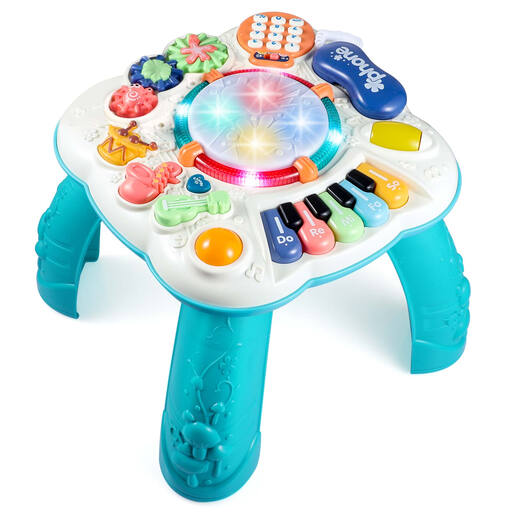
Why this product suits this profile: This model offers six play zones, volume control and detachable legs. Depending on the child’s developmental stage, it can therefore be used as a floor play panel or activity table.
The volume can be adjusted according to the product description. This reduces the risk of the music functions being left at an unnecessarily high volume during everyday use.
Two ways to use it, six play areas and a stated age range of 6 to 36 months; batteries are not included.
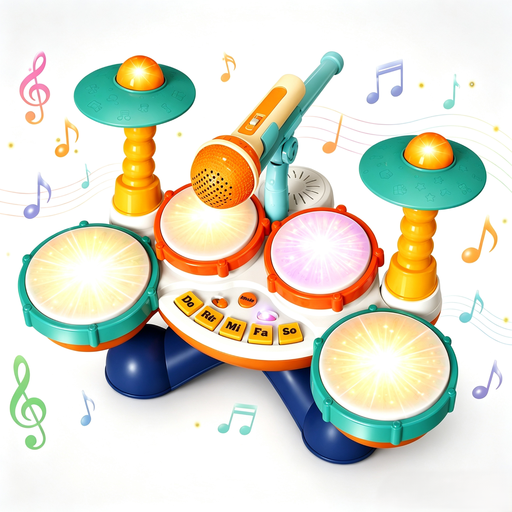
Why this product suits this profile: For children who want to explore music and rhythm in a focused way, this set offers drum surfaces, cymbals, a microphone and several melodies. It is better suited to lively play areas than quiet surroundings.
The integrated volume control allows the sound level to be adjusted to suit the room and time of day. A suitable play surface also helps prevent the instrument from tipping over.
Four illuminated drum surfaces, two cymbals, a microphone and ten integrated melodies; batteries are not included.
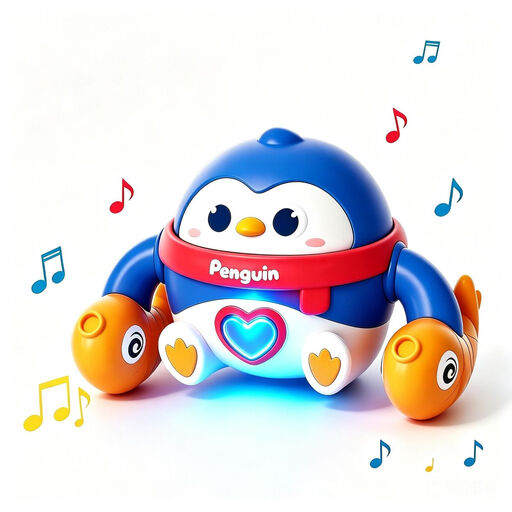
Why this product suits this profile: According to the product information, this moving toy is suitable for children aged 6 to 36 months. It complements an activity cube when movement and visual tracking are also desired.
The product description states that it has rounded edges and no loose parts. As the toy rolls, stairs, cables and small objects should be removed from the play area.
360-degree rolling movement, light effect, music and motion sensor; batteries must be purchased separately.
We have put together a complete, regularly updated list of products that fully meet these strict selection criteria and the safety regulations applicable in the EU.
An activity cube can support hand–eye coordination, grasping movements and an understanding of cause and effect through free play. Focused development of fine motor skills comes primarily through repeated, independent exploration and shared play prompts from adults.
This depends on the specific age recommendation and the size of the controls. Models for 1 to 3 years should not contain accessible small parts and should be positioned securely. Supervision is particularly important for younger children.
There is no fixed usage period. Different types of play, such as turning, pressing, music and role play, can appeal to different interests. The cube will usually remain relevant for longer when adults occasionally introduce new play ideas without pressuring the child to use it in a particular way.
Yes, for electronic models. According to the descriptions, batteries are not included with the products mentioned. The actual ongoing costs depend on the battery type, usage time and volume. An on/off switch and volume control can help limit energy consumption in everyday use.