
Lieferung heute & morgen

Qualitätsgarantie

Willkommens-Angebote freischalten: KOSTENLOSE Lieferung | Bis zu 80 % RABATT | Kostenlose 30-Tage-JoyPlus-Testphase
App herunterladen
A baby activity cube combines several play elements in a compact format: cogs, buttons, flaps, music and simple role-play features. However, choosing the right one can be confusing for parents, grandparents and other relatives. Many products are advertised using terms such as “Montessori”, “sensory” or “educational”, without clearly highlighting the product details that really matter.
To prevent the cube from being left unused in the nursery after a short time, it is worth taking a close look at the age recommendation, safety features, volume, power supply and the actual play opportunities.
A baby activity cube may be advertised with numerous modes. What matters is whether these functions are genuinely different. A cube with several identical buttons offers less variety than a model that combines pressing, turning, sliding, grasping and role play.
So look for specific details: does it include cogs, musical panels, a telephone function and instruments? Can the elements be used without help? Depending on a child’s stage of development, simple mechanical functions may be more interesting to a toddler than a collection of electronic sounds.
Manufacturer claims such as BPA-free ABS, rounded edges or CE and EN71 compliance are useful indicators. However, they do not replace an inspection before first use. Check the cube for:
The CE marking is a legally required declaration of conformity by the manufacturer, not an independent quality seal. Children under three should use the toy in accordance with the age recommendation and under supervision.
Musical baby toys can quickly become disruptive in everyday life if they have no volume control. So check whether a volume control, automatic switch-off or quiet mode is specified. For battery-operated models, the battery type, what is included and access to the battery compartment should also be included in your product comparison.
For children aged 1 to 3, a cube should generally be usable without complicated instructions. Large buttons, easy-to-grip turning parts and a sturdy construction make it easier to get started. A baby busy board or Montessori-inspired educational toy should not merely look minimalist, but should enable specific hand movements.
Also bear in mind that a toy for 6 to 18 months will not necessarily remain engaging for a three-year-old. Conversely, very small parts or complex functions may be unsuitable for younger children.
The reference model, 8-in-1 Baby Activity Cube, is described as being made from ABS plastic and BPA-free materials, with rounded edges and dimensions of 23 × 23 × 24 cm. This compact size can be practical for travelling, visiting grandparents or using at the dining table.
Material details should be specific. Smooth surfaces and straightforward cleaning are useful for electronic developmental toys for toddlers. Fabric parts require different care instructions from plastic. Before buying, you should also check whether the product may only be wiped clean or has removable, washable elements.
A well-designed educational baby toy offers different types of interaction:
These elements should be viewed as playful activities. Individual product features cannot guarantee the development of particular skills.

Why this product suits this profile: The cube combines several types of play in a compact format and, according to the product description, is intended for children aged 1 to 3.
The eight listed play modes are described specifically, including a piano, guitar, telephone, cogs and a musical windmill. This makes it easier to assess the range of functions before buying.
ABS construction, rounded edges, a carry handle and stated dimensions of 23 × 23 × 24 cm.
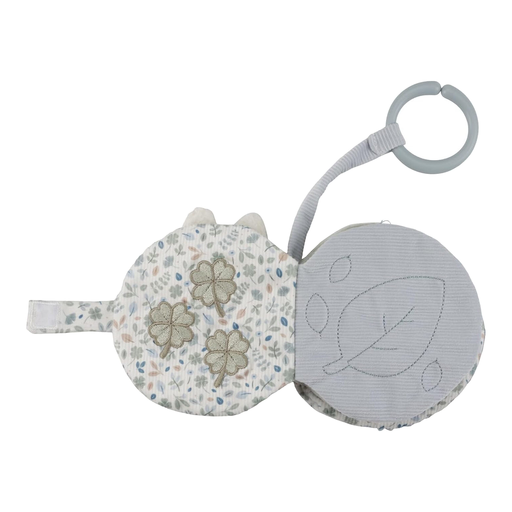
Why this product suits this profile: As a textile alternative, this activity book is ideal for families looking for a lightweight, portable sensory toy with a variety of materials.
It does not rely solely on lights and sounds, but includes crinkle paper, sounds, a mirror and an attachment ring for a pushchair.
100% polyester according to the product details, dimensions of 13.5 × 13.5 × 6 cm and suitable from birth.
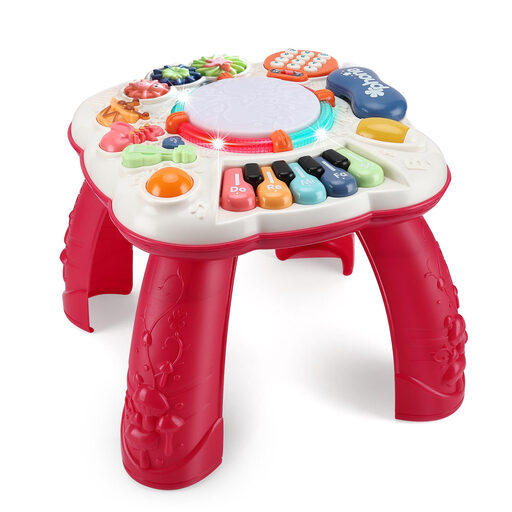
Why this product suits this profile: An alternative to a cube for children who play sitting down or later standing up and need a larger play surface.
The product description lists six play areas and detachable legs. This means the toy can be used as a floor panel or as a table.
Piano, drum, toy telephone and cogs; volume control and battery operation are also specified.
If you are looking for a gift for children aged 1 to 3, you should also check whether the toy complements what they already have. Another electronic item is not always the best choice if they already own lots of toys that make sounds. For a wider selection of age-appropriate, gender-neutral gift ideas, you can also browse the category gender-neutral baby gifts.
We have put together a complete, regularly updated list of products that fully meet these strict selection criteria and the safety regulations applicable in the EU.
That depends on the individual model. According to the product details, the featured 8-in-1 cube is intended for 1 to 3 years. Other activity or sensory toys are suitable from birth or from six months. The age recommendation and safety information for the specific product should always be treated as decisive.
There is no guaranteed period of use. Models with mechanical and electronic elements can appeal to different play interests. The actual lifespan also depends on the material, workmanship, battery consumption, cleaning and daily use. Check the toy regularly for damage.
This depends on the volume, how long it is used and whether it has an automatic switch-off function. Before buying, check which battery type is required and whether batteries are included. For frequent use, a model with volume control and automatic switch-off may be more practical in everyday life.