
Lieferung heute & morgen

Qualitätsgarantie

Willkommens-Angebote freischalten: KOSTENLOSE Lieferung | Bis zu 80 % RABATT | Kostenlose 30-Tage-JoyPlus-Testphase
App herunterladen
A baby activity table with music combines several activities in one place: pressing, turning, tapping and sounds. For parents and grandparents, this can be practical when a child between 6 and 36 months wants to play independently and try out different movements. However, musical activity tables differ significantly in terms of features, stability, volume and age recommendation.
A play table often looks particularly versatile in product images. What really matters, however, is whether the individual play areas are arranged so that the child can reach and understand them. Buttons that are too small, elements that are difficult to turn, or complicated battery compartments can mean the toy only gets used for a short time.
So look for a clear layout of the play surfaces. A musical activity table for babies should allow different actions without overwhelming the child with too many unnecessary details.
Music and sound effects are a key feature, but they can be annoying in everyday life. If there is no volume control or mute function, the table is less flexible for use in flats, during quiet times or in shared rooms.
Adjustable volume is therefore an important practical feature. It does not replace supervision and is not a medical safety measure, but it does allow you to adapt it to your surroundings.
A baby who is still playing on their tummy or sitting up needs different conditions from a toddler who can already stand confidently. A tall table is not automatically suitable for younger children. Likewise, a purely floor-based play centre can quickly lose its appeal for a standing child.
Check whether the legs are removable or whether the product has been specifically designed as a 2-in-1 activity toy. The manufacturer's instructions and adult supervision remain important.
For a sensory toy from 6 months, use should be appropriate for the child's developmental stage. The product from the selection below is described as suitable for 6 to 36 months and measures approximately 30 × 30 × 31 cm. The legs can be removed so that the play surface can first be used on the floor. Later, it can be set up as a standing play table for 1 to 3 year olds.
Check before you buy:
For plastic models, details such as ABS, BPA-free and rounded edges are relevant. These should be clearly stated in the product description. Removable legs and other connecting parts must be checked regularly to ensure they are secure.
If a seller refers to CE or EN 71, this information should be taken from the specific product page or labelling. Such information does not replace a visual inspection. Loose parts, damage or sharp edges are reasons to stop using the toy.
A baby play centre with a piano, drum, gears and buttons offers different grasping and pressing movements. This can create opportunities for motor skills toys for babies, hand-eye coordination and auditory perception. However, a guaranteed developmental effect cannot be derived from this.
A combination of free play and shared use makes sense. Adults can name sounds, demonstrate simple rhythms and give the child time to discover functions for themselves. This is also a helpful principle with Montessori toys for babies: few stimuli, enough space for independent activity.
The following recommendations sort the available products by usage situation. The decisive factors are the product data provided, not general quality promises.
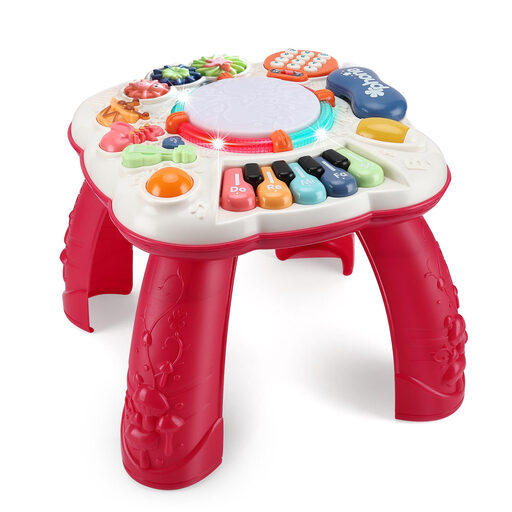
Why this product fits the profile: The table combines six play areas in a compact design and can be used for children from 6 to 36 months according to the product description. Removable legs allow floor or standing play.
The product description mentions a volume control and a sleep mode. Batteries are not included and need to be budgeted for separately.
Piano keys, drum, gears and instrument buttons; ABS plastic with rounded edges according to product details.
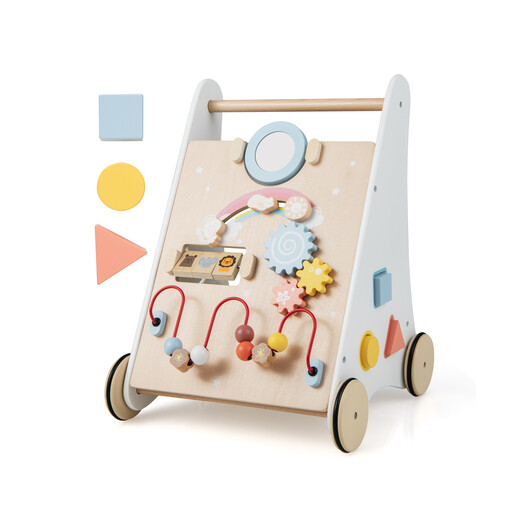
Why this product fits the profile: This baby walker is aimed at children from 12 months according to the product details and combines push-along support with several activity elements.
The stated use from 12 months defines the application more clearly. Rubberised wheels and a wide base are mentioned in the description; the walker must be assembled correctly.
Linden wood and MDF according to the specification, seven activity areas, rubber rims on the wheels and a basket for toys.
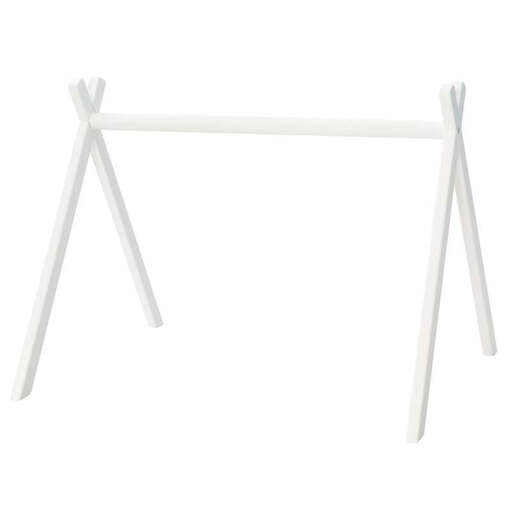
Why this product fits the profile: The play arch is suitable from 3 months according to the product details and is an alternative for families who are initially looking for a quieter grasping and discovery option without built-in music.
The product description clearly states the actual features: it is a play arch without a built-in music module. This means no false expectations are created about a musical activity table.
Lacquered wood, wipe-clean surfaces, dimensions of approximately 52 × 70 × 50.5 cm and use on a flat surface.
The lifespan of a baby activity table depends on the material, use and care. Wipe surfaces with a slightly damp cloth according to the manufacturer's instructions. Do not use harsh cleaning products unless they are expressly approved. Batteries should be removed during longer periods of non-use to prevent damage from leaking.
Check regularly:
A musical learning toy should only be used under supervision, especially if a child cannot yet sit or stand confidently. What matters for your decision is not just the number of features, but their safe and appropriate use.
We have put together a complete, regularly updated list of products that fully meet these strict selection criteria and the safety regulations in force in the EU.
That depends on the individual model. Some products are designed for floor use from around 6 months, others only from 12 months for standing use. The manufacturer's instructions, the child's posture and a safe, supervised environment are decisive.
Choose a model with volume control and mute function if possible. The lowest comfortable setting is usually sufficient for everyday use. The table should not be operated directly next to the child's head and should be switched off immediately if the child seems uncomfortable or frightened.
This varies from child to child. Models with several play zones, an adjustable design or removable legs can cover different usage situations over a longer period. There is no guarantee of a specific usage duration. Playing together and occasionally putting the toy away can help to keep the existing functions varied.