
Lieferung heute & morgen

Qualitätsgarantie

Willkommens-Angebote freischalten: KOSTENLOSE Lieferung | Bis zu 80 % RABATT | Kostenlose 30-Tage-JoyPlus-Testphase
App herunterladen
Motor skills toys for toddlers encourage them to grasp, turn, sort and balance. But in everyday use, it soon becomes clear whether a product really suits your home, your child’s age and their abilities. Eye-catching design alone tells you little about how practical a toy will be.
Common buying mistakes tend to fall into three categories:
For learning toys for babies from around 6 months, simple features that are easy to reach are usually a good choice, such as moving shapes, large turning parts or a play gym. Wooden toys for children aged 1 and over can introduce sorting tasks, simple fastenings and sliding parts. A motor skills board with several fastenings, letters or a clock, on the other hand, is often intended for older toddlers.
The manufacturer’s age guidance is a useful starting point. Carers should also check:
For wooden toys, smooth, neatly finished surfaces, rounded edges and securely fitted components are important practical features. For plastic products, information such as BPA-free and a sturdy construction may be relevant. The CE mark indicates that the manufacturer declares the product meets the relevant EU requirements. However, it is not an independent quality mark and does not replace checking the warnings, manufacturer’s information and workmanship.
For settings such as nurseries, durable materials, easy-to-clean surfaces and regular checks for loose parts are also sensible. FSC-certified wood can provide useful information about the material, but on its own it says nothing about the product’s other features.
A wall-mounted motor skills board can save floor space if it is fitted securely, but it needs a sturdy wall that has been made safe for children. An activity cube can be used flexibly in the nursery or when travelling. For a high chair, only use accessories that are explicitly compatible with your model.
If you want to develop fine motor skills, don’t focus only on the number of activities. What matters is whether your child can regularly grasp, press, sort or turn things independently. A simpler toy that’s easy to reach may be more suitable for everyday use than a complex set with lots of features that rarely get used.
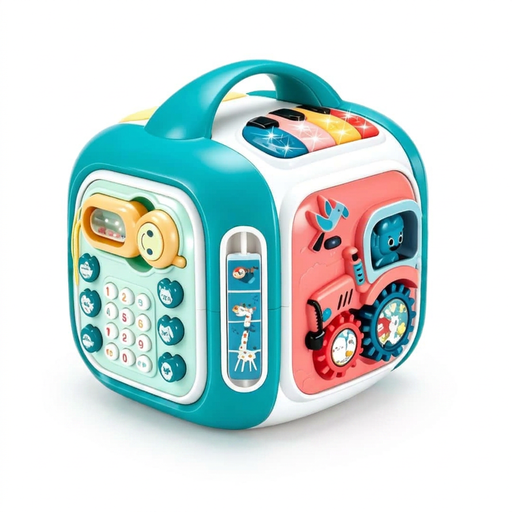
Why it suits this profile: This compact activity cube brings several types of play together in one place. It’s a good option for families looking for a versatile toy to use at home or on the go.
The age guidance of 1 to 3 years and compact size make it easier to choose. Even so, parents should check the guidance on loose parts and supervision before buying.
Eight play modes, listed dimensions of 23 × 23 × 24 cm and a handle for carrying.
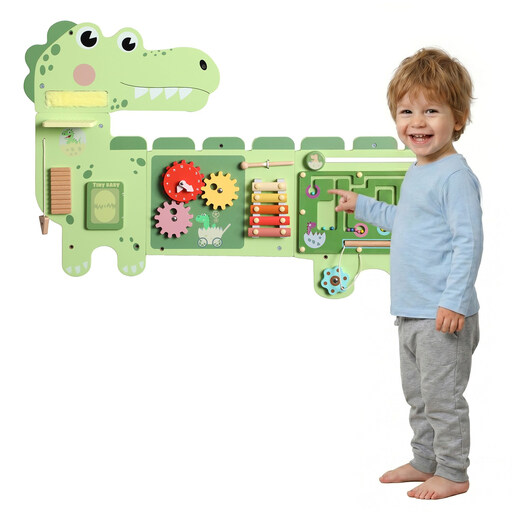
Why it suits this profile: This wall-mounted board is suited to families and childcare settings with a dedicated play area and enough wall space.
The stated dimensions of 87 × 52 × 5,5 cm make it easy to check how much space you’ll need before fitting the board. It must be fixed securely to a suitable wall and kept away from hazards within a child’s reach.
Four activity areas featuring, among other things, a xylophone, gears and a clock; materials listed in the product description: MDF, plywood, pine, beech and metal.

Why it suits this profile: This soft, compact busy book is handy for travelling, waiting times and quiet play, as long as your child meets the stated age and safety guidance.
The book doesn’t need assembling and is described as quiet. Direct supervision is still important because it contains small or moving parts.
15 activities, including a zip, buttons, lacing and hook-and-loop fastening; material listed by the seller: felt with reinforced stitching.
We’ve put together a complete, regularly updated list of products that meet these strict selection criteria and the safety regulations in force in the EU.
It depends on the features of each toy. Simple toys for grasping and exploring textures may be suitable for babies. Toys with fastenings, sorting shapes or small moving parts are often intended for children aged 1 or 2 and over. Always follow the specific manufacturer’s guidance and warnings, and take your child’s development into account.
How long a toy remains useful depends on its versatility, build quality and your child’s stage of development. A play gym is often used at an earlier stage, while an activity cube or busy board may suit children across several stages of development. Regular checks for loose parts, damaged surfaces and wear won’t automatically extend the toy’s safe life, but they can help you assess its condition in good time.
Mechanical Montessori toys, wooden puzzles and many motor skills boards work without batteries. Products with lights, music or sounds may need batteries, which aren’t always included. Before you buy, check the battery type, what’s included, how the product needs to be cleaned and whether you’ll need any additional accessories.