
Lieferung heute & morgen

Qualitätsgarantie

Willkommens-Angebote freischalten: KOSTENLOSE Lieferung | Bis zu 80 % RABATT | Kostenlose 30-Tage-JoyPlus-Testphase
App herunterladen
A baby ball may look like a simple toy at first glance. In practice, though, different models can vary considerably in how easy they are to grip, their materials, how they can be cleaned and the age they’re suitable for. For babies and toddlers, bright colours aren’t the only thing that matters. The ball should suit your child’s motor development, where it will be used and the age stated by the manufacturer.
Some products are described as suitable from birth, while others are intended for babies aged 3 or 6 months and over. Packaging may also include a warning that gives a different age limit. For example, the Chicco Musical Ball has a stated minimum age of 0.5 years, while another warning refers to use by children under 6 years. Before buying, check any conflicting information against the current packaging and the manufacturer’s details.
A baby bath ball needs to be easy to care for hygienically after use. If a model has openings, a battery compartment or moving parts, check whether it can be fully submerged. The Fisher-Price WaterMates Duck Ball is described as waterproof in its product details, but its care instructions say to clean it with a damp cloth and not to immerse it in water. So, if your baby is splashing with it, use it only in shallow water and never leave them unsupervised.
Names such as “sensory ball”, “developmental ball” or “baby motor skills toy” don’t tell you much about how a product can actually be used. More useful details you can check include:
A very heavy or smooth ball may be harder for a younger child to grip than a lightweight baby grasping ball with a flexible structure.
A ball for babies should be easy for little hands to pick up and hold. The Oball Classic Ball measures around 10 cm and weighs 23 g, according to the product details. Its 32 finger holes provide plenty of places to grip. This design may be more practical for babies than a fully enclosed, smooth ball.
For a play ball for toddlers, choose a size that suits your child’s age and surroundings. In crawling areas, the ball shouldn’t disappear between furniture or under cushions. For taking out and about, a light weight and easy cleaning are useful.
Look for a durable but flexible surface with no sharp edges. Check seams, fastenings, mirrors, tags and decorative elements regularly for damage. If a part comes loose or a tear appears, stop using the toy.
For products with batteries, make sure the battery compartment and its fastening are out of your child’s reach. The Chicco Musical Ball has a removable battery cover so that the fabric ball can be cleaned. Batteries should always be kept out of children’s reach and fitted according to the manufacturer’s instructions.
A children’s soft ball for playing indoors has different requirements from a baby bath ball. Lightweight models in easy-to-see colours are ideal for crawling and rolling games. Clean a fabric ball according to its care instructions. Plastic models can often be cleaned with mild soap and water or a damp cloth.
Supervision is still essential: even a product described as suitable from birth should only be used while an adult is watching. When playing in water, your child must be supervised closely throughout.

Why it suits this profile: This lightweight plastic ball is described as suitable from birth and has 32 finger holes to grip. It’s a simple way for babies to start exploring a ball freely.
The open grip areas avoid a smooth surface that can be hard to hold. Its low weight of 23 g is a specific, verifiable product detail.
10 cm diameter, 23 g weight, 32 grip holes and cleaning with mild soap and water, according to the product description.
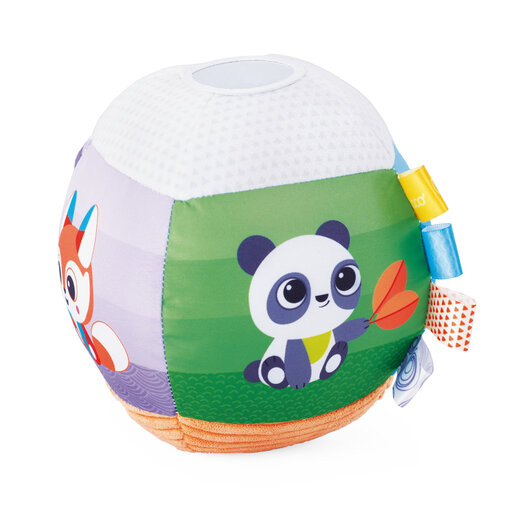
Why it suits this profile: This fabric ball combines different textures, loops to hang it from and electronic sounds. According to the product details, it’s intended for children aged 0.5 years and over; check the warnings before use.
The product description specifies the materials, removable battery compartment and different textures. This makes it easier to assess the cleaning requirements and features before you buy.
A mix of fabrics, hanging play elements, sounds when moved and a removable battery compartment for cleaning.

Why it suits this profile: According to the product details, this model is intended for children aged 3 months to 3 years. It can be used on play mats, in a playpen or for supervised play with a little water.
The age range, approximate 10 cm diameter and care instructions are provided. The advice not to immerse the ball clearly sets out how it can be used in the bath.
A transparent ball with a moving duck figure, confetti-style details and a lightweight design. The product description also says it’s suitable for use in water.
We’ve put together a complete, regularly updated list of products that meet these strict selection criteria and the safety regulations in force across the EU.
It depends on the model. Some products are described by the manufacturer as suitable from birth, while others are intended for babies aged 3 or 6 months and over. Always follow the product’s specific age guidance, warnings and instructions for use. Babies and toddlers should be supervised while playing.
A lightweight baby grasping ball can be engaging from the first stage of grasping through to the crawling stage. Later on, balls designed for rolling, pushing or crawling after can be a good choice. How long your child uses one depends on their age, interest in play, the condition of the material and the ball’s size. Before each use, check for cracks, loose parts and damaged seams.
A baby musical ball may need batteries. Check whether batteries are included, what type it takes and whether the battery compartment can be securely closed. A simple plastic ball without electronics won’t incur ongoing battery costs.