
Lieferung heute & morgen

Qualitätsgarantie

Willkommens-Angebote freischalten: KOSTENLOSE Lieferung | Bis zu 80 % RABATT | Kostenlose 30-Tage-JoyPlus-Testphase
App herunterladen
A baby bedside crib should keep your baby close to your bed while fitting your room, mattress height and daily routine. In practice, poor purchases are often not down to missing features, but unclear product information: a model may not fit next to a divan bed, the sleeping area may become too small too soon, or the wheels and fixings may not be suitable.
This guide explains which details to check before buying a baby bedside crib, and which models may suit different homes and ways of using them.
The description ‘height-adjustable bedside crib’ doesn’t tell you much on its own. What matters is whether you can adjust the sleeping surface to the height of the top of your mattress. As well as the number of settings, check the actual height range and the design of the legs or fixing brackets.
Before you buy, you should:
A 3-in-1 baby cot may be used as a bedside crib, cradle or nursery cot, for example. However, that doesn’t automatically mean it will be suitable as a sleeping place for several years. Compact models with a sleeping area of around 45 x 90 cm are often intended for the first few months. Larger baby cots measuring 60 x 120 cm or 70 x 140 cm may be used for longer, but need more floor space.
Check the stated age and weight limits. For some models, you should stop using the bedside crib once your child can pull themselves up, sit or kneel.
A bedside crib with wheels is easy to move around, but the brakes must be engaged when it is stationary. You’ll also need straps or metal brackets to attach it to your bed. Any mattress supplied must fit the sleeping area precisely; there should be no gaps between the mattress and the frame.
Don’t judge textiles such as bumpers, canopies or bedding solely by what’s included. Check the care instructions and material details, and whether the cover can be removed.
Mattress dimensions are non-negotiable. Common sizes include:
Only use a mattress intended for the specific cot. Even with a baby cot with mattress, check that the size, thickness and support surface match the product specifications.
A bedside crib must stand securely next to your bed. Straps or adjustable metal brackets should help prevent it from moving out of place. If the model has wheels, the brakes must work on a firm, level surface.
Several of the roba models mentioned are described by the manufacturer as meeting EN 1130:2019. This information relates to the relevant product description and does not replace checking the assembly instructions. Before every use, check:
Depending on their design, mesh sides can make it easier to see your baby and reach them. A zip on the fabric side can be handy when lifting your baby out or caring for them. Removable, washable covers are useful for everyday life.
An inclined sleeping surface should not be considered a medical feature. The product description for the Costway portable baby cot, and the identical beige model, states that it has a 10-degree incline. Always follow the instructions and the usage limits given there.
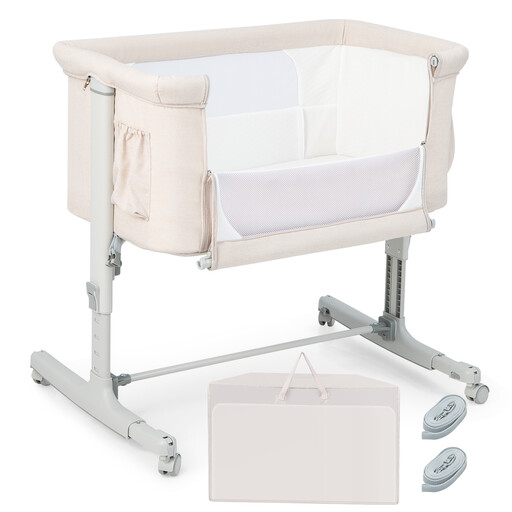
Why this product suits this profile: This compact model is designed for newborns up to around five months old and a maximum weight of 9 kg. Five height settings, wheels and a carry bag make it a good option for smaller homes or occasional moves between rooms.
The specifications state the height range, mattress dimensions of 76 x 43 cm and maximum load. This makes it easier to check whether the crib is suitable before you buy.
Five height settings, two fixing straps, mesh sides, lockable wheels and a carry bag.
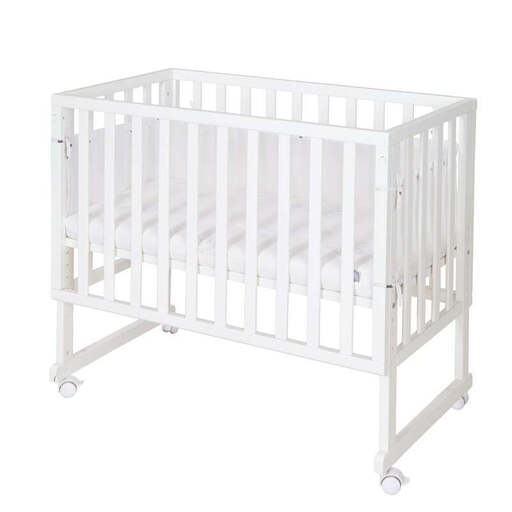
Why this product suits this profile: This wooden model has a 45 x 90 cm sleeping area, seven height settings and a design that the manufacturer describes as meeting EN 1130:2019.
The manufacturer gives a clear usage limit of around 6–12 months, or until your baby can pull themselves up, sit or kneel. This helps avoid assuming that the crib can be used indefinitely.
Seven height settings, washable mattress cover, mesh surround, four braked wheels and safety straps.
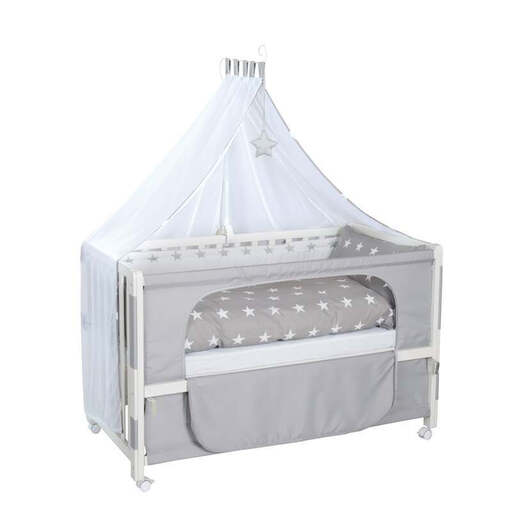
Why this product suits this profile: According to the manufacturer, this larger Roombed can be used as a bedside crib, cradle and cot. It’s aimed at families with enough floor space who want a product that can be used for longer.
The six height settings and adjustable metal brackets are clearly specified. The recommended mattress size and weight limit are also given.
60 x 120 cm sleeping area, mattress included, zip-up side panel, braked wheels and manufacturer-stated use up to around four years.
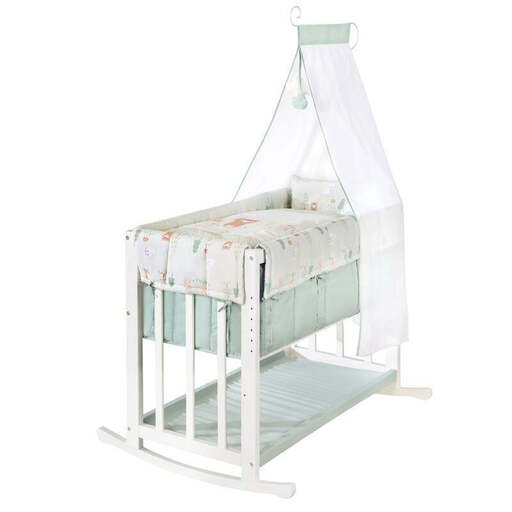
Why this product suits this profile: This model may appeal to parents looking for a nursery cot with several set-up options, storage space and a wide range of accessories.
According to the product information, the six height settings start at 42.5 cm. This makes it easier to assess in advance whether the cot will fit next to your bed.
45 x 90 cm sleeping area, six height settings, fixing strap, wipe-clean textiles and the option to use it with or without wheels.
We’ve put together a complete, regularly updated list of products that meet these strict selection criteria and the safety regulations in force across the EU.
Adjust the height so the sleeping surface lines up with your mattress. Then attach the crib using the supplied straps or metal brackets, following the instructions. Check regularly that the connection is secure. The wheels must be locked when the crib is stationary.
It depends on the size of the sleeping area, the weight limit and your child’s development. Compact models are often intended for the first few months. Larger 60 x 120 cm models may be used for longer as a baby cot or children’s bed, according to the manufacturer. Once your child can pull themselves up or climb out of the cot unaided, check that it is still suitable for the intended use.
Yes. Use a mattress with the dimensions specified by the manufacturer. For a 45 x 90 cm cot, the mattress must be designed to fit that sleeping area; larger models require different dimensions. An additional mattress must not be too thick or leave gaps around the edges.