
Lieferung heute & morgen

Qualitätsgarantie

Willkommens-Angebote freischalten: KOSTENLOSE Lieferung | Bis zu 80 % RABATT | Kostenlose 30-Tage-JoyPlus-Testphase
App herunterladen
A baby bedside crib should keep your little one close, take up minimal space and attach securely to the parents’ bed. In practice, however, some purchasing decisions can quickly lead to unnecessary extra costs or a short period of use. Features, mattress dimensions and height adjustment are particularly easy to misjudge.
The term “height-adjustable” may initially seem self-explanatory. What really matters, however, is whether the sleeping surface can be aligned with the top of the parents’ mattress. Attaching the crib can be more difficult with divan beds, beds with drawers or unusually thick side frames. Therefore, check the following:
A compact bedside cradle or a model measuring 45 x 90 cm works well in smaller bedrooms. However, it will generally be suitable for a shorter period than a 60 x 120 cm baby cot. The manufacturer’s specifications and your child’s development are always the key factors. As soon as your baby can pull themselves up, sit up or climb out independently, the crib should no longer be used as a bedside crib.
A mattress, bumper, canopy or bedding may seem practical, but none of these replaces correct assembly. For safe use, the fastenings, brakes, side panels and height locks must be checked regularly. Additional pillows, blankets or a second mattress can also alter the sleeping surface intended by the manufacturer.
The mattress must fit inside the bed frame without any significant gaps. Common sizes include:
When buying a children’s bed with mattress, check whether the mattress is actually included in the delivery. Some offers include only the slatted base.
The product details should state a specific safety standard and provide clear instructions for use. Depending on the design, you may see references such as EN 1130 for bedside cribs or EN 716 for children’s cots. A standards reference alone does not replace assembly according to the instructions.
A co-sleeper must be securely attached to the parents’ bed using the supplied straps or brackets. Before every use, check that the connection is secure and that no gap has formed between the sleeping areas.
A bedside crib with castors is easier to move around the room. For safety, however, it is essential that all the castors can be locked securely when the crib is stationary. Models with a folding function or carry bag are more suitable as a travel cot for babies, provided the manufacturer states that they are designed for this purpose. A stationary wooden baby cot is not automatically suitable for transport.
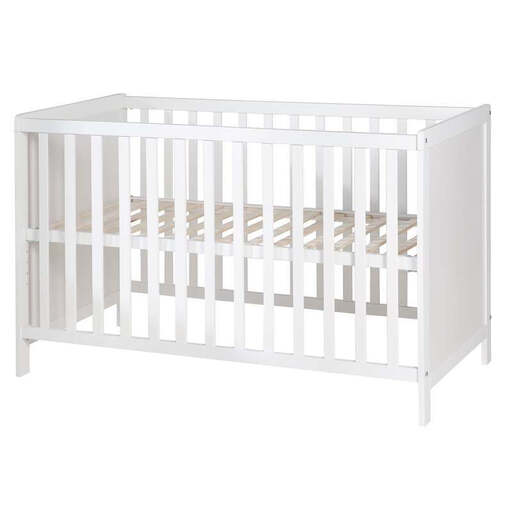
Why this product suits this profile: This model combines a 60 x 120 cm sleeping area with adjustable height and can later be used as a children’s cot.
The recommended mattress size is clearly specified. The attachment is designed for bed sides up to 4.5 cm thick.
Height range from 22 to 42 cm, five removable slats and use up to approximately five years of age according to the product details.
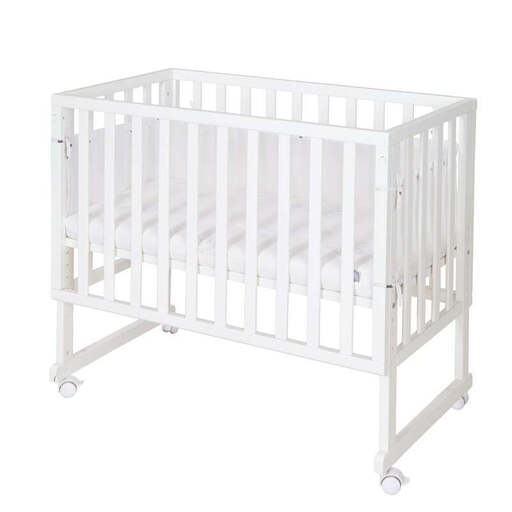
Why this product suits this profile: A compact solution with mattress, canvas barrier, mesh panel and seven height settings for the early stages.
According to the product details, it is intended for use until approximately six to twelve months of age or until your baby can pull themselves up independently.
45 x 90 cm mattress, washable cover and seven height positions between approximately 22.4 and 44.6 cm.
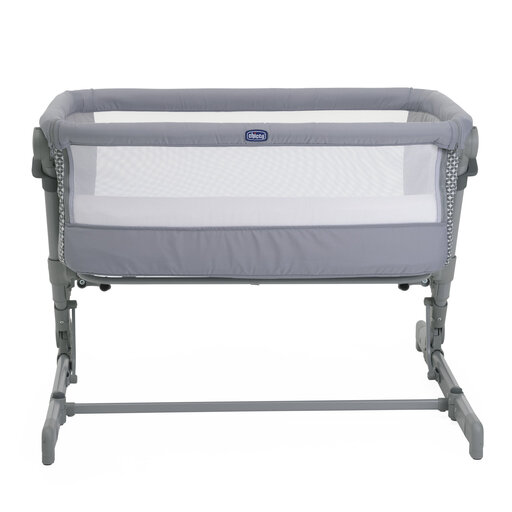
Why this product suits this profile: The folding function, six height positions and four castors are ideal for families who want to move or transport the crib frequently.
This model is designed for compact transport. The locking mechanism, straps and brakes must be checked before every use.
Folds without disassembly, has a washable cover and offers a sleeping area measuring 83 x 50 cm according to the stated dimensions.
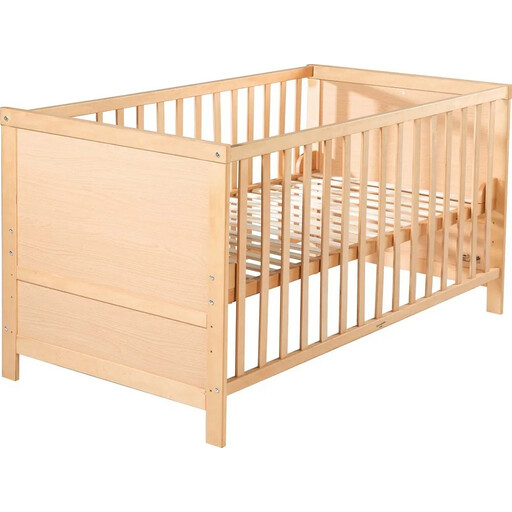
Why this product suits this profile: The larger sleeping area and conversion into a junior bed make it appealing to households looking for a cot that grows with their child.
The conversion options are clearly described. However, this model is wider than a traditional bedside crib and therefore requires more floor space.
70 x 140 cm sleeping area, three height settings and three removable climbing bars according to the product description.
We have put together a complete, regularly updated list of products that fully meet these strict selection criteria and the safety regulations applicable in the EU.
Assemble the cot strictly according to the instructions, and ensure that this is done by an adult. Before first use, check all screws, connectors and height locks. With a bedside crib on castors, the brakes should also form part of your daily visual inspection.
Use only the specified mattress or an exactly matching replacement mattress. Check the cover, mesh fabric and fastening straps regularly. If there are tears, missing parts or unstable connections, stop using the cot.
The sleeping surface should ideally be level with the parents’ mattress. What matters is not the height of the frame but the actual height of the top of the mattress. Once adjusted, the crib must be securely attached without leaving a gap.
This depends on the sleeping area, the manufacturer’s specifications and your child’s development. Compact models measuring 45 x 90 cm are often intended for the first few months. If your baby starts sitting, kneeling, pulling themselves up or wriggling out independently, stop using the crib as a bedside crib.
A complete set can help you avoid the additional cost of buying a mattress and accessories separately. However, whether it offers better value depends on how long it can be used. A 60 x 120 cm or 70 x 140 cm baby cot can be used for longer, but requires more space than a compact bedside cradle.